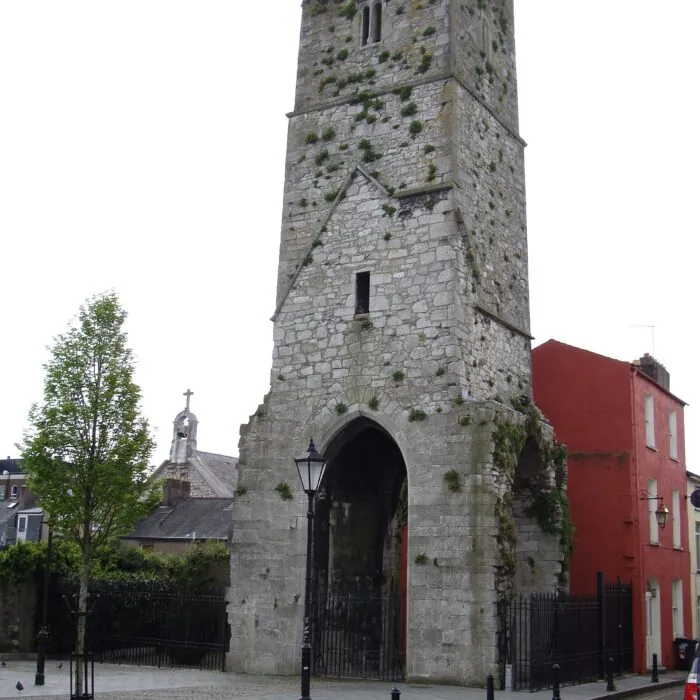


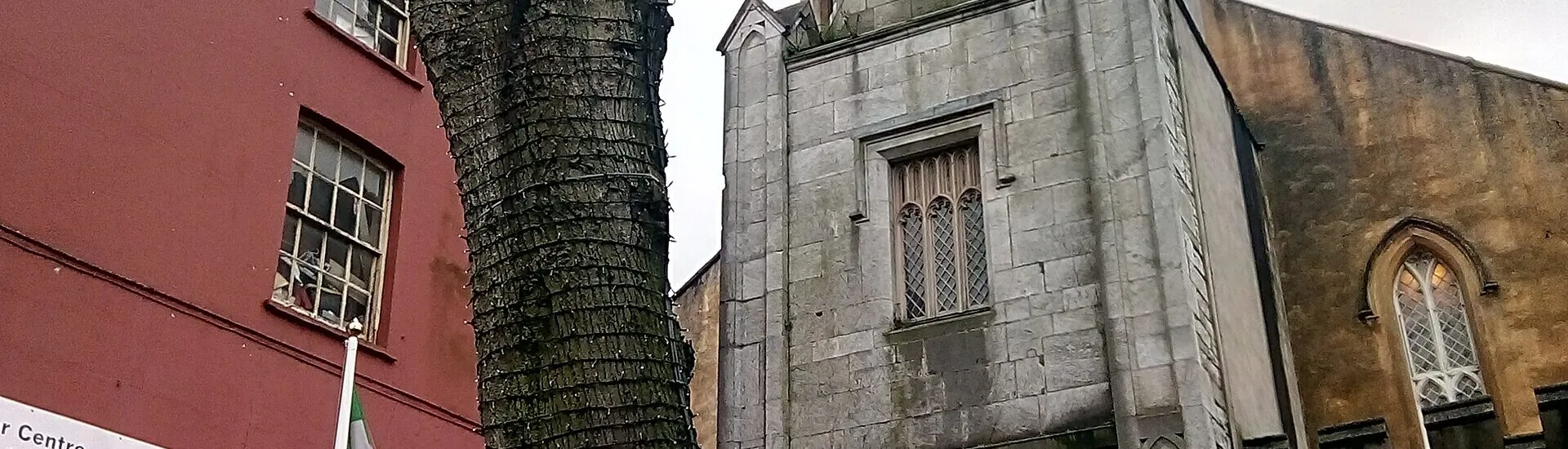
On North Main Street, St Peter’s Cork stands in one of the city’s oldest areas. Behind the present building lies a far broader story: that of medieval Cork, its parishes, its merchants and the long street that once ran north to south through the walled city.
Less spectacular than St Fin Barre’s Cathedral or Shandon’s landmarks, St Peter’s nevertheless deserves a place on any route exploring Cork’s heritage. Its interest lies as much in its location as in the building itself: it is an excellent starting point for understanding a medieval city now largely hidden beneath modern streets.
St Peter’s stands on North Main Street, the historic continuation of South Main Street. Together, these two streets formed one of the principal thoroughfares of old Cork. The religious site of St Peter’s is part of this ancient history and appears in historic depictions of the city alongside other major religious landmarks, including Christchurch.
It would, however, be misleading to imagine the building seen today as an intact medieval church. The site has undergone major changes over the centuries, through successive phases of construction, rebuilding and adaptation.
It is when considering its surroundings that St Peter’s becomes particularly compelling. North Main Street retains the route of a key artery in the old city. The width and orientation of its streets, along with certain landmarks, still make it possible to trace some of the reference points around which Cork was organised before becoming a major trading city.
Beneath this contemporary urban landscape lies a much older history. Archaeological research carried out in Cork city centre has revealed medieval layers beneath modern buildings, as well as traces of the city’s former defensive system.
To understand the importance of the site, one must imagine a Cork very different from the city of today. The medieval city developed in an environment shaped by the channels of the River Lee, islands and wetlands. It was protected by walls, with access controlled through gates.
The route now followed by North Main Street and South Main Street structured much of this city. It brought together traffic, trade, homes and religious establishments. St Peter’s was therefore part of a true urban landscape, rather than an outlying district.
Churches were essential landmarks at the time. They shaped religious life, but also the social organisation of different neighbourhoods. St Peter’s long-standing presence therefore offers a clearer understanding of the geography of medieval Cork and the continuity of certain places despite the city’s successive transformations.
The quays, canals and streets have changed profoundly, yet a few historic locations have endured through the centuries. St Peter’s is one of these links between the old city and contemporary Cork.
One of Cork’s most fascinating characteristics is the invisibility of much of its ancient heritage. Unlike other European cities, where medieval walls and districts are immediately recognisable, here part of that history lies quite literally beneath the present-day city.
Archaeological excavations have shown that ancient layers may survive at relatively shallow depths in the North Main Street and South Main Street area. Sections of the former city defences are also buried beneath modern buildings and streets.
St Peter’s thus becomes a kind of anchor point. From North Main Street, try to mentally strip away part of contemporary Cork and picture narrow plots, tightly packed houses, fortified gates and the various river channels that once shaped the landscape.
This perspective considerably changes the way the city centre is seen. Streets that now appear largely commercial regain a far greater historical depth.
Like many urban religious buildings in Ireland, St Peter’s has weathered periods of profound religious, political and architectural upheaval. The building associated with the site has evolved, and its uses have changed over time.
This succession of transformations is precisely part of its appeal. St Peter’s is not the fixed witness of a single era; rather, it illustrates how Cork has continually rebuilt, adapted and reused its old places.
There is therefore no need to come to St Peter’s expecting to discover a spectacular monument. Its interest is more historical and urban in nature. The site gives a precise location to a history that can otherwise seem abstract elsewhere in Cork city centre, where visible remains are lacking.
It is this role as a landmark that gives it its full value on a route devoted to the city’s heritage.
St Peter’s location makes it easy to include in a walking tour of the historic centre. North Main Street leads towards the areas north of the old city, while South Main Street allows visitors to continue their exploration towards other sites associated with old Cork.
Nearby are Christchurch and the English Market. Continuing north, visitors can also reach the Shandon area and discover another important stage in Cork’s urban development.
St Peter’s therefore works best as a stop rather than a stand-alone visit. Within a few hundred metres, it is possible to move from medieval Cork to the trading city of later centuries, then on to the major religious and civic buildings that accompanied its growth.
Combining St Peter’s with Christchurch is particularly worthwhile: the two sites make it possible to trace two former religious landmarks and better understand how the historic city was organised around the axis formed by North Main Street and South Main Street.
St Peter’s is primarily for travellers wishing to look beyond Cork’s best-known attractions. The monument has neither the scale of a cathedral nor the visual impact of the city’s major tourist sites. Its value lies elsewhere: it helps visitors read the urban landscape and understand how Cork was built on the traces of the medieval city.
In a city where much of the ancient remains now lie beneath its streets and buildings, the few landmarks that can still be identified are especially valuable. St Peter’s connects history to a tangible place and, for the duration of a walk along North Main Street, brings to mind a Cork that has almost entirely disappeared.
Want to extend your visit without having to rush around? Here are a few well-located places to stay near the must-see attractions.
Essential information to help you plan your visit, including key landmarks, access information, and booking options.
North Main Street, Cork
51.8993, -8.4802