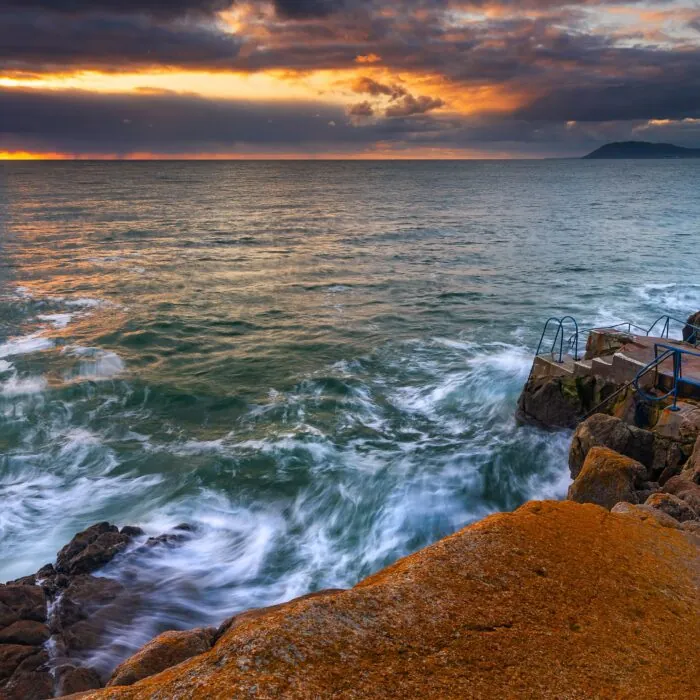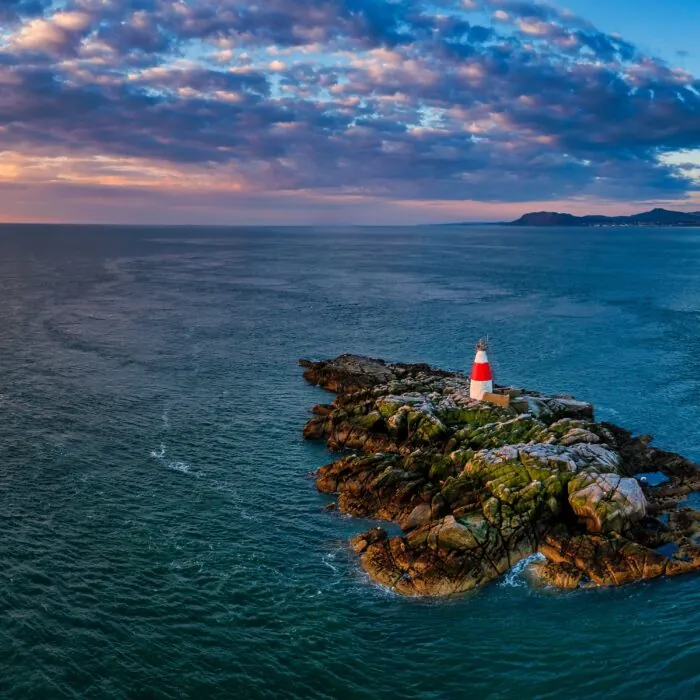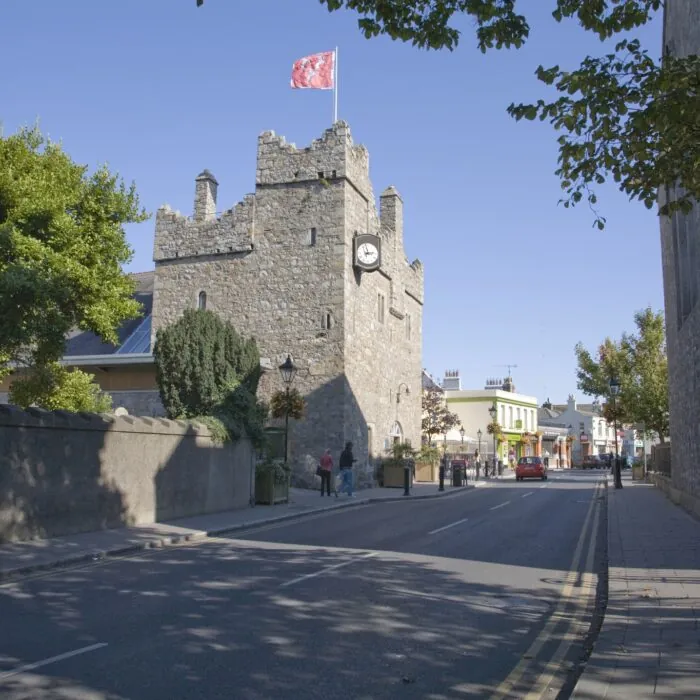


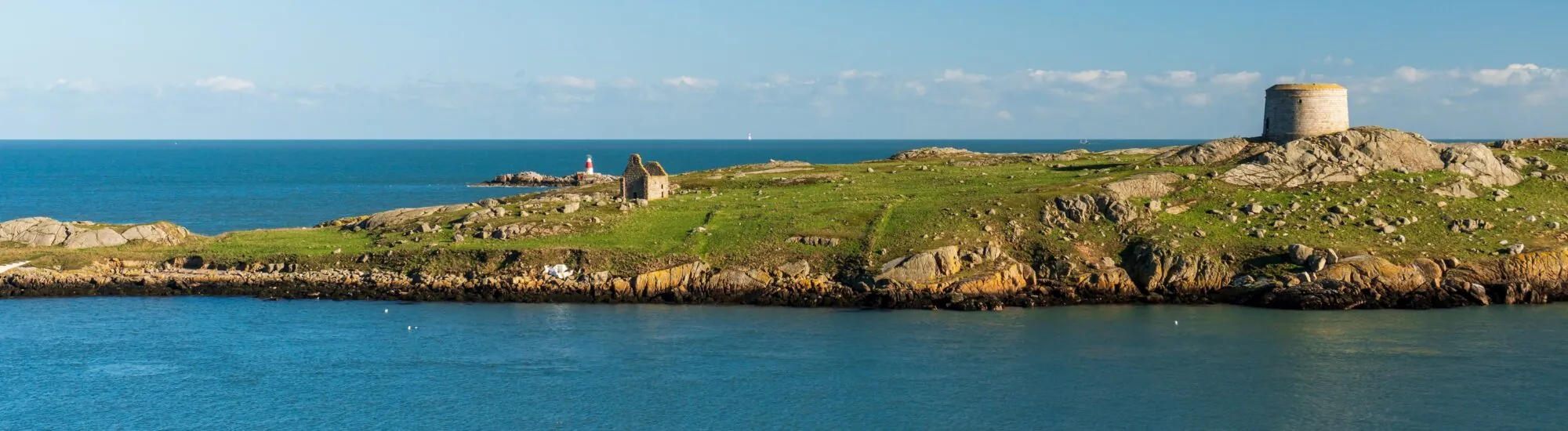
Just a few hundred metres off Dublin’s southern coast, Dalkey Island (Deilginis in Irish) feels as though it belongs to an entirely different world. Facing the village of Dalkey, this small uninhabited island brings together thousands of years of Irish history within just a few hectares: prehistoric remains, an old church dedicated to St Begnet, fortifications and an impressive Martello tower overlooking the bay.
Yet Dalkey Island is also a wonderful natural escape on Dublin’s doorstep. Just a few minutes by boat takes you away from the bustle of the coast to an island of grassland, visited by seabirds and surrounded by waters where seals can regularly be spotted.
Accessible in particular from Coliemore Harbour, Dalkey Island is one of the most unusual excursions to take around Dublin. It is a small maritime adventure combining heritage, archaeology, landscapes and wildlife watching, without having to travel hundreds of kilometres to Ireland’s west coast.
From the shore, Dalkey Island looks almost close enough to swim to. Yet the short stretch of water separating it from the mainland is enough to create a real sense of escape.
Once ashore, there are no streets, traffic or houses: only grassland, rocks, a handful of historic monuments and the sea on the horizon.
The island is easy to explore on foot. Its modest size means you can take your time, explore the main remains and enjoy the various views over Dalkey, Killiney, Dublin Bay and the Wicklow Mountains.
The crossing is already part of the experience. Dalkey Sound is a narrow sea passage framed by the coast and the surrounding rocky islets. In fine weather, the island can be reached from Coliemore Harbour in just a few minutes.
Dalkey Island should not, however, be thought of as a conventional tourist attraction. There are no shops, cafés or proper visitor centre: its wild character is precisely what makes it so appealing.
Behind its peaceful appearance, Dalkey Island has a remarkably ancient human history.
Archaeological excavations on the island have uncovered evidence of settlement dating back to the Mesolithic. Archaeologists have found shell middens, stone tools and various remains attesting to a human presence on the island several millennia before our era.
Other discoveries point to activity during the Neolithic and Bronze Age. Pottery, stone objects and other remains show that this small island, now facing one of Ireland’s most urbanised areas, was visited long before Dublin was founded.
Its occupation did not end in prehistoric times. Evidence from the early Middle Ages has also been found, while the monuments still visible today reflect Dalkey Island’s later religious and military uses.
This succession of eras makes the island far more than a simple place for a walk: several millennia of Irish history overlap within just a few hectares.
Dalkey Island’s main religious monument is St Begnet’s Church, now protected by the Office of Public Works as a national monument.
The church is dedicated to St Begnet, who is also associated with another old church in the village of Dalkey.
The origins of the religious site may date back to the 9th or 10th centuries, with an initial building probably constructed in wood. The church visible today was later built in granite.
Despite its ruined state, several architectural features remain clearly legible. The walls still rise to the gables, making it possible to picture the outline of the former building.
The church also had an associated burial ground. Archaeological excavations carried out there in the 20th century revealed several burials, along with remains dating from the medieval period.
Nearby, there are also crosses carved directly into a natural granite outcrop, as well as an old holy well.
The history of St Begnet’s Church has one surprising feature.
At the beginning of the 19th century, when the British began fortifying the Irish coast against the threat of a Napoleonic invasion, the old church was temporarily converted to house labourers working on Dalkey Island.
The building was partly altered: some openings were modified and a chimney was installed.
These changes explain why not every feature visible today necessarily reflects the church’s medieval appearance.
It is impossible to visit Dalkey Island without noticing its imposing Martello tower.
Built around 1804, it formed part of the extensive system of coastal fortifications developed by the British authorities in the early 19th century to protect Ireland and Great Britain against a possible invasion by Napoleon’s armies.
Dalkey Island occupied a strategic position. From its heights, it was possible to watch the sea approaches to Dublin and the vessels travelling through the bay.
The tower was associated with a coastal battery, also built around 1804. Together, they now form one of the island’s most distinctive heritage features.
Its squat silhouette is easily recognisable from the mainland and makes a strong contribution to Dalkey Island’s visual identity.
The Vikings are part of Dalkey’s and Dublin Bay’s maritime history, but caution is needed with certain stories about the island that are regularly repeated.
Its location near a natural anchorage and a stretch of coast that would become particularly important for maritime trade explains its strategic value over the centuries.
In the Middle Ages, Dalkey became an important port where ships could unload part of their cargoes before continuing to Dublin, whose access by sea was difficult at the time.
There is, however, nothing to establish with certainty that St Begnet’s Church was abandoned specifically following a Viking invasion. The island’s archaeological history is more complex and spans a much longer period.
Among Dalkey Island’s lesser-known features is an ancient promontory fort.
Located on a small rocky outcrop, it was protected by a bank and ditch. Archaeological excavations in this area have yielded fragments of imported pottery dating from the late Roman and post-Roman periods, suggesting that the site was occupied or fortified in the early Middle Ages.
Archaeologists have also found much older evidence there, including stone tools and prehistoric remains.
Today, the monument is far less visually striking than the Martello tower or St Begnet’s Church, but it perfectly illustrates the historical depth of this small island.
While archaeology is one of Dalkey Island’s main draws, its wildlife is the other great reason to visit.
The waters and rocks surrounding the island are frequented by grey seals. It is sometimes possible to spot them resting on the rocks or swimming in Dalkey Sound.
Sightings are, of course, unpredictable: these are wild animals, and no encounter can be guaranteed.
Many birds also frequent the area. Black guillemots, little auks and various seabird species can be seen around the rocks and neighbouring islets, depending on the time of year.
A pair of binoculars can therefore be an excellent addition to your visit.
Dalkey Island is also known for its goats, which have become a familiar part of the island’s landscape over the years.
It is not unusual to spot them in the grassland or near rocky areas while walking around the island.
As with all the island’s wildlife, it is best to observe them from a distance, avoid trying to feed them and refrain from any behaviour that might disturb them.
With goats in the grassland, seals around the rocks and seabirds above Dalkey Sound, the island offers a surprisingly wild impression of nature even though Dublin city centre is only a few kilometres away.
Dalkey Island is not connected to the mainland by a bridge. Reaching its shores therefore necessarily involves going by sea.
The traditional option is to leave from Coliemore Harbour, the small harbour opposite the island. Local operators offer crossings when sea conditions allow.
The distance is very short and the crossing generally takes only a few minutes.
These services should not, however, be regarded as a regular connection comparable to a conventional ferry. Departures depend in particular on the season, weather, sea conditions and tides.
It is therefore best to check crossing options before making a special journey to visit the island.
Sea kayaking is an excellent alternative for discovering Dalkey Sound and the area around the island.
Several guided excursions are offered in the Dalkey area. They allow you to approach the island’s shores from the sea and offer very good opportunities for seal watching.
Kayaking also provides a different appreciation of the area’s geography: from the water, the Martello tower dominates the island, while the hills of Killiney and the Wicklow Mountains appear behind the coast.
However, the short distance between Dalkey Island and the mainland should not lead you to underestimate sea conditions. Currents, wind, tides and boat traffic can make Dalkey Sound more challenging than it appears.
For visitors without sea kayaking experience, a professionally guided outing is therefore clearly preferable to an improvised crossing.
The waters around Dalkey have a long fishing tradition, and the area remains popular with sea anglers.
Different species may be present depending on the season, including mackerel.
If you plan to fish from the rocks, check the applicable rules beforehand and choose your spot carefully. Some rocky areas can become dangerous as the tide rises or waves become stronger.
On an island such as Dalkey Island, conditions must always take priority over finding the best fishing spot.
Dalkey Island is small enough to explore without any major difficulty, but its appeal lies precisely in the opportunity to slow down.
Ideally, allow one to two hours to explore the church at leisure, see the Martello tower, walk through the landscapes and enjoy the views across the bay.
There is no café or restaurant on the island. Bring water and perhaps something to eat, taking care, naturally, to take all your rubbish away with you.
Good footwear is also recommended. The ground is natural, uneven in places and can become slippery after rain.
The milder months generally offer the best conditions for discovering Dalkey Island, but there is no guarantee of good weather on the Irish coast.
More than rain, it is above all the wind and sea conditions that can determine whether a crossing is possible.
Overcast skies are certainly no obstacle to enjoying the island. The changing light over Dublin Bay can lend great character to the landscape.
When rough seas or strong gusts are forecast, however, crossings may be cancelled. Check conditions and departures with your operator on the day of your visit.
Just a few minutes by boat from Dalkey, the island ultimately offers a rare experience close to a European capital: leaving the city, landing on an uninhabited island and walking through several thousand years of history overlooking the Irish Sea.
Essential information to help you plan your visit, including key landmarks, access information, and booking options.
à 300 mètres au large de Dalkey, Dalkey, County Dublin, Republic of Ireland, Tourist Attractions in Ireland
53.271957, -6.084271