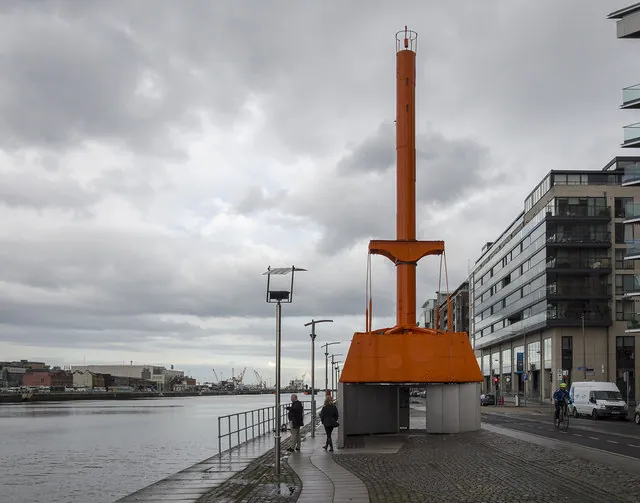
On the south bank of the Liffey, a tall orange structure stands out against the glass-fronted buildings of the Docklands. You could easily walk past it, mistaking it for an old crane. In fact, Dublin’s Diving Bell once descended beneath the water. This 90-tonne diving bell allowed six men to work together on the riverbed, protected from the water, preparing the foundations for the quays. Today, a walkway beneath the machine and explanatory panels offer a glimpse of a construction site that has largely vanished below the surface.
In the 19th century, expanding a port meant more than simply drawing a new line on a map. There had to be enough depth at the foot of the quays for ships to approach them, and a wall had to be built that could remain stable in the water. In Dublin, port engineer Bindon Blood Stoney opted for very large prefabricated concrete blocks. The blocks could be made on land, but their foundations had to be prepared directly on the riverbed.
Built by Grendon and Co. in Drogheda, the bell was delivered to Dublin Port in 1866. According to Dublin Port, it entered service in 1871 and remained in use until 1958. Its story is written into the fabric of the neighbourhood. Stoney helped build several quay walls, including those at Sir John Rogerson’s Quay and the extension of North Wall Quay. The machine displayed on the south bank helps explain how the quays were built, including their unseen parts.
Imagine pushing an upside-down glass into a sink: the trapped air inside prevents the water from immediately filling it. The Diving Bell used a similar principle, on a very different scale. A floating platform brought the machine above the worksite, then lowered it to the bottom. The working chamber was open underneath. A neighbouring barge pumped compressed air into the bell to keep the water at bay and allow the team to work.
The men entered through a vertical shaft from the surface and passed through an airlock before reaching the chamber. The National Inventory of Architectural Heritage describes a square chamber measuring around seven metres on each side and two metres high. Once on the riverbed, the workers had the ground beneath their feet to prepare. When viewing the machine from the quay, look for the shaft rising above the large chamber. Its elongated silhouette reflects the route the team had to take between the surface and the worksite.
A team could consist of six men. Using picks and shovels, they dug and levelled the riverbed. Excavated material was placed in containers suspended inside the bell and lifted up with it. The concrete blocks then had to be put in place; according to the Dublin Port archives, they could weigh up to 350 tonnes. The bell was therefore used to prepare their position. Making and laying the blocks formed part of other stages of the construction work.
The same archives describe heat that limited the time spent working in the chamber. Returning to the surface also required a stop in the airlock because of the change in pressure. These details bring greater depth to the object seen today. Even with air pumped from the barge and a platform to lower the machine, the quality of the foundations still depended on a handful of people working by hand below the level of the Liffey.
In 2015, Dublin Port Company unveiled the Diving Bell’s new display. The bell was raised on a steel structure around two metres high, creating a passage beneath the machine. This is the most interesting part of the visit: from the promenade, you mainly see its bulk and colour. Walking underneath it, you can understand where the working chamber was located. The panels explain how the machine worked and the port’s role in the development of the neighbourhood.
The exhibition is entirely outdoors. You can stop briefly to see the object, or take time to read the panels before continuing your walk. For a photograph, step back along the quay to frame the bell with the Liffey. Then move closer to its support for a better view of the underside of the chamber and the height of the shaft. The contrast between the riveted machine and the Docklands buildings neatly encapsulates part of the area’s history.
The bell stands on Sir John Rogerson’s Quay, on the south bank of the Liffey, east of Samuel Beckett Bridge. From the city centre, follow the quays downstream. If you are coming from the north bank, cross the bridge and turn left towards Grand Canal Dock. The easiest landmark is the orange structure, visible from the promenade.
For a walk exploring Dublin’s maritime past, combine the bell with the Jeanie Johnston and EPIC, the Irish Emigration Museum, on the opposite bank. The sailing ship and museum tell the story of departure and sea crossings. The Diving Bell shows how the port where ships docked was built. Between these visits, crossing the Liffey reveals how the two sides of the Docklands are arranged around the river.
Essential information to help you plan your visit, including key landmarks, access information, and booking options.
Sir John Rogerson’s Quay, Docklands District, Dublin, County Dublin, Republic of Ireland, Tourist sites in Ireland
53.34666, -6.23738
Monument and open-air exhibition on a public quay. The bell is visible from the promenade.
Check the opening hours and admission requirements before you leave, especially during peak season or on Irish public holidays.
Free access, with no ticket or booking required.