Viator


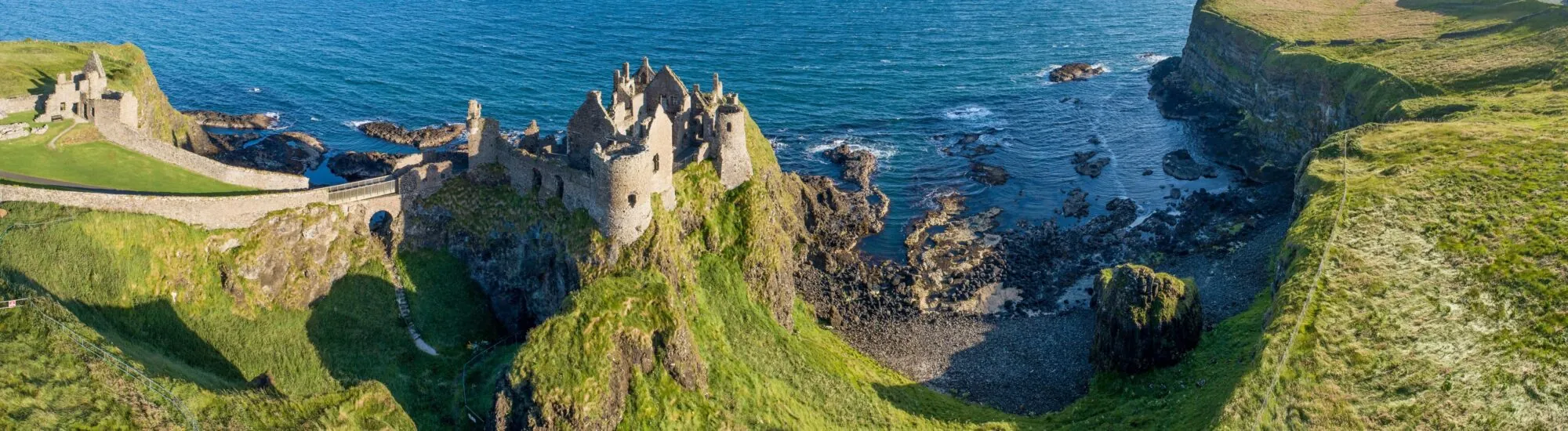
Perched on a rocky headland overlooking the Atlantic Ocean, Dunluce Castle is one of Northern Ireland’s most spectacular castles. Its ruined walls rise above the cliffs of County Antrim, between Portrush and Bushmills, along the famous Causeway Coastal Route.
The setting seems made for a fantasy tale: an isolated fortress, a bridge spanning a deep ravine and the ever-changing waters of the Atlantic stretching as far as the eye can see. Yet behind this romantic silhouette lies a very real history, marked by clan rivalries, the ambitions of the MacDonnell family and the development of a town that has now vanished.
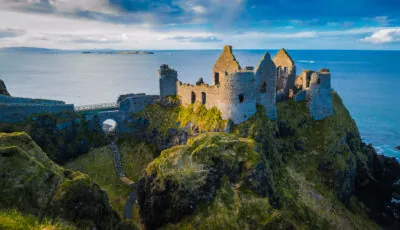
Dunluce Castle on the Antrim coast – © Artur
Dunluce Castle stands on a basalt outcrop separated from the mainland by a deep natural fissure. Today, the ruins are reached via a bridge that already provides a striking view of the cliffs.
This position was far from accidental. It made it possible to control part of Ireland’s northern coastline while protecting the residence from attack by land. The cliffs formed a particularly effective natural defence, even if they made everyday life more difficult when winds and storms battered the coast.
The first fortification at Dunluce is traditionally attributed to Richard Óg de Burgh, Earl of Ulster, in the 13th century. However, knowledge of this early structure remains limited. Most of the remains visible today date from developments carried out between the 16th and 17th centuries.
The presence of the McQuillan family is documented from the early 16th century. These Gaelic lords, known as the Lords of the Route, then controlled part of northern County Antrim. They made Dunluce one of their main strongholds and helped build its imposing circular towers.
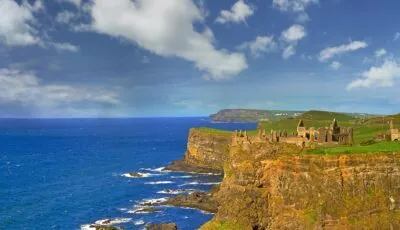
The fortified remains of Dunluce Castle – © Pecold
In the 16th century, the McQuillans gradually lost control of their lands to the MacDonnell clan. Originally from the western isles of Scotland, this powerful Gaelic family maintained close ties between Ulster and the Hebrides.
The central figure of this period is Sorley Boy MacDonnell. Contrary to what some accounts suggest, he was not an English commander but a Scottish Gaelic leader. Despite several interventions by the English Crown, he succeeded in consolidating his authority over the region and made Dunluce one of his residences.
Under the MacDonnells, the castle gradually evolved. The military fortress also became an aristocratic residence intended to display the power and status of its owners.
In October 1588, the Girona, a ship of the Spanish Armada, was wrecked near Lacada Point, not far from the Giant’s Causeway. The vessel therefore did not sink directly beneath Dunluce Castle, contrary to a frequently repeated belief.
Sorley Boy MacDonnell recovered part of the cargo, valuable objects and equipment from the wreck. The resources obtained from the shipwreck are said to have contributed to the embellishment of Dunluce. However, there is no way of stating with certainty that all the cannons now associated with the site came from the Girona.
At the beginning of the 17th century, Randal MacDonnell, Sorley Boy’s son and future Earl of Antrim, transformed the estate extensively. He created a more comfortable residence within the castle grounds and founded a small town nearby around 1608.
Dunluce Town had paved streets, merchants’ houses and buildings arranged according to a relatively structured plan. Archaeological research has uncovered the foundations of several homes and provided a better understanding of daily life in this community.
The town was severely affected by the conflicts of the 17th century, particularly during the disturbances of 1641. It was subsequently abandoned and almost entirely disappeared from the landscape. Its remains are now one of the least-known aspects of the visit. The [official Department for Communities website](https://www.communities-ni.gov.uk/heritage-sites/dunluce-castle) presents the discoveries made in its former streets and stone houses.
According to a very popular story, part of the kitchen collapsed into the ocean during a violent storm in 1639. Several servants are said to have died, while a young boy supposedly survived in the only corner of the room still clinging to the cliff.
This account should be regarded as a legend, rather than as established historical fact. No solid evidence confirms that employees died in these circumstances, and the remains of the kitchen can still be identified in the castle. The story may be linked to the collapse of another part of the cliff, embellished over generations.
The castle was not, in fact, abandoned immediately after 1639. It remained the seat of the Earls of Antrim for part of the 17th century. Its decline became more pronounced after the political upheavals of the late century and the deterioration of the family’s financial situation.

A banshee in Irish folklore – © Declan Hillman
Like many Irish castles, Dunluce has its supernatural tales. The best-known features Maeve Roe, the daughter of a McQuillan lord. The names and details vary between versions, a sign that this is indeed an oral tradition.
The young woman is said to have been imprisoned in a tower after refusing an arranged marriage. She then reportedly managed to escape with Reginald O’Cahan, the man she loved. Their boat is said to have sunk in a storm as they tried to reach the coast.
Legend has it that Maeve’s laments can still be heard around the north-east tower. She is sometimes described as Dunluce’s banshee, a female figure from Irish folklore whose cries foretell death or misfortune.
The silhouette of Dunluce Castle is closely associated with the world of Game of Thrones. Exterior views of the monument were used to create Pyke, the stronghold of House Greyjoy in the Iron Islands.
However, the castle seen in the series was extensively altered using digital effects. Visitors should not expect to find exactly the same towers and walkways. Several other locations on the Antrim coast, including Ballintoy Harbour, were also used to depict the Iron Islands.
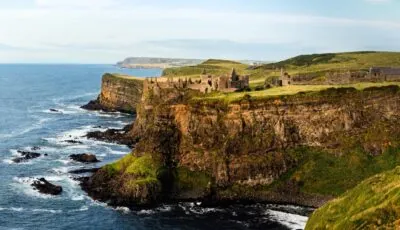
The ruins of Dunluce Castle overlooking the Atlantic – © Dawid
The visit begins by crossing the bridge linking the mainland to the rocky headland. Visitors can then explore the fortress’s various parts: the towers, inner courtyard, lords’ quarters, great hall and domestic areas.
Interpretation panels help place the remains in context. In particular, they explain how the medieval fortress was transformed into an aristocratic residence at the beginning of the 17th century.
Allow around one hour to explore the ruins at a leisurely pace, read the information and take in the scenery. A longer visit may be worthwhile if you also wish to discover the remains of Dunluce Town and photograph the castle from its various viewpoints.
A sea cavity known as Mermaid’s Cave lies beneath the headland. It is a natural cave shaped by erosion, not a secret harbour designed to hide boats.
The cave should not be regarded as a standard part of the visit. Access may be closed or discouraged because of tides, falling rocks and ground conditions. It is essential to respect the barriers and information provided on site, and not attempt to reach the cave when access has not been officially authorised.
Dunluce Castle is directly exposed to Atlantic winds. Waterproof clothing and shoes with good grip are recommended, even when the weather appears calm at first.
The ground includes uneven cobbles, steps and narrow passages. Some areas may therefore be difficult to access for people with reduced mobility. It is best to check accessibility conditions with the site manager before travelling.
The cliffs are steep and the site can become slippery after rain. Children must remain under adult supervision. For safety reasons, access to certain areas may also be restricted when weather conditions are unfavourable.
Parking nearby is limited, particularly during busy periods. Visitors should use authorised spaces and avoid stopping on the A2 coastal road, where visibility and verges are sometimes limited.
Located east of the castle, the Magheracross viewpoint offers one of the best views of Dunluce Castle and the surrounding cliffs. The Wishing Arch, a natural arch carved by the ocean, can also be seen from there. This viewpoint is a separate stop: it should not be assumed that it always serves as parking for a castle visit.
Late-afternoon light particularly enhances the contours of the fortress. In clear weather, the contrast between the dark stone, grassland and Atlantic creates one of the most photogenic landscapes on Northern Ireland’s north coast.
Dunluce Castle lies at the heart of a region particularly rich in natural and historic sites. A visit can easily be included in a day exploring the Antrim coast.
Just a few kilometres away are the Giant’s Causeway, the village of Bushmills and its historic distillery, as well as the coastal resorts of Portrush and Portballintrae. Continuing east, visitors can reach Dunseverick Castle, Ballintoy Harbour and the Carrick-a-Rede Rope Bridge.
Was Dunluce Castle used in Game of Thrones?
Yes. Its exterior appearance inspired and provided the visual basis for Pyke Castle, the seat of House Greyjoy. However, the monument was heavily altered using digital effects.
Did the castle kitchen really fall into the ocean?
This story belongs mainly to local tradition. No solid historical evidence confirms the collapse of the kitchen in 1639 or the deaths of the servants described in the legend.
How long does it take to visit Dunluce Castle?
Around one hour is enough to see the main ruins and enjoy the panorama. Allow more time to explore the remains of Dunluce Town and nearby viewpoints.
Can you see Dunluce Castle without visiting the ruins?
The castle can be seen from several points along the coastal road and from the Magheracross viewpoint. However, visiting the interior remains the best way to understand its architecture and history.
Essential information to help you plan your visit, including key landmarks, access information, and booking options.
87 Dunluce Rd, Bushmills, Bushmills (County Antrim) - Northern Ireland
55.210717, -6.579606
45 minutes
Compare tickets, guided tours, and excursions available through our partner platforms.