Viator


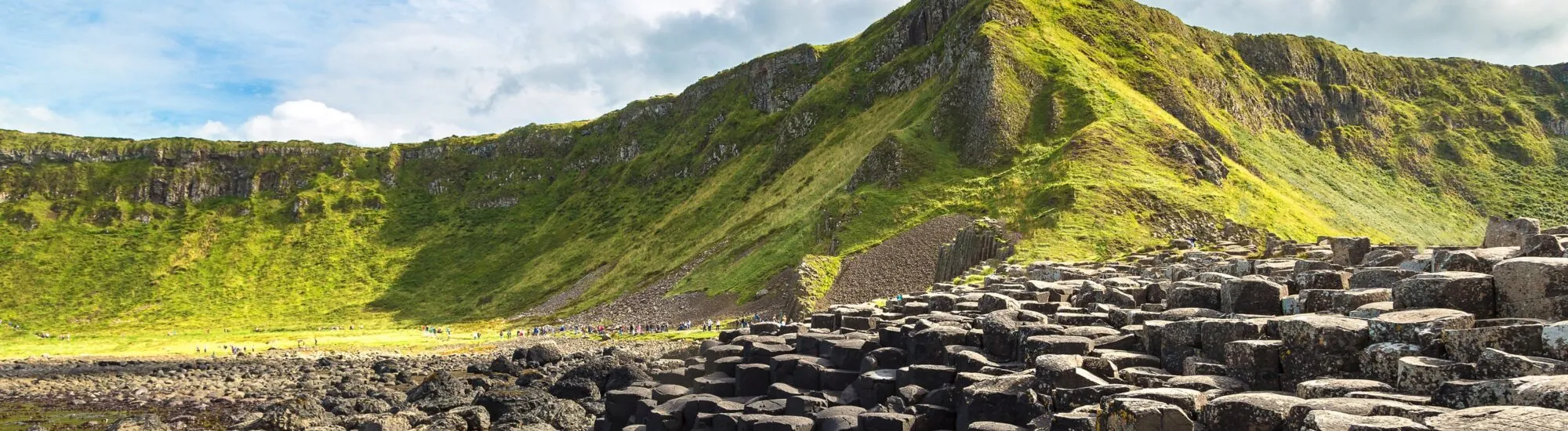
The Giant’s Causeway, known in Irish as Clochán an Aifir, is one of Northern Ireland’s most spectacular landscapes. Located on the County Antrim coast near Bushmills, it comprises around 40,000 basalt columns that appear to form a vast paved way descending into the ocean.
The site has been a UNESCO World Heritage Site since 1986 for its natural beauty and geological importance. Some columns reach almost 12 metres in height, but it is above all their near-regular polygonal shapes that make the landscape so remarkable.
Can you visit the Giant’s Causeway for free? Which car park should you choose? How much time should you allow? Here is all the practical information you need to plan your visit, understand how the columns formed and discover the site’s main trails.
Pedestrian access to the Giant’s Causeway columns is free. A public right of way allows visitors to reach the rocks without buying a ticket for the visitor centre. However, this free access does not include parking in the main car park, the exhibition, the audio guide or guided tours.
The ticket offered by the National Trust is for the Giant’s Causeway Visitor Experience. It generally includes:
It is therefore possible to visit the columns for free if you arrive on foot or by public transport. However, visitors wishing to park right beside the centre should book the Visitor Experience.
Visitor Experience prices vary according to the season, day and selected time slot. In 2026, you should generally allow between £14 and £18 for an adult and between £7 and £9 for a child aged 5 to 17. Children under 5 are usually admitted free. Family tickets are also available.
These amounts are indicative, as the National Trust uses variable pricing. Booking online lets you see the price for your chosen date and obtain the best available rates. National Trust members can access the Visitor Experience and car park free of charge, but are also advised to book a time slot.
Travellers who only wish to access the trails can use the Causeway Coast Way Car Park, located at Innisfree Farm, 60 Causeway Road. In 2026, its official price is £12 per vehicle, payable through the JustPark app. It is open from 5am to 8pm, cannot be booked, and spaces are allocated on a first-come, first-served basis.
A Park and Ride option is also available from the Dundarave car park in Bushmills. The “Green Ticket” includes the bus journey and access to the Visitor Experience at a reduced price. This option is particularly useful during busy periods.
The Giant’s Causeway is on the B147, around 3km north of Bushmills, 18km from Coleraine and 21km from Ballycastle. From Belfast, the most direct journey takes approximately 1 hour 20 minutes to 1 hour 40 minutes, depending on traffic. The coastal route is longer, but allows you to discover several landscapes along the Causeway Coastal Route.
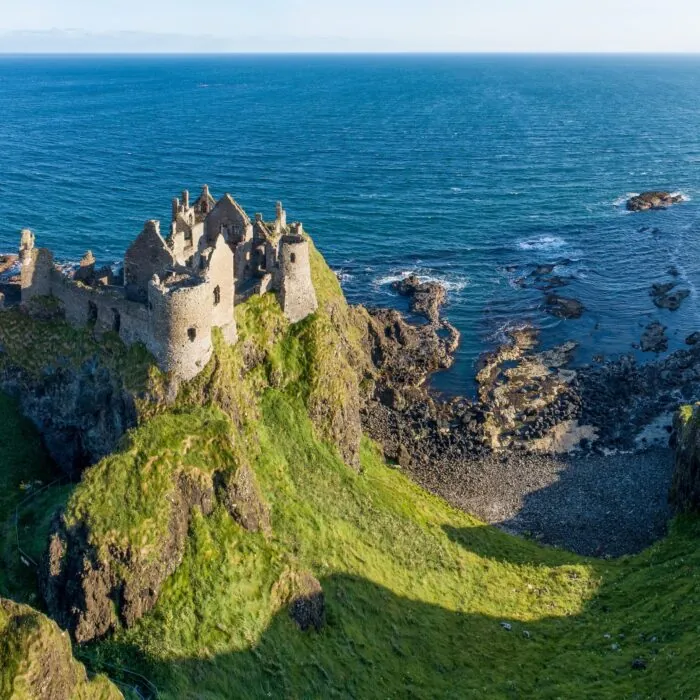
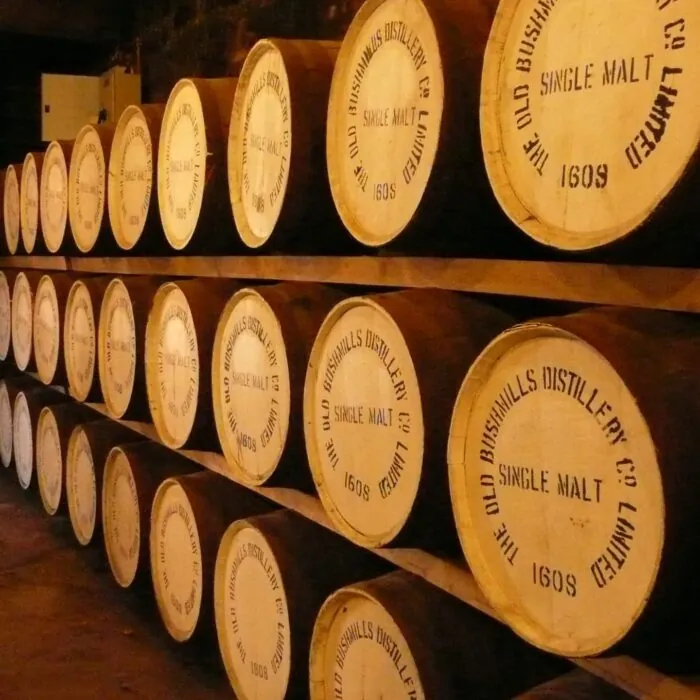
From Derry-Londonderry, allow around 1 hour 10 minutes. The site can easily be combined with Dunluce Castle, Bushmills Distillery, Carrick-a-Rede Rope Bridge, or the beaches at Whitepark Bay and Portrush.
The main car park is reserved for Visitor Experience ticket holders, National Trust members and holders of certain local passes. Do not park on the verges along Causeway Road: traffic can be heavy, and obstructive parking makes it difficult for local residents and emergency vehicles to pass.
The most convenient railway station is Coleraine. Trains connect Belfast and Derry-Londonderry with Coleraine, where you can continue by bus to the Giant’s Causeway.
Several Translink services serve the area, including routes 172, 221, 402 and 252. Some services operate seasonally. The Causeway Rambler 402 is particularly useful for visiting the coast’s main attractions during the tourist season.
As timetables and route numbers may change, check the Translink journey planner before travelling. Arriving by bus avoids parking constraints and allows you to use the free right of way to the columns.
A visit of two to three hours gives you time to walk down to the Grand Causeway, see the main rock formations and return to the visitor centre at a leisurely pace. Allow more time if you want to follow the Red Trail, visit the exhibition or join a guided tour.
The Blue Trail linking the centre to the columns is around 1.3km each way. The descent is relatively easy, but the return is uphill and can be tiring in strong winds. For a quick visit, allow around 1 hour 30 minutes. Half a day is preferable if you want to enjoy the landscape without rushing and explore the higher ground.
The Giant’s Causeway is very busy from late morning to mid-afternoon, particularly during holidays and summer weekends. For a quieter experience, arrive early in the morning or later in the afternoon.
The first hours of the day generally offer a more peaceful atmosphere and less crowded rocks. Late afternoon can bring superb light to the columns, but leave enough time to get back to the car park before it closes.
The landscape remains impressive under overcast skies, but rain makes the rocks extremely slippery. Fog and severe weather can also reduce visibility. Check the local weather forecast and bring waterproof clothing whatever the season.
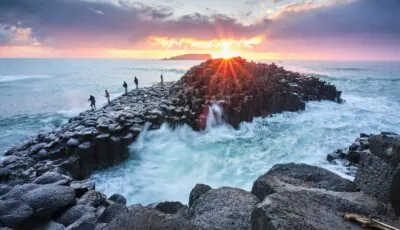
Basalt columns at the Giant’s Causeway
The Giant’s Causeway formed around 50 to 60 million years ago, during the Palaeogene period. At that time, the gradual opening of the North Atlantic Ocean was accompanied by major volcanic activity. Magma rose through the chalk layers of the Antrim Plateau, producing vast flows of basaltic lava.
As it cooled, the lava contracted. Cracks then gradually spread through the rock, creating a network of polygonal columns. Most have six sides, but some have four, five, seven or more. Their regularity is explained by the way stresses were distributed during cooling.
Erosion then removed some of the material covering the lava flows. The ocean, wind and natural coastal movements gradually exposed the columns visible today.
The Giant’s Causeway is therefore much more than a photogenic curiosity. Its study, carried out for more than three centuries, contributed to the development of Earth sciences. UNESCO considers the site an outstanding example of basaltic volcanism and polygonal column formation.
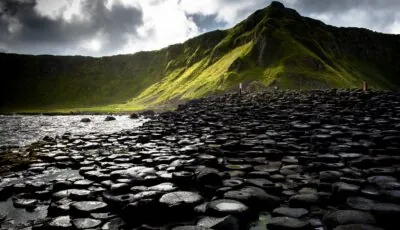
The Giant’s Causeway, between geology and mythology
Long before geologists provided their explanations, Irish folklore attributed the building of the causeway to Finn McCool, the anglicised form of the hero’s name, Fionn mac Cumhaill.
According to the most widespread version, Finn had a fierce rivalry with the Scottish giant Benandonner. Unable to cross the sea to confront him, Finn is said to have laid huge stones between Ireland and Scotland to create a passage.
When he caught sight of Benandonner, who was much larger than him, Finn realised he had probably overestimated his own strength. He hurried back home. His wife, often called Oonagh or Sadhbh depending on the version, then came up with a trick: she disguised Finn as a baby and placed him in a cradle.
On seeing the impressive size of the supposed baby, Benandonner became frightened. If the child was so gigantic, his father must be absolutely colossal. The Scottish giant therefore fled back to his homeland, destroying the causeway behind him so that he could not be followed.
The presence of similar basalt formations in Fingal’s Cave on the Scottish island of Staffa probably reinforced the ancient idea of a bridge linking the two coasts. The legend has many variations and belongs to folklore: it should clearly not be confused with the site’s geological explanation.
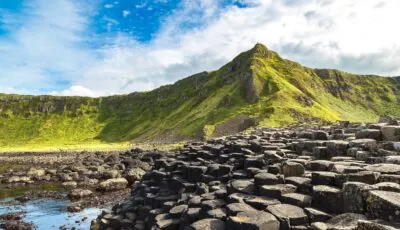
The Grand Causeway facing the ocean
The Grand Causeway, or Grand Causeway, is the site’s best-known section. The columns form an uneven pavement that gradually slopes down towards the ocean. Their flat tops allow you to walk between the blocks, but surfaces near the water quickly become slippery.
The Middle and Little Causeways are two smaller neighbouring outcrops. Together, they reveal the variety of forms created by the cooling and erosion of basalt.
At low tide, some columns appear to extend further out to sea. However, never venture into areas reached by the waves. Conditions can change quickly on this exposed coast.
The Giant’s Boot is a rock formation that resembles a massive shoe. According to legend, it belonged to Finn McCool. It lies beyond the Grand Causeway, along the Blue Trail.
Its shape is the result of erosion, but its size has naturally helped fuel the tales of giants told along the Antrim coast.
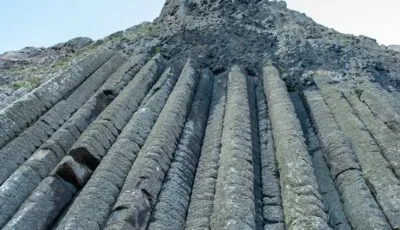
The Giant’s Organ
The Giant’s Organ is one of the area’s most impressive formations. Its long vertical columns line the cliff like the pipes of a monumental organ. Some reach almost 12 metres.
To see it, continue beyond the Grand Causeway along the authorised path. The route can be exposed to the wind and may occasionally be affected by rockfalls. Observe any closures put in place by National Trust rangers.
The Wishing Chair is a group of columns arranged in a way that resembles a natural seat. Its surface has been polished by generations of visitors.
Tradition has it that those who sit there may make a wish. Access may nevertheless be restricted when visitor numbers, the condition of the rocks or conservation measures require it.
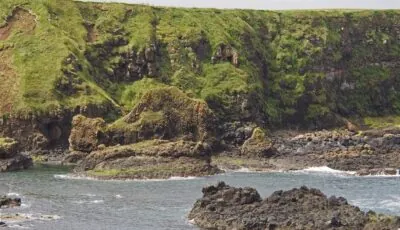
The Camel, Finn McCool’s petrified mount
The Camel is an isolated rock whose outline resembles a resting camel. In local folklore, it was Finn McCool’s mount before being turned to stone.
It can be seen from the Blue Trail in Portnaboe Bay. Its resemblance to the animal depends greatly on the viewing angle and a little imagination.
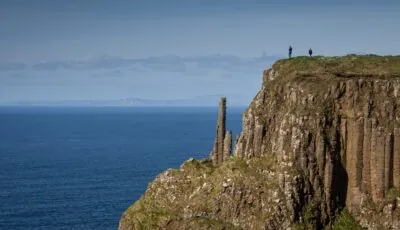
The Chimneys at the top of the cliff
The Chimneys are several columns rising above the coast like the chimneys of a castle. A local story links them to the wreck of the Girona, a Spanish Armada ship lost off this coast in 1588.
However, the story that the sailors mistook the columns for a castle and fired in their direction belongs to local tradition. It should not be presented as established historical fact.
The Blue Trail is the easiest and busiest route. It links the visitor centre to the main columns over around 1.3km. The National Trust estimates the outward journey at around 25 minutes.
The path is surfaced, but has a noticeable slope. The return journey therefore requires more effort. The columns themselves are uneven and very slippery when wet.
An accessible shuttle runs between the centre and the rock formations during Visitor Centre opening hours. Check arrangements and fares on site.
The Red Trail is a loop of around 3.2km, with sweeping views over the Grand Causeway and neighbouring bays. It joins the famous Shepherd’s Steps, a staircase of 162 steps leading back down to the coast.
This route is graded moderate. It includes uneven sections, steep steps and areas close to unprotected cliff edges. It is not suitable for people with reduced mobility.
The Green Trail is the site’s only route stated to comply with British DDA accessibility standards. It offers several viewpoints accessible with a pushchair or certain mobility aids, although conditions must always be considered.
The Yellow Trail follows part of the Causeway Coast Way on higher ground. It runs for around 2.9km between Runkerry Head and Hamilton’s Seat. More rugged, it offers magnificent coastal views, but requires sturdy footwear and particular care in strong winds.
The Giant’s Causeway can certainly be visited with children, provided you remain vigilant. The columns are fun to explore, but their surface becomes slippery in the rain or when reached by waves.
Young children should stay close to an adult. Avoid running on the rocks, jumping between columns and approaching the sea when there is a heavy swell.
The visitor centre introduces the geology and legend of Finn McCool through content that is more accessible for families. The shuttle also makes the return journey easier when the uphill walk is too tiring.
The Visitor Centre has step-free access, accessible toilets and a Changing Places facility available with a RADAR key. Wheelchairs and various mobility aids can be loaned to Visitor Experience ticket holders, subject to availability.
The accessible shuttle makes it easier to travel between the centre and the columns. However, the Blue Trail has slopes, while moving directly over the rocks remains difficult in a wheelchair. The Green Trail is the most suitable route.
As needs vary greatly from person to person, it is best to contact the centre before visiting to check equipment availability and trail conditions.
Wear shoes with non-slip soles. The columns may look easy to walk across, but water, algae and sea spray make their surface particularly slippery.
Do not go near the waves in bad weather, and follow rangers’ instructions. Some trail sections may close because of wind, erosion or the risk of rockfalls. Not all cliff edges are protected by barriers.
Bring a waterproof windproof jacket, even in summer. An umbrella is rarely practical on this coast. Flying a drone is also discouraged unless you have first checked the rules and obtained the necessary permissions.
Visitors must neither take away rocks nor wedge coins into the cracks in the columns. The National Trust launched a specific campaign against this practice in 2025.
When exposed to sea air, coins corrode and increase in volume. They then put pressure on the basalt, causing it to crumble and leaving oxidation marks. Removing them requires particularly costly specialist work.
To protect this UNESCO-listed site, simply leave no trace, stay on authorised routes, take your rubbish away and follow staff instructions.
Opened in July 2012, the Visitor Centre was designed to blend into the landscape. Its angular lines, dark façades and green roof evoke the geometric forms of the basalt columns.
The exhibition explains the site’s volcanic formation, its importance in the history of science and the main legends associated with Finn McCool. Audio guides in several languages and guided tours are included in the Visitor Experience.
The building also contains a café, shop, tourist information point and toilets. You can access the public right of way without passing through the paid exhibition.
The Giant’s Causeway fits easily into a day exploring the Causeway Coastal Route. Several major sites are nearby:
If you only have one day from Belfast, avoid trying to fit in too many brief stops. The Giant’s Causeway deserves at least two hours, especially if the weather allows you to explore the coastal trails.
No. Pedestrian access to the columns is free thanks to a public right of way. The Visitor Experience is paid and includes, among other things, the official car park, exhibition, audio guide and guided tours.
The Visitor Experience price varies by date and time slot. Generally, expect to pay between £14 and £18 per adult and between £7 and £9 per child. Check the National Trust ticket office for the exact price.
The main car park is included with the Visitor Experience ticket. The Causeway Coast Way Car Park costs £12 per vehicle in 2026 and operates without booking, subject to space availability.
Allow two to three hours to see the columns and main viewpoints. Half a day lets you add a cliff-top trail and a visit to the centre.
The Blue Trail is around 1.3km each way. The outward journey takes approximately 25 minutes, but the uphill return may take longer.
Yes, but the rocks become very slippery. Wear good footwear and do not go near the waves. Some areas may close when conditions are dangerous.
Dogs on leads are allowed on the trails and in Visitor Experience areas. Owners must pick up after them and avoid disturbing wildlife.
Yes. Translink buses connect the site with Coleraine, Bushmills and several stops along the coast. You can also join an organised tour from Belfast or Dublin.
As the basaltic lava cooled and contracted, it cracked into a polygonal network. The distribution of stresses favours six-sided forms, but not all columns are perfectly hexagonal.
No. No stone bridge crossing the sea remains. However, similar basalt formations exist in Fingal’s Cave on the Scottish island of Staffa, which probably helped inspire the legend.
Essential information to help you plan your visit, including key landmarks, access information, and booking options.
à 10km au nord de Bushmills, Bushmills (County Antrim) - Northern Ireland
55.239277, -6.510130
2h30
Compare tickets, guided tours, and excursions available through our partner platforms.