Viator

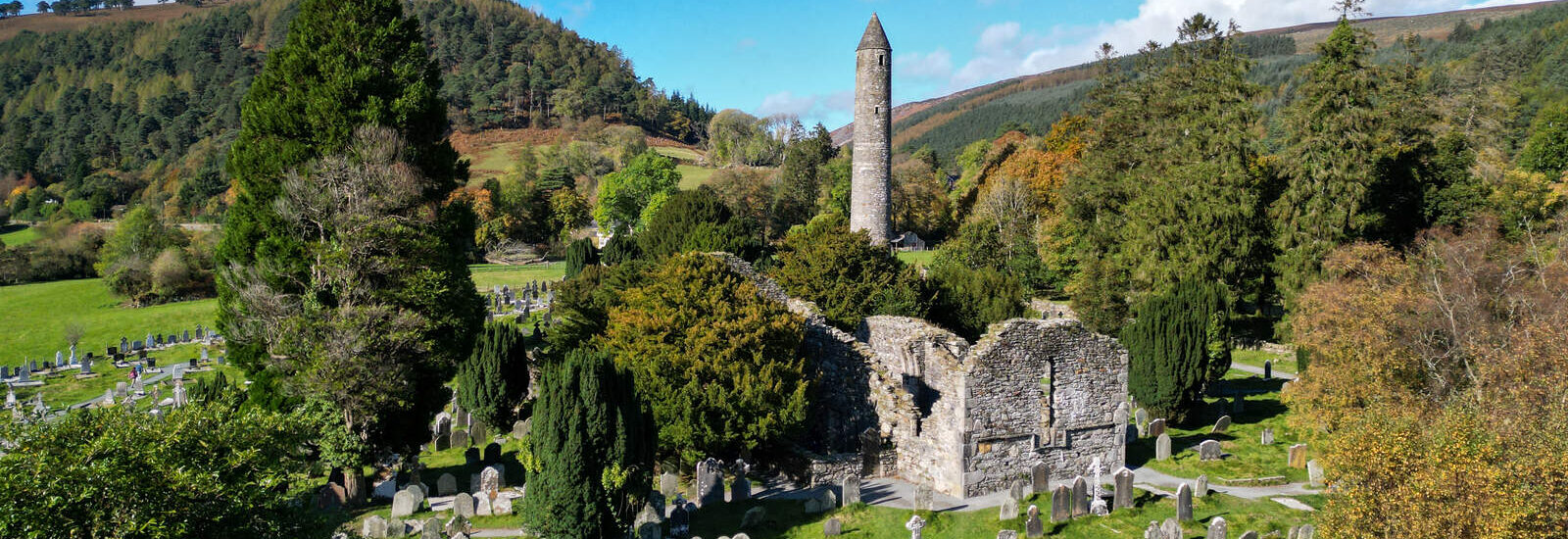
In a glacial valley in the Wicklow Mountains, a round tower rises above the trees and gravestones. Glendalough is home to the remains of one of medieval Ireland’s most important monastic centres, founded by St Kevin in the 6th century. Two dark lakes, oak woods and several walking trails surround these ruins.
Located around 50 kilometres south of Dublin, Glendalough offers the chance to combine heritage, scenery and a walk in the great outdoors in a single day. The monastic site is freely accessible all year round, while the Visitor Centre, car parks and certain routes have their own opening times and access conditions.
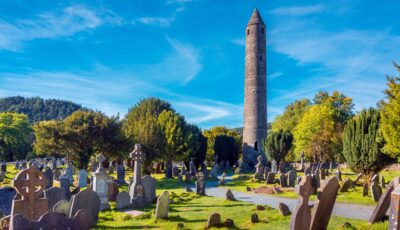
The monastic site of Glendalough – © Evgeni Fabisuk
The name Glendalough comes from the Irish Gleann Dá Loch, meaning “valley of the two lakes”. The Lower Lake and Upper Lake lie in a valley carved out by glaciers during the last Ice Age.
Glendalough is not simply a small hamlet. The name refers to the valley, the former religious complex, the two lakes and one of the busiest areas of Wicklow Mountains National Park.
The main monastic site stands near the Lower Lake and the Visitor Centre. Other religious remains are scattered throughout the valley, particularly around the Upper Lake. Walking trails link these different areas through wetlands, woodland and mountain terrain.
Glendalough was founded in the second half of the 6th century by St Kevin, or Cóemgen in Irish. Born into a noble Leinster family, he chose to withdraw to the Wicklow Mountains to lead a life of asceticism and prayer.
According to tradition, Kevin first lived as a hermit in a hollow above the Upper Lake. Known as St Kevin’s Bed, this site is a small recess cut into the cliff face. Its exact origins remain uncertain: it may predate Christianity and may originally have been used as a prehistoric tomb.
Kevin’s spiritual reputation gradually drew disciples. A religious community formed in the valley and continued to develop after the saint’s death, traditionally dated to 617 or 618.
Within less than a century, Glendalough had become one of Ireland’s leading religious centres. It was a place of prayer, study and manuscript production. Craftspeople, farmers and families also lived around the community. By the end of the 8th century, the monastic centre may have employed up to a thousand lay people.
Glendalough’s wealth attracted many raiders. Between the late 8th and 11th centuries, the site was repeatedly attacked by local groups and Scandinavians. These raids did not, however, lead to its immediate disappearance. The community rebuilt and continued its activities for several centuries.
Glendalough’s decline was chiefly the result of political and religious reorganisation. In the 12th century, its diocese gradually lost its autonomy to Dublin. The reform of the Irish Church and the arrival of the Anglo-Normans also changed the organisation of religious institutions.
In 1398, English forces devastated a significant part of the site. This episode marked the end of Glendalough as a major ecclesiastical centre, but not the end of all religious life in the valley. Some churches continued to be used, and Glendalough remained a place of pilgrimage associated with St Kevin.
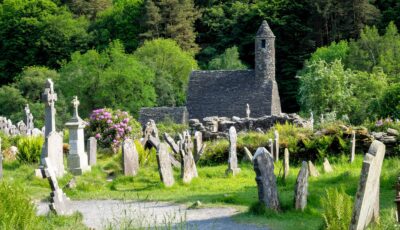
The monastic remains of Glendalough – © rudiernst
The main monastic site can be explored freely throughout the year. Access to the outdoor monuments is free and not dependent on Visitor Centre opening hours. The route passes through a cemetery that is still in use and several fragile buildings, so visitors should stay on the designated paths and respect the graves.
The historic entrance to the site is through the Gateway, a rare example of an Irish medieval monumental gateway. The building once had two storeys and probably a wooden roof. Part of its original paving can still be seen beneath visitors’ feet.
One to two hours is enough to see the main remains. Allow more time to reach the Upper Lake or follow one of the national park’s trails.
The round tower is Glendalough’s most recognisable monument. Standing around 30 metres high, it is thought to have been built between the 10th and 12th centuries. Its doorway is nearly 3.5 metres above ground level and was once reached by ladder.
The interior was divided into six levels linked by wooden ladders. The tower may have served as a bell tower, landmark and storage space. It also provided occasional shelter for people and valuables, though it was not a fortress capable of withstanding a prolonged attack.
Its conical roof was rebuilt in 1876 using original stones found nearby. The tower cannot be visited inside, but its excellent state of preservation makes it one of the finest examples of Irish monastic architecture.
The cathedral is Glendalough’s largest religious building. It was built in several phases between the 10th and 13th centuries, rather than solely during the 12th century.
The walls still reveal the nave, chancel and several liturgical features. A small wall cupboard was used to store objects for worship, while a piscina was used to wash sacred vessels.
Outside stands St Kevin’s Cross, a large granite cross whose ring is not pierced through. A popular belief holds that anyone able to encircle its shaft with their arms will see one of their wishes come true.
St Kevin’s Church is sometimes known as St Kevin’s Kitchen. This name probably comes from its small cylindrical bell tower, once mistakenly thought to be a chimney.
The building is distinguished by its roof, which is built entirely of stone. It rests on an internal semicircular vault. Its bell tower, topped with a stone cap, is a miniature echo of Ireland’s great round towers.
The Priest’s House is a small Romanesque building, almost entirely rebuilt in 1779 using its original stones. Its function remains uncertain. Rather than housing a priest, as its current name suggests, it may have been used to keep St Kevin’s relics.
The Visitor Centre is located immediately beside the main site. Its exhibition traces the life of St Kevin, the development of Glendalough and the role played by monasteries in medieval Ireland. An audiovisual presentation provides useful context before exploring the ruins.
Entry to the centre is charged, but visiting the outdoor monastic site remains free.
Paying for parking at the Visitor Centre entitles visitors to one free admission to the interpretation centre. This free admission applies to one entry, not necessarily to all passengers in the vehicle.
A relatively accessible route links the monastic site, the Lower Lake and the Upper Lake. It includes a boardwalk along the wetlands and passes through wooded areas.
From the Visitor Centre, allow around twenty minutes to reach the Upper Lake without stopping. In practice, the viewpoints and detours make it worth allowing more time.
The Green Road Walk is an easy loop of around 3 kilometres. It follows almost flat paths and boardwalks, with an estimated duration of 45 minutes. A short detour allows you to include the monastic ruins in the route.
Nine waymarked trails begin near the National Park Information Office, close to the Upper Lake. Each route is identified by a colour and has a different length and level of difficulty.
The Miners’ Road Walk, marked in purple, is one of the most accessible options. This 5-kilometre out-and-back route follows the Upper Lake before reaching the remains of the former mining village. It also offers views, from the opposite shore, of the hollow known as St Kevin’s Bed.
More experienced walkers can head up to the Spinc heights and enjoy sweeping views over both lakes. These routes involve significant climbs, steps and sections exposed to the weather.
2026 information: works began on 20 July on part of the White Trail, between the mining village and a boardwalk. Occasional disruptions may also affect the Blue Trail. The Bronze Trail remains closed because of storm damage, although St Kevin’s Cell can still be reached by an out-and-back route. Check trail conditions on the national park website before setting off.
Three public car parks serve Glendalough. The Visitor Centre car park is directly beside the monastic site. It is paid and generally open from 8 am to 8 pm. Payment can be made by card or cash at the machines.
The Upper Lake car park, which is also paid, is at the end of the valley. It is the best option for starting a walk, but fills up quickly on sunny weekends and during the high season. When the car park is full, a long queue can form on the only access road.
A third, free car park is located in Laragh, near the Woollen Mills and the sports ground. From there, it is around a 3-kilometre walk through the woods to reach the Upper Lake.
Parking is prohibited along the road leading to the Upper Lake. This narrow route must remain clear for emergency vehicles. Vehicles parked on yellow lines risk being fined or towed away.
Glendalough is around 50 kilometres from Dublin. By car, the journey generally takes between one hour and one and a half hours, depending on the departure point, route and traffic.
The route can go via Roundwood and Laragh, or cross the mountains via Sally Gap. The latter route is particularly scenic, but follows narrower roads and can become difficult in fog, frost or snow.
A private company operates a bus service between central Dublin and Glendalough. Timetables and frequency vary by season, so it is best to book and check the return time before departure.
Many guided tours combine Glendalough with Wicklow Mountains National Park, Sally Gap, Lough Tay or the Powerscourt Estate. They suit travellers who want to discover the region without driving.
Allow at least two to three hours to explore the monastic site and walk to the lakes. A full day is needed for a longer walk in the hills.
The weather can change quickly in the Wicklow Mountains. A waterproof jacket, suitable footwear and a warm layer are useful even in summer. For the Spinc routes, bring water, a map and a fully charged phone.
The Visitor Centre is accessible to people with reduced mobility. Access to the monastic cemetery, however, is difficult because of the uneven ground. The Lower Lake boardwalk is used by some wheelchair users and families with pushchairs, but the park’s trails do not have official accessibility certification.
Dogs must be kept on a lead throughout the national park. The lakes are deep, cold and unsupervised. There is no lifeguard, and the banks can drop steeply into the water.
Is Glendalough free to visit?
Access to the monastic site, lakes and trails is free. The Visitor Centre exhibition and some car parks are charged.
How long does it take to visit Glendalough?
Allow one to two hours for the monastic site, and at least three hours if you wish to walk to the Upper Lake. A walk on the Spinc takes half a day.
Can you visit Glendalough without a car?
Yes. A private bus service serves the valley from Dublin, and several agencies offer organised day trips.
Essential information to help you plan your visit, including key landmarks, access information, and booking options.
Suivre la route en direction de Laragh. Un parking gratuit vous attend à l'arrivée., Laragh, Laragh (County Wicklow) - Republic of Ireland
53.010568, -6.327204
1h30
Compare tickets, guided tours, and excursions available through our partner platforms.