

A few kilometres from Portmagee, at the far end of the Iveragh Peninsula, the Kerry Cliffs offer one of County Kerry’s most spectacular panoramas. Here, immense cliffs plunge dramatically into the Atlantic, while offshore lie Skellig Michael, Little Skellig and Puffin Island. It is a monumental landscape, battered by wind and waves, and among the finest in south-west Ireland.
Located on the Skellig Ring, around 3 km from Portmagee, the Kerry Cliffs rise to more than 300 metres in places. Above all, they offer the closest land-based viewpoint of the famous Skellig Islands. When the weather is clear, the almost unreal silhouette of Skellig Michael stands out on the horizon, around a dozen kilometres offshore.
Less famous than the Cliffs of Moher, the Kerry Cliffs have little to envy them when it comes to spectacle. Their more secluded setting, proximity to the Skelligs and location along one of Ireland’s finest coastal drives make them an unmissable stop on a road trip around the Iveragh Peninsula.
Your visit begins at the site entrance, where you will find the car park and main visitor facilities. From there, allow around ten minutes’ walk to reach the first major viewpoints.
As you walk on, the horizon opens up and the landscape becomes ever more dramatic. The pastures gradually recede behind you as the Atlantic fills your entire field of view.
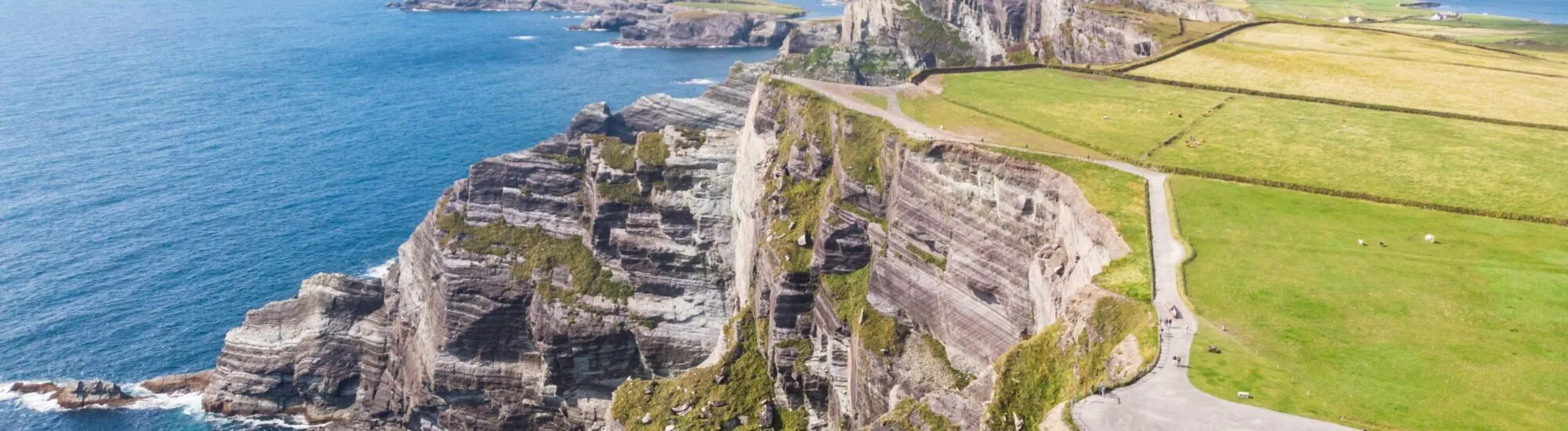
Then the Kerry Cliffs reveal themselves.
The rock faces drop almost vertically towards the ocean, more than 300 metres below. At the foot of the cliffs, waves crash against the rock with a roar that can be heard from above when the sea is rough.
The landscape is all the more impressive because the cliffs have a particularly ancient geology. Their rocks date back around 400 million years and were formed in an environment very different from the one we know today.
The result is a spectacular coastline, deeply carved by erosion and exposed for millions of years to storms sweeping in from the Atlantic.
This is probably what makes the Kerry Cliffs truly unique.
From their heights, they offer the closest mainland viewpoint of the Skellig Islands, those extraordinary rocky pinnacles rising from the Atlantic off the Iveragh Peninsula.
On a clear day, it is impossible to miss Skellig Michael. Its pyramid-shaped silhouette stands out sharply on the horizon. The island is famous for its ancient Christian monastery, perched at the summit of the rock, and is now a UNESCO World Heritage Site.
Nearby lies Little Skellig, which is inaccessible to the public and known for hosting an immense colony of gannets.
Closer to the coast, Puffin Island also comes into view: a small protected island of particular importance to seabirds. During the breeding season, it is home to Manx shearwaters, European storm petrels and, as its name suggests, Atlantic puffins.
When visibility is excellent, the combination of cliffs, islands and ocean offers one of the most photogenic panoramas along Ireland’s entire south-west coast.
The good news is that you do not need to be an experienced walker to enjoy the scenery.
Unlike some of Ireland’s wild coastal sites, the Kerry Cliffs have been laid out for visitors. Paths lead to different viewpoints at the top of the cliffs, allowing you to enjoy the panorama without undertaking a long hike.
The walk is fairly short, but it would be a shame to rush through it. Allow at least an hour on site to take in the cliffs, the Skelligs and the seabirds. Photography and birdwatching enthusiasts could easily spend longer here.
Barriers and fences protect the main areas open to the public. They should obviously not be crossed: the terrain remains extremely steep, and the wind can be powerful at the top of the cliffs.
This makes the site far better suited to a family visit than some of Ireland’s completely wild cliffs. With young children, however, constant supervision remains essential because of the terrain and exposure to the wind.
The Kerry Cliffs are not just about the view. The area is also an excellent place to observe the wildlife that inhabits this stretch of Irish coastline.
The cliff faces and surrounding islands are home to numerous seabird species. Depending on the season, you may spot various species nesting or moving along the coast.
The cliffs regularly draw birdwatchers, while Puffin Island and the Skellig Islands are two major sanctuaries for seabirds.
Puffins are especially sought after by travellers, but their presence is seasonal. You should not therefore expect to see them from the Kerry Cliffs all year round. To spot them in the region, the period from spring to early summer is generally the most favourable.
Binoculars can be very useful, both for watching birds and for making out the outlines of Skellig Michael and Little Skellig on the horizon.
As is often the case on Ireland’s Atlantic coast, the weather plays an essential role in the experience.
On a clear day, visibility can stretch a long way, offering perfect views of the Skellig Islands. Slightly cloudy skies can even make the landscape especially photogenic, casting alternating shade and light across the cliffs.
Thick mist or very low cloud, on the other hand, can completely obscure the islands and greatly reduce visibility.
The wind must also be taken seriously. The Kerry Cliffs are directly exposed to Atlantic weather systems, and gusts can be particularly strong. Bring a waterproof, windproof layer, even when the weather seems fairly mild when setting off from Portmagee.
Opening hours may also change according to weather conditions. In the event of a storm or high winds, it is best to check the situation before setting out.
Late afternoon can offer very good conditions for photographing the Kerry Cliffs, but there is no single perfect time that applies throughout the year.
The sun’s position varies considerably with the seasons, as do cloud cover and visibility of the Skelligs. In Ireland, an unexpected break in the clouds can sometimes offer more dramatic light than a perfectly uniform blue sky.
If your itinerary allows, keep a little flexibility. A day when the Skelligs are perfectly visible from the coast is clearly one to make the most of.
Take care not to arrive too late, however: the site has opening hours and a last admission time, which may vary or change depending on the weather.
The Kerry Cliffs are ideally placed to include in a day exploring the Skellig Ring, one of the Iveragh Peninsula’s most impressive scenic drives.
The site lies just a few kilometres from Portmagee, a charming fishing village known in particular as one of the main departure points for boat trips to Skellig Michael.
You can easily combine a visit to the cliffs with Valentia Island, reached by bridge from Portmagee, before continuing to Bray Head or Geokaun Mountain.
In the other direction, the road climbs towards Coomanaspic Pass, which in turn offers superb views of the ocean, cliffs and peninsula.
The Skellig Ring offers a succession of spectacular landscapes over a relatively short distance. Narrower and more secluded than some stretches of the Ring of Kerry, it crosses a region where the ocean, mountains and islands seem to compete constantly for the horizon.
The comparison often comes up, but the two sites actually offer rather different experiences.
The Cliffs of Moher are far more famous and have extensive visitor infrastructure. They are one of Ireland’s iconic natural landmarks, impressive both for their length and for the vastness of the coastal landscape.
The Kerry Cliffs are more secluded, and a visit is much more closely bound up with the Skellig landscape.
That is precisely their greatest asset: an exceptional composition of cliffs in the foreground, the Atlantic below and the silhouettes of Skellig Michael and Little Skellig rising offshore.
There is therefore no real need to declare a winner. But if you are exploring the Ring of Kerry and the Skellig Ring, passing near Portmagee without heading up to the Kerry Cliffs would be a real shame.
Allow at least an hour to explore the Kerry Cliffs properly.
This gives you time to reach the main viewpoints, stroll along the waymarked paths and enjoy the panorama without feeling as though you are simply ticking off another stop on your road trip.
Photographers and bird enthusiasts can easily extend their visit. The site also has an area where you can eat and have a drink, which can be welcome when the weather is cool.
But the main attraction is, of course, at the end of the path. When the clouds part and Skellig Michael appears beyond the immense rock faces, the Kerry Cliffs offer one of those images that sums up the Irish coast in a single view: rugged land, a vast Atlantic and a handful of islands that seem to sit at the edge of the world.
Essential information to help you plan your visit, including key landmarks, access information, and booking options.
Skellig Ring, Foilnageragh, Portmagee, Iveragh Peninsula, County Kerry, Republic of Ireland, Tourist sites in Ireland ; Ring of Kerry, Iveragh Peninsula, County Kerry, Republic of Ireland, Tourist sites in Ireland
51.868645, -10.385572