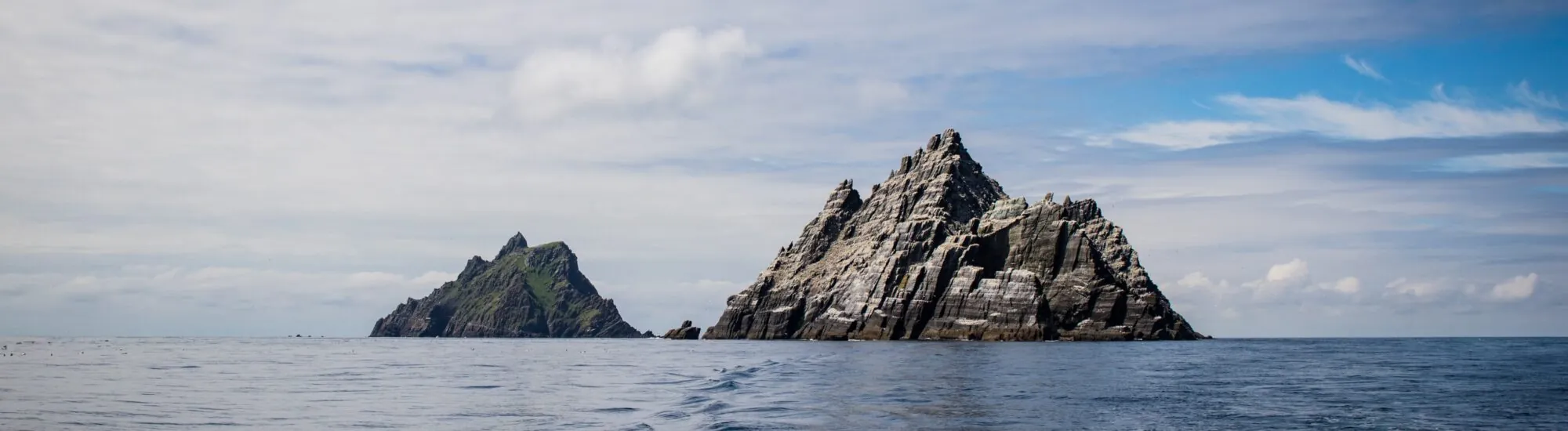
Standing offshore from the Iveragh Peninsula in County Kerry, the Skellig Islands seem to have risen straight from the depths of the Atlantic. This tiny archipelago consists of two rocky islands: Skellig Michael, famous for its ancient monastery, and Little Skellig, an inaccessible sanctuary occupied by thousands of seabirds.
Located around 12 kilometres from the coast, the Skellig Islands form one of Ireland’s most spectacular landscapes. Their dark cliffs, dizzying steps and isolation tell a story of faith, survival and adaptation to an especially hostile environment.
An excursion allows you to sail around both islands. Landing, however, is authorised only on Skellig Michael, during a limited season and when sea conditions permit. Little Skellig remains entirely reserved for birds.
Discovering the Skellig Islands
Two rocky pyramids in the middle of the Atlantic
The Skellig Islands lie south-west of Ireland, offshore from the Iveragh Peninsula and the famous Ring of Kerry. Their name comes from the Old Norse skellig, meaning a steep rock or reef.
The archipelago comprises two main islands:
- Skellig Michael, also called Great Skellig or Sceilg Mhichíl in Irish;
- Little Skellig, or Sceilg Bheag, located slightly closer to the coast.
These two formations consist of Devonian sandstone, a very old rock also found on the Iveragh Peninsula. Erosion and geological movements have gradually sculpted their cliffs, ridges and impressive landforms.
Skellig Michael reaches 218 metres at its southern summit. The island has a jagged outline centred around two peaks, separated by a depression known as Christ’s Saddle.
Vegetation is limited by the wind, salt and the thinness of the soil. Plants able to survive there grow in cracks in the rock and on small sheltered terraces. This apparent austerity contrasts with the extraordinary richness of the surrounding marine life.
Skellig Michael
A monastic island listed as a World Heritage Site
Skellig Michael is the larger and more famous of the two islands. It is home to one of the best-preserved early medieval monastic complexes in Europe.
The exact date when the monastery was founded remains unknown. The first settlements are generally placed between the 6th and 8th centuries, but the archaeological evidence does not allow a precise year to be established. The island was probably placed under the patronage of Saint Michael between the 10th and 11th centuries.
The complex is sometimes associated with Saint Fionán, although information about his historical role remains uncertain. It is therefore preferable to refer to the monastery of Skellig Michael rather than claim that it was directly founded by this religious figure.
The island’s isolation reflected an especially demanding spiritual ideal. The monks sought to withdraw from the world in order to devote their lives to prayer, work and contemplation.
In 1996, Skellig Michael was inscribed on the UNESCO World Heritage List. The organisation recognises the exceptional character of this religious settlement built on a pyramidal rock in the middle of the ocean.
The monastery of Skellig Michael
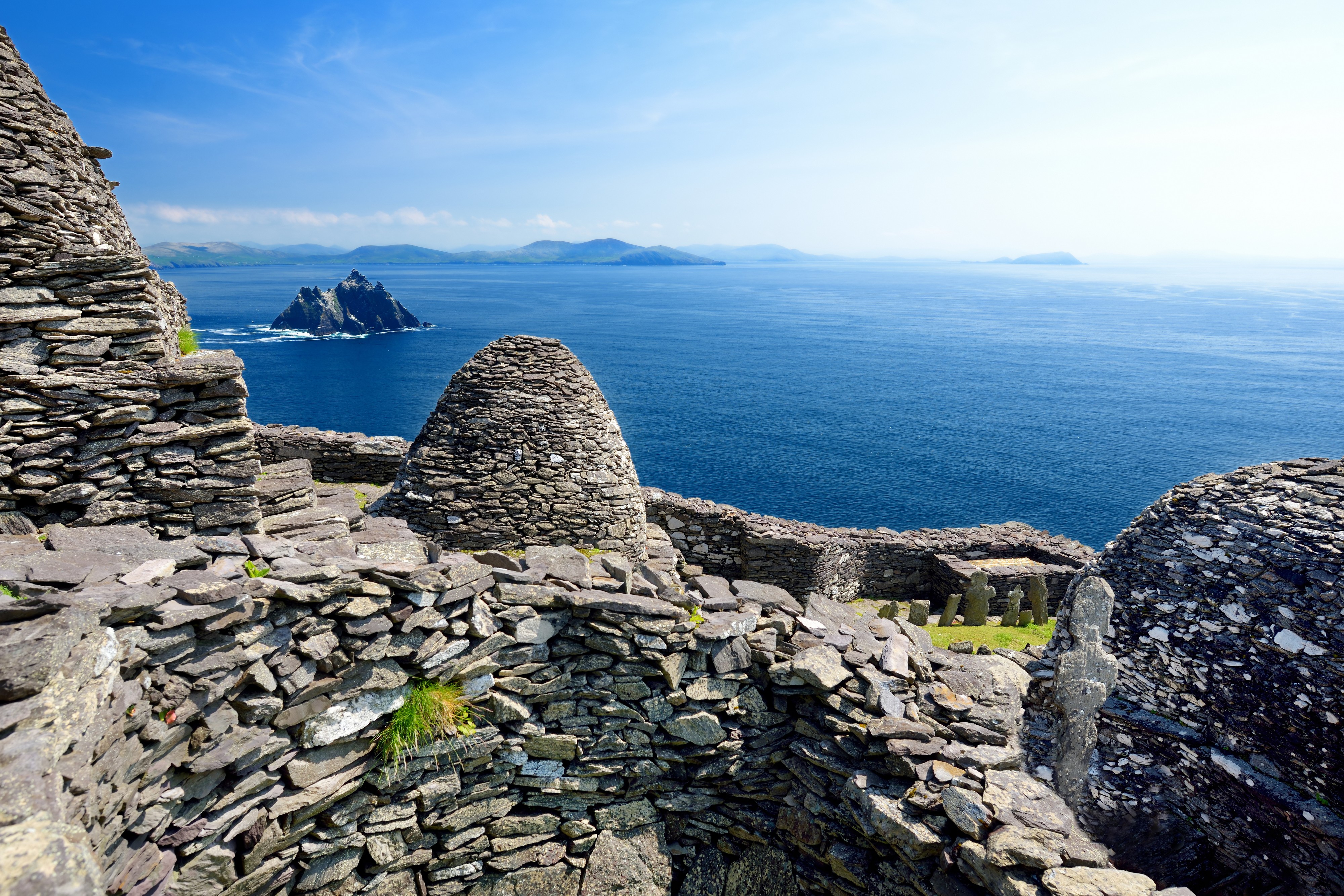
Stone cells suspended above the sea
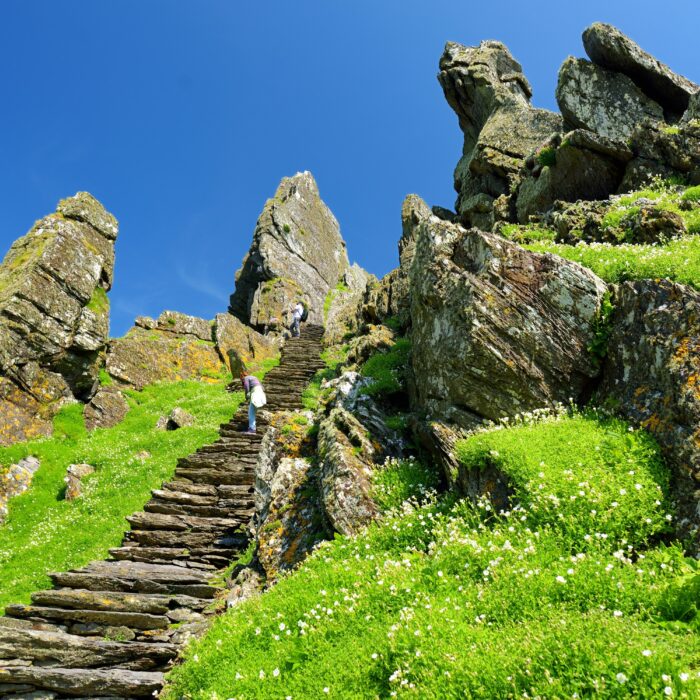
To reach the monastery, visitors must climb 618 ancient steps cut into or assembled from stone. The route rises approximately 180 metres above the ocean and does not always have guardrails.
At the summit, the monastic complex consists of cells, oratories, crosses, gravestones and small terraces. The religious community also created areas for collecting rainwater and growing a few plants.
The most emblematic buildings are the clocháin, dry-stone cells shaped like beehives. Each row of stones projects slightly inward until it closes the structure, without requiring a wooden framework.
These cells are not simply rudimentary piles of stones. Their design helped limit water infiltration and withstand the powerful gusts coming from the Atlantic. More than a thousand years after their construction, several are still standing.
The site also includes a hermitage near the South Peak, in an even more spectacular location. This extremely difficult-to-reach space bears witness to the search for isolation taken to its greatest extreme. It is not open to ordinary visitors.
The monks’ life on Skellig Michael
An austere existence in an extreme environment
The religious community’s daily life is imperfectly known. No detailed account allows us to say with certainty how each day was organised. Descriptions of monks fishing every morning or methodically tending their vegetable gardens are partly reconstructions.
Archaeology nevertheless reveals a remarkably organised community. The monks had dwellings, places of prayer, cisterns and small terraces that could support cultivation. Fishing, collecting eggs and seabirds, and exchanges with the mainland probably contributed to their subsistence.
Wind, dampness, storms and the lack of cultivable land made their existence particularly difficult. Viking raids mentioned in medieval sources added another threat to an already formidable environment.
The monastic community eventually left the island to settle on the mainland, probably at Ballinskelligs, during the 13th century. Skellig Michael was subsequently visited occasionally by pilgrims.
Its exceptional isolation helped preserve its buildings. While many Irish monasteries were altered, rebuilt or destroyed, the one on Skellig Michael has remained frozen above the ocean.
Little Skellig
The inaccessible kingdom of the gannets
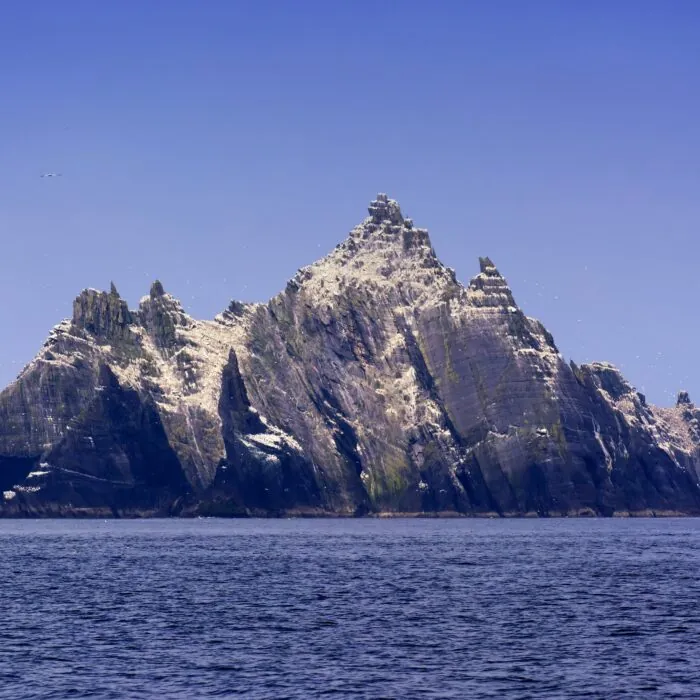
Little Skellig lies between Skellig Michael and the Kerry coast. Smaller in size, it covers approximately 7.8 hectares and has steep sides that plunge almost directly into the ocean.
The island has no monastery and appears never to have supported a permanent human settlement. Its topography, lack of genuinely flat ground and the power of the swell make any landing particularly dangerous.
Little Skellig is best known for its huge gannet colony. Tens of thousands of birds come to breed on its ledges, covering parts of the rock with a white mantle visible from the sea.
It is one of the main breeding sites for this species in Europe and is of international ornithological importance. Little Skellig has been designated a nature reserve since 1988.
Landing there is strictly forbidden. Excursion boats may nevertheless approach it at a reasonable distance when conditions permit. The sight of birds circling the rock is one of the most impressive moments of the crossing.
The birds of the Skellig Islands
Puffins, guillemots and petrels above the ocean
Both islands form part of a special protection area because of the diversity of their seabirds. They are home in particular to gannets, guillemots, fulmars, kittiwakes, European storm petrels and Manx shearwaters.
Atlantic puffins are mainly seen on Skellig Michael. They come to nest there in spring and early summer, using burrows and cavities created in the grassy slopes.
With their colourful bills and awkward walk, puffins have become the island’s natural stars. They nevertheless remain wild animals and must never be touched, fed or chased to obtain a photograph.
Little Skellig, for its part, is dominated by gannets. The concentration of these large white birds explains the astonishingly pale colour the rock can take when viewed from a boat.
The National Parks and Wildlife Service protects the entire Skelligs for their seabird populations. Visitors must remain on authorised routes so as not to damage burrows or disturb nesting.
The Skellig Islands and Star Wars
Luke Skywalker’s refuge at the edge of the galaxy
Skellig Michael’s strange silhouette attracted the attention of the teams behind the Star Wars saga. The island appears at the end of Episode VII, The Force Awakens, and then in Episode VIII, The Last Jedi.
In the films, it represents Ahch-To, a remote planet where Luke Skywalker has withdrawn. The Irish monastic cells directly inspired the dwellings of the fictional community of island caretakers.
Filming took place on Skellig Michael in 2014 and 2015. The shoot prompted discussions concerning the protection of the heritage and birds, as the site is simultaneously a national monument, a nature reserve and a UNESCO-listed property.
The saga’s popularity greatly increased tourist interest in the Skellig Islands. The number of visitors permitted to land each day nevertheless remains limited in order to preserve this exceptional environment.
Visiting the Skellig Islands by boat
Choosing between a landing and a panoramic excursion
Two types of excursions allow visitors to discover the Skellig Islands.
The first involves landing on Skellig Michael. It includes the crossing, docking and approximately 2 hours 30 minutes spent on the island. Visitors can then climb the steps leading to the monastery under the supervision of guides from the Office of Public Works.
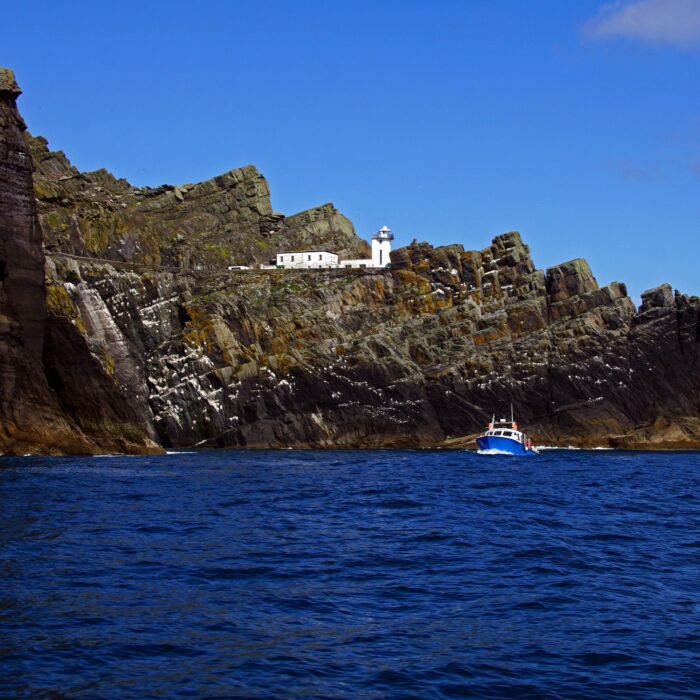
The second option is a panoramic excursion, often called an eco tour. The boat sails around Skellig Michael and Little Skellig without landing. This outing is shorter and better suited to families, people who suffer from vertigo or travellers who do not wish to undertake the ascent.
Boats mainly depart from Portmagee, on the Iveragh Peninsula. Some operators also use other ports in the region. Only authorised companies may organise landings on Skellig Michael.
Access to the monument is free, but the crossing is paid for and booked directly with the boat operator. Prices and cancellation conditions vary between companies.
When to visit the Skellig Islands?
A short season entirely dependent on the weather
For the 2026 season, Heritage Ireland announces that Skellig Michael will open from 12 May until September. The exact closing dates may change depending on the condition of the site and weather conditions.
Outside the official period, the island is unstaffed and landings are prohibited. Non-landing excursions may be offered over a longer season, provided the sea is calm enough.
Even with a reservation, no landing is guaranteed. Wind, swell and visibility may lead to the trip being cancelled on the morning itself. This decision concerns passenger safety and should never be challenged.
Book as early as possible and, if your itinerary allows, plan a replacement day in Kerry. Staying overnight in Portmagee, on Valentia Island or nearby also makes an early departure easier.
The period from May to July is generally the most interesting for observing puffins. Their presence is never guaranteed, however, as migration dates vary from year to year.
Climbing Skellig Michael
A spectacular but physically demanding visit
The climb to the monastery should not be regarded as an ordinary walk. The 618 steps are uneven, sometimes narrow, wet and exposed to the drop. Good physical condition, sure balance and suitable footwear are essential.
People suffering from vertigo, heart conditions, breathing difficulties or mobility problems should carefully assess their abilities before booking a landing.
Young children may be refused by some operators, each of which applies its own safety rules. Parents should check the conditions when booking.
Bring warm clothing, a waterproof jacket, water and a small meal. Umbrellas are useless and potentially dangerous because of the wind. There is no café, shop or public toilet on Skellig Michael.
Visitors must remain on recognised paths, follow the guides’ instructions and take nothing away. The stones, plants and archaeological objects form part of an extremely fragile environment.
Practical information about the Skellig Islands
Location, access and visit duration
Location: offshore from the Iveragh Peninsula, in County Kerry
Main departure port: Portmagee
Distance from the coast: approximately 12 kilometres
Skellig Michael coordinates: 51.7720, -10.5400
Little Skellig coordinates: 51.7820, -10.5090
Access to Skellig Michael: only with an authorised boat operator
Access to Little Skellig: landing prohibited
Time on Skellig Michael: approximately 2 hours 30 minutes, excluding the crossing
Difficulty level: difficult, with 618 steps and exposed sections
Facilities on the island: no shops, shelter or public toilets
SEO information about the Skellig Islands
Title, primary keyword and meta description
SEO title: Skellig Islands: visiting Skellig Michael and Little Skellig


 +
+
 Tourist attractions
 Irish Restaurants and Pubs
 Partner Accommodations
 Campgrounds and Lodging