

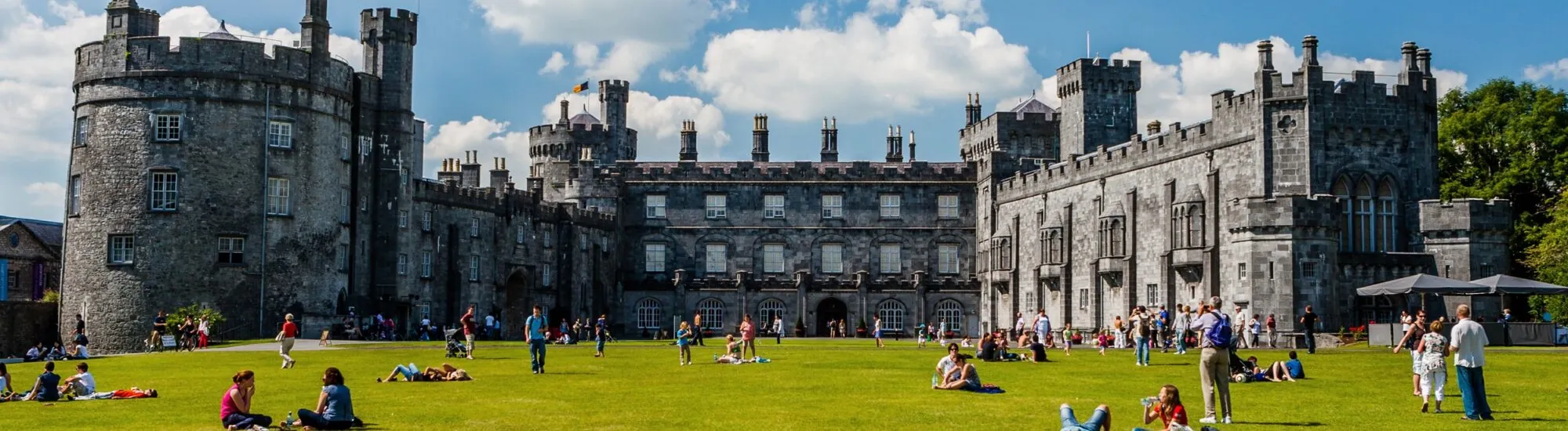
At the heart of the medieval city of Kilkenny, a massive silhouette dominates the banks of the Nore. With its three round towers, state rooms and extensive parkland, Kilkenny Castle is among Ireland’s most remarkable historic monuments.
Built in the early 13th century, this former Anglo-Norman fortress was transformed over successive generations into an elegant aristocratic residence. A visit takes you through almost eight centuries of Irish history, from the earliest Norman conquests to the Victorian era.
Kilkenny Castle occupies a strategic position on high ground overlooking an ancient crossing of the River Nore. Part of the medieval city grew up around its walls, and is now renowned for its narrow lanes, historic houses and religious buildings.
The castle first impresses with its architecture. Its circular towers and thick walls bear witness to its defensive past, while its drawing rooms, bedrooms and picture gallery tell a more refined story: that of the powerful Butler family, who lived here for almost six centuries.
Contrary to what its appearance might suggest, the monument visible today did not remain frozen in the Middle Ages. Extended, remodelled and restored many times, it is a true architectural assemblage, blending medieval heritage, Gothic influences and Victorian décor.
A first wooden fortification is thought to have preceded the present castle. It controlled the crossing of the Nore as well as the trade routes linking Kilkenny with the rest of south-east Ireland.
In the early 13th century, the powerful Anglo-Norman lord William Marshal, Earl of Pembroke, had a stone fortress built. The castle then had four circular towers linked by sturdy curtain walls. Three of these towers still survive today.
Its location was far from accidental. From this elevated position, its occupants could watch the river, defend the city and assert their authority over a particularly coveted territory.
In 1391, the castle was acquired by James Butler, third Earl of Ormond. It then became the Butler family’s principal Irish residence, one of the most influential dynasties in the country’s history.
Earls, marquesses and then dukes of Ormond, the Butlers wielded considerable authority over south-east Ireland. Their closeness to the English Crown enabled them to hold important political and military offices.
For almost 600 years, each generation altered the estate to suit its tastes and the customs of its time. The former medieval fortress gradually lost its military function to become a vast aristocratic home.
The façades were altered, new windows were added and the interiors were redesigned. This succession of transformations explains the architectural richness of the monument today.
At the beginning of the 20th century, maintaining such a vast property became increasingly costly. Political upheaval, changes in Irish society and the family’s financial difficulties hastened the estate’s decline.
In 1935, the Butlers left Kilkenny. The furniture, artworks and part of the collections were dispersed during an auction held over several days. The castle then remained unoccupied for around 30 years.
In 1967, Arthur Butler, sixth Marquess of Ormonde, transferred the castle to the people of Kilkenny for the symbolic sum of £50. This amount gave the transaction legal standing: the monument was not truly sold, but transferred to ensure its preservation.
The castle came under the responsibility of the Irish State in 1969. Major research, conservation and restoration works were then undertaken. The monument was gradually opened to the public from the 1970s onwards.
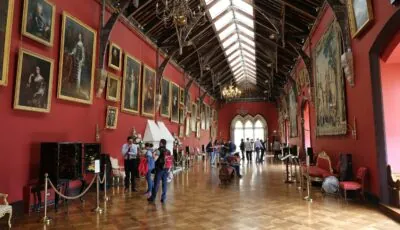
Picture Gallery at Kilkenny Castle – © BOULENGER Xavier
The interior visit reveals less a medieval fortress than a grand aristocratic residence of the 18th and 19th centuries. The principal rooms have been restored to evoke the Butler family’s everyday life, particularly during the 1830s and the Victorian era.
The route takes in the library, drawing room, dining room, nursery and several bedrooms. Wall hangings, tapestries, wood panelling, fireplaces and antique furniture recreate the elegant atmosphere of an Anglo-Irish aristocratic residence.
The entrance hall has a remarkable floor made of black Kilkenny limestone and pale sandstone. Portraits, giant Irish deer antlers and various decorative objects recall the prestige once associated with the estate.
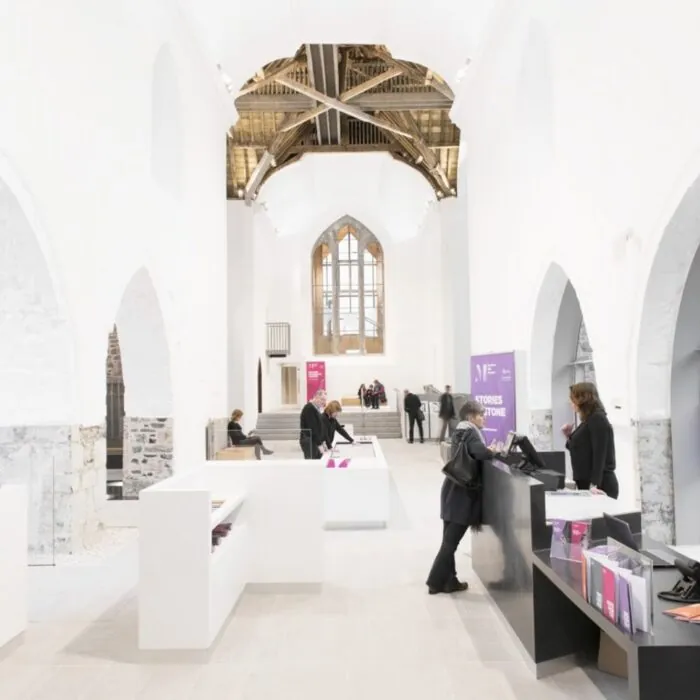
The Picture Gallery, sometimes referred to as the painting gallery, is one of the castle’s most spectacular spaces. Fitted out in the east wing in the 19th century, it was designed to display the Butler family’s painting collection.
Its architecture draws as much attention as the works on display. The room has a long, richly decorated wooden vault, large windows and natural light that enhances the portraits hanging on the walls.
Part of the family collection, acquired by the Irish State in 1994, is now displayed in the castle’s various rooms. These paintings put faces to the people who occupied the place over several centuries.
The experience does not end with the apartments. The castle is surrounded by around 50 acres of parkland, or nearly 20 hectares, which can be accessed free of charge.
In front of the west façade lies a formal garden arranged around a fountain. Its geometric paths and flower beds recall the pleasure gardens created for the estate’s owners.
Further on, the landscape becomes more natural. Lawns, century-old trees, wooded areas and an artificial lake make up a vast walking area right in the city centre. From certain paths, the castle’s three towers rise above the foliage, offering fine views.
The park also includes a playground, picnic tables, orienteering trails and a tearoom. It is particularly pleasant in spring and summer, but retains plenty of charm on misty autumn days in Ireland.
The interior tour generally takes between 35 and 50 minutes. It is nevertheless best to allow around an hour to enjoy the rooms and look at the works without rushing.
A guided tour lasts approximately 45 minutes. A self-guided visit allows you to explore at your own pace and can be accompanied by an audio guide available in French.
With the park, gardens and a break at the tearoom, it is easy to spend two to three hours across the estate as a whole.
The castle stands on The Parade, in Kilkenny’s historic centre. Its location makes it easy to reach on foot from the main shopping streets and the city’s other landmarks.
The ground-floor rooms are accessible to visitors with reduced mobility. Some older sections and upper levels do, however, present architectural constraints. If you have particular requirements, it is best to contact the castle before your visit.
Flash-free photography is generally permitted in the rooms for personal use. Videos, large backpacks and bulky luggage are not allowed in the historic apartments.
Choose a morning visit for a quieter atmosphere, particularly in summer. In mild weather, follow it with a walk in the park or along the Nore: it is from the gardens that the castle’s scale and silhouette are best appreciated.
Kilkenny Castle is far more than a medieval backdrop. Its walls tell the story of a military fortress that became an aristocratic residence, then a national monument open to all.
The austere power of its towers contrasts with the elegance of its drawing rooms and Picture Gallery. Outside, the vast park provides a green escape in the heart of the city.
Whether you are interested in Irish history, architecture or simply places steeped in atmosphere, Kilkenny Castle is an essential stop on a stay in the south-east of the country.
Want to extend your visit without having to rush around? Here are a few well-located places to stay near the must-see attractions.
Essential information to help you plan your visit, including key landmarks, access information, and booking options.
The Parade, Collegepark, Kilkenny, County Kilkenny, Republic of Ireland, Tourist sites in Ireland
52.650459, -7.249287
These opening hours may change for ceremonies, works or public holidays. It is therefore advisable to check the official Kilkenny Castle website before travelling.
The park opens each morning at around 8.30am or 9am, depending on the season. Its closing time varies considerably throughout the year, from 4.30pm in winter to 8.30pm during the long summer days.
Check the opening hours and admission requirements before you leave, especially during peak season or on Irish public holidays.
During the summer season, some guided tours have separate prices:
Access to the park and gardens is free. During high season, the castle can be very busy: booking through the official ticket office makes it easier to plan your visit. The site also states that no third-party reseller is authorised to sell its tickets.