Beside Kilkenny railway station, stone buildings now form part of the MacDonagh Junction shopping centre. In the 19th century, they belonged to the Kilkenny Union Workhouse, an institution where people without means came in search of shelter and food. The Kilkenny Famine Experience explores this history through an audiovisual trail. The contrast between the site’s present-day use and the admission records makes for a particularly moving visit. You pass through a place used every day, following in the footsteps of people whose lives are sometimes known only through a few lines in a register.
The term workhouse refers to a relief institution established under the Poor Law. In Ireland, the 1838 Act organised this system into districts known as Poor Law Unions. The workhouse took in people who could no longer provide for themselves. This assistance came with institutional discipline, and residents were separated by age and sex, which could divide families. The term “poorhouse” gives a useful sense of the place’s function, provided the admission rules and obligations attached to this relief are kept in mind.
The Great Famine placed these institutions under considerable pressure. In Kilkenny, the visit offers a view of the crisis at the scale of a town and its district. How did people come to be here? Who decided on admission? What can be known about the daily lives of those taken in? The stories along the trail begin with these practical questions. The workhouse then emerges as a stopping point in lives often already disrupted by poverty, distance or the loss of loved ones.
One of the stories highlighted by MacDonagh Junction follows John and Patrick Saul. The two brothers were admitted to the workhouse in 1841, before the Great Famine began. The trail recounts that they had been abandoned on the quays in Dublin and were attempting to walk back to Clonmel. Their story helps place the institution’s role in context before the food crisis transformed the scale of need. It also shows how an admission register can preserve the trace of a journey, a sibling bond and an administrative decision, even when what happened next remains difficult to establish.
In 2005, excavations connected with the redevelopment of the site revealed a former burial ground near the workhouse buildings. Archaeologist Jonny Geber documents the remains of at least 970 people in his study published by the Kilkenny Archaeological Society. The burials examined date from the period 1847–1851. This precision matters. Archaeology establishes a minimum number of people buried and places the burials in time. The causes of death and individual life stories require other evidence.
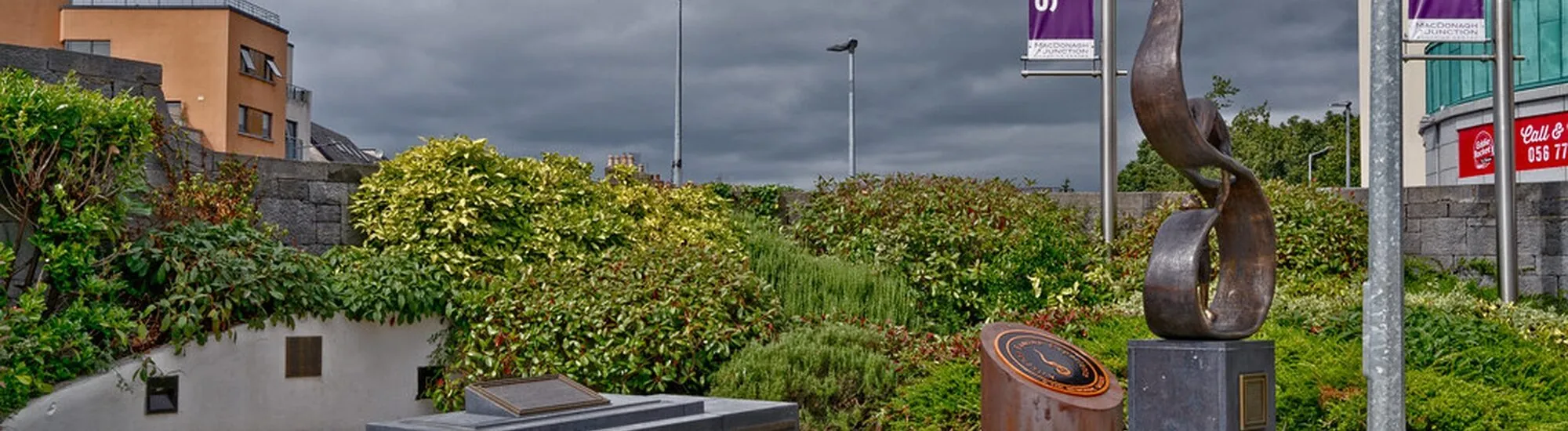
During the visit, the garden of remembrance offers a moment to pause over this history. The memorial conveys the scale of what was discovered, while the trail explains the connection between the burials and the institution. Allow a few minutes for this stop if you are visiting as a family. With children, it can be helpful to explain beforehand that the visit addresses poverty, family separation and death. Each person’s age and sensitivity matter more than the trail’s duration alone.
The fact that the trail takes place in a shopping centre changes the way the site is experienced. Between stops, take time to distinguish the preserved buildings from more recent additions. Return to the map or trail information if the flow of visitors makes you lose your bearings. The recorded stories and the places complement one another. The former provide names and dates; the latter help explain how the workhouse buildings fitted into this part of the town.
The trail is self-guided and lasts around 50 minutes. The venue indicates that it begins near the self-service gift card kiosk inside the shopping centre. Book a time slot through the ticketing service indicated by MacDonagh Junction. Trail times differ from shop opening hours. If you are arriving by train, Kilkenny railway station is right next door. From the historic centre, follow John Street uphill towards the station and look for the MacDonagh Junction name. Once inside, look for the trail’s starting point rather than the entrance to a separate museum.
To plan half a day in Kilkenny, you can combine the visit with the Medieval Mile Museum or the castle. Allow an hour for the trail, plus a little extra time before your next booking. The former workhouse offers another perspective on the town: that of the people who entered the archives because they needed help.
Want to extend your visit without having to rush around? Here are a few well-located places to stay near the must-see attractions.
Essential information to help you plan your visit, including key landmarks, access information, and booking options.
Hebron Road, MacDonagh Junction Shopping Centre, Kilkenny, County Kilkenny, Republic of Ireland, Tourist sites in Ireland
52.6552, -7.2434
Time slots are listed on Mondays and from Thursday to Sunday, between 9.30 am and 4.30 pm. Closed on Tuesdays and Wednesdays. Book a time slot through the ticketing service indicated by MacDonagh Junction.
Check the opening hours and admission requirements before you leave, especially during peak season or on Irish public holidays.
€5 per person according to Visit Kilkenny. Check the final price on the ticketing service when booking.