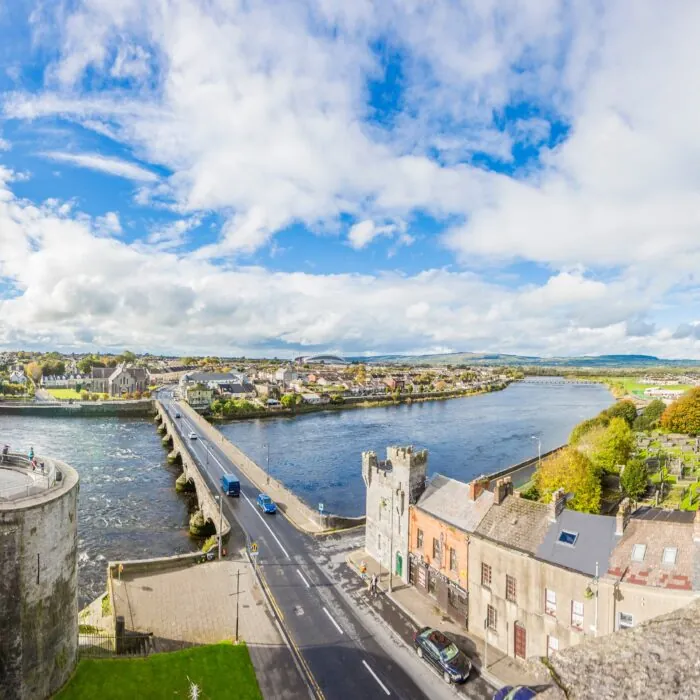


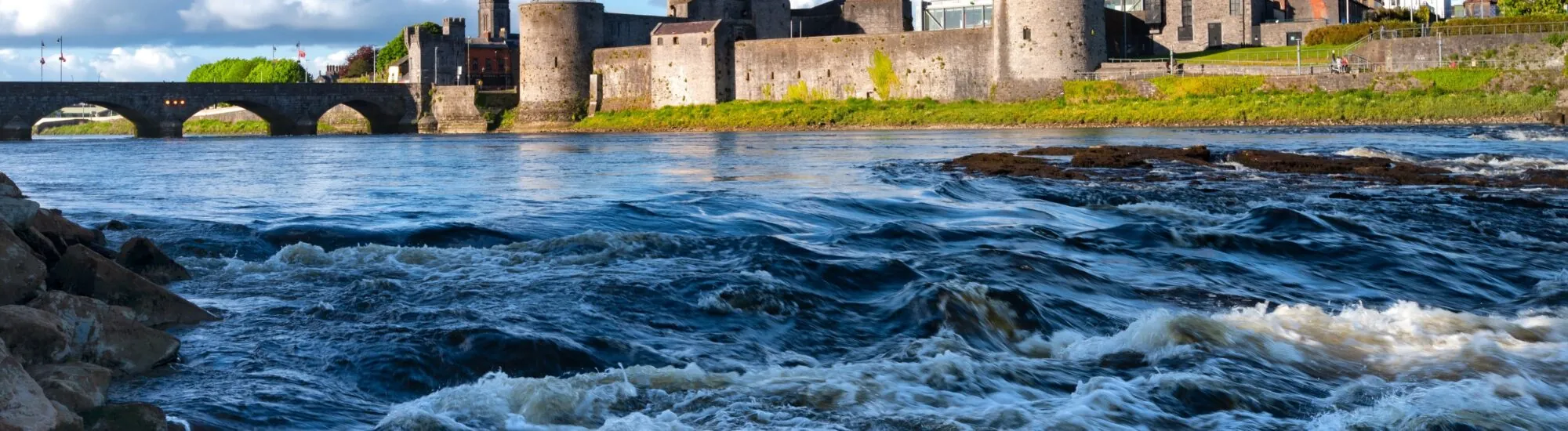
Built on the banks of the Shannon in the heart of Limerick, King John’s Castle is one of Ireland’s most impressive medieval fortresses. Its walls, massive towers and location on King’s Island bear witness to more than 800 years of history.
King John’s Castle now houses an interactive exhibition devoted to the Anglo-Norman conquest, the major sieges of Limerick and daily life in the Middle Ages. Visitors can also explore the courtyards, towers and ramparts, with fine views over the Shannon and the medieval quarter.
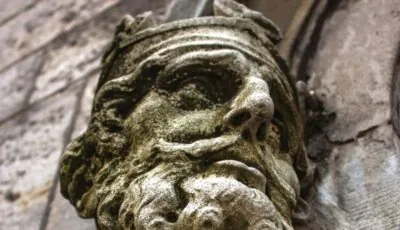
Brian Boru – J.-H. Janßen – CC
Long before the present castle was built, King’s Island already held a strategic position. Vikings settled in Limerick at the beginning of the 10th century and developed a trading settlement protected by earthwork fortifications and ditches.
This settlement enabled them to control navigation on the Shannon and trade with inland Ireland. At the time, Limerick maintained trading links with other Viking towns in Ireland and Europe.
At the end of the 10th century, the Vikings of Limerick were defeated by the Dál gCais. Brian Boru seized the town and incorporated it into his territory, several decades before becoming High King of Ireland.
The Anglo-Normans took lasting control of Limerick in 1195. A few years later, King John of England, also known as John Lackland, ordered the construction of a fortress to protect the town and assert the authority of the Crown.
Work began around 1200, and the castle was largely completed by about 1210. Its location allowed it to oversee the crossing of the Shannon, the port, Thomond Bridge and access to the medieval town.
The castle was designed around a large courtyard defended by strong walls, a fortified gate and several corner towers. Its thick walls could withstand the siege weapons of the period, while its towers gave soldiers clear views of the surrounding area.
King John did not live in the fortress, but it retained his name. It became one of the main symbols of Anglo-Norman power in western Ireland.
Contrary to what is sometimes written, Limerick endured not five but four major sieges in the 17th century: in 1642, 1651, 1690 and 1691. King John’s Castle played a major role in these confrontations, although the fighting involved the entire fortified town.
The first siege took place during the Irish Confederate Wars. Protestant settlers took refuge in King John’s Castle while Irish Catholic forces took control of the town.
The besiegers began digging beneath the walls to threaten their foundations. After several weeks of resistance, the castle’s occupants eventually surrendered. Part of the fortifications was badly damaged during the fighting.

Oliver Cromwell – Public domain
In 1651, Limerick was besieged by the Parliamentary army commanded by Henry Ireton, Oliver Cromwell’s son-in-law. Cromwell had already left Ireland and therefore did not personally lead the siege of the town.
Limerick held out for several months, protected by its walls, the Shannon and the fortifications of King’s Island. Hunger, disease and internal divisions nevertheless weakened the defenders. The town capitulated in October 1651.
Henry Ireton died shortly afterwards, probably from an infectious disease contracted during the campaign. The Parliamentary victory strengthened English control over Limerick and led to harsh reprisals against some of the leaders of the resistance.
The third siege took place during the Williamite War, which pitted supporters of the Catholic king James II against those of the Protestant king William III of Orange.
In 1690, the Williamite army attempted to capture Limerick, which had become one of the main Jacobite strongholds in Ireland. Despite bombardment and a breach in the defences, the assaults were repelled after fierce fighting in the streets.
A lack of supplies and the arrival of poor weather eventually forced William III to lift the siege. This resistance earned Limerick a reputation as a particularly difficult town to conquer.
The Williamite forces returned in 1691 with a better-equipped army. After several weeks of siege and the Jacobite defeat at the Battle of Aughrim, the defenders’ position became increasingly untenable.
Limerick negotiated its surrender rather than endure another general assault. The Treaty of Limerick was signed in October 1691, bringing the main Jacobite resistance in Ireland to an end.
Tradition associates this agreement with the Treaty Stone, visible on the other side of the Shannon. After the capitulation, many Irish soldiers left the country to serve in European armies. This exile is known as the « Flight of the Wild Geese ».
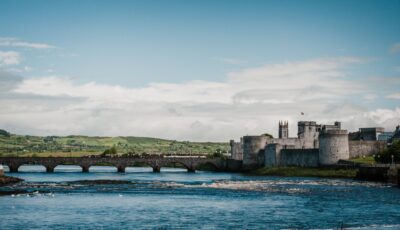
King John’s Castle – Marion Wacker – CC
The visit begins with an exhibition tracing the history of Limerick from its Viking settlement to the major conflicts of the 17th century. Three-dimensional models, animations and interactive displays explain the construction of the fortress and the development of the town.
The tour also explores daily life in the Middle Ages. It presents the role of the soldiers, craftspeople and residents who lived around the castle, as well as the techniques used to defend or attack a stronghold.
The visit continues in the courtyard, at the foot of the walls and towers. Several areas offer a closer look at the castle’s military architecture, narrow passageways, staircases and defensive positions.
The ramparts offer remarkable views over the Shannon, Thomond Bridge and the rooftops of Limerick. Some sections do, however, feature steps and uneven surfaces, typical of a medieval fortress.
Archaeological excavations carried out on the site have uncovered features dating from before or during the castle’s earliest phases. The tour includes the foundations of buildings, old walls and various traces of medieval occupation.
These remains show that King John’s Castle was not an isolated monument. It formed part of an urban complex of houses, workshops, streets, fortified gates and ramparts protecting English Town, Limerick’s Anglo-Norman quarter.
The castle was altered several times to adapt to new military techniques. The arrival of artillery and the sieges of the 17th century led, in particular, to changes to some of its defences.
King John’s Castle is particularly well suited to families. The interactive displays make the explanations accessible to younger visitors without diminishing the historical interest of the visit for adults.
Depending on the programme, costumed characters, demonstrations or activities may be offered in the courtyard. Children can discover the handling of medieval weapons, traditional crafts and the strategies used during sieges.
Allow around one to one and a half hours to explore the entire castle. Visitors wishing to read all the information and spend more time on the ramparts may want to allow longer.
The sieges, destruction and many deaths associated with the history of Limerick have naturally encouraged the emergence of ghost stories. Some tales mention a headless soldier, a lady dressed in grey or unexplained noises in the towers.
These figures are not, however, documented in the castle’s official historical sources. Stories of apparitions, doors closing by themselves or prisoners haunting a guardroom therefore belong to contemporary folklore rather than established fact.
The same applies to the story that plague-ridden bodies were catapulted into the castle during the siege of 1691. No reliable historical source confirms this episode, which should not be presented as fact.
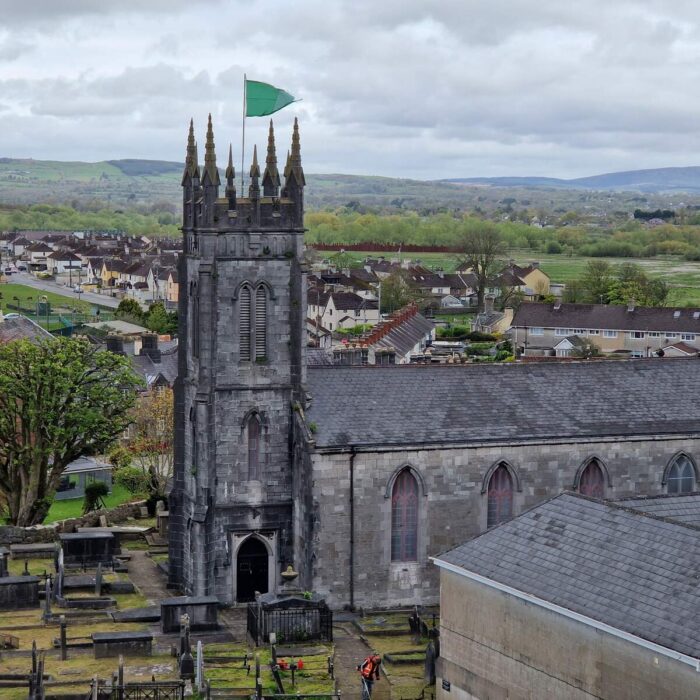
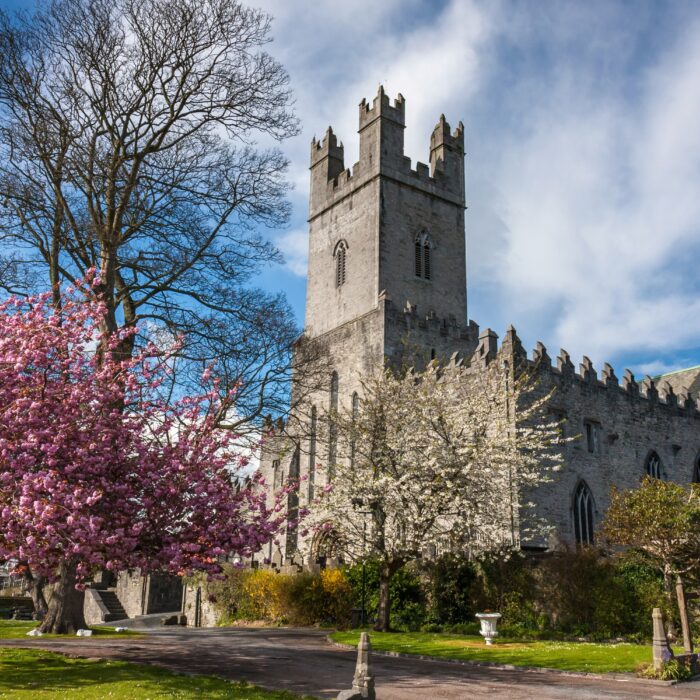
King John’s Castle stands at the heart of Limerick’s historic quarter. A few minutes’ walk away, St Mary’s Cathedral, founded in the 12th century, retains several remarkable medieval features.
On the other side of Thomond Bridge stands the Treaty Stone, associated with the signing of the Treaty of Limerick in 1691. The banks of the Shannon also offer fine views of the castle’s towers and walls.
Your visit can be rounded off with a walk through Limerick city centre, a visit to the Hunt Museum or a stop at the Milk Market, one of the city’s most popular covered markets.
Essential information to help you plan your visit, including key landmarks, access information, and booking options.
52.669708, -8.625511
1h30
Allow around 1 hour 30 minutes to explore the exhibition, courtyards, towers and ramparts. Exceptional closures may occur during the end-of-year holidays or for events held at the castle.
Check the official opening hours for King John’s Castle before your visit.
Check the opening hours and admission requirements before you leave, especially during peak season or on Irish public holidays.
The ticket includes admission to the castle, interactive exhibitions, medieval games in the courtyard and the ramparts. Family prices are calculated according to the number of children selected when booking.
As prices may change, check the official King John’s Castle ticket office before booking.