
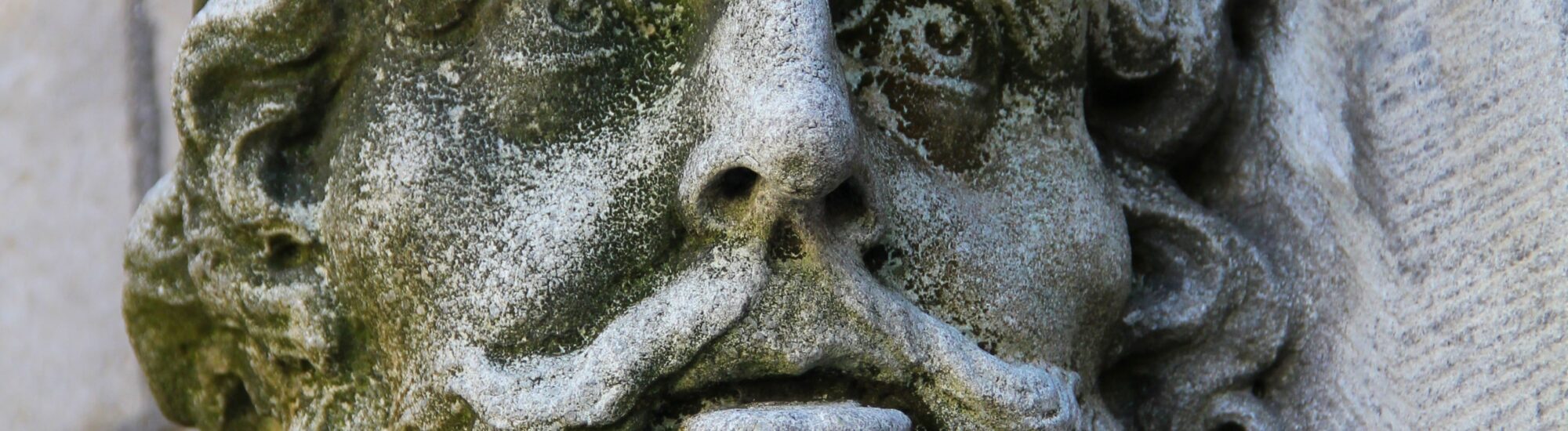
In 11th-century Ireland, power was not exercised from a single capital. The island was divided among a multitude of kingdoms, rival dynasties and Norse towns that had become important trading centres. It was in this shifting political landscape that Brian Boru, one of the most famous rulers in Irish history, emerged.
King of Munster and later High King of Ireland, Brian Boru gradually imposed his authority over much of the island. His life reached its climax in 1014 at the Battle of Clontarf, won by his army but in which he lost his life. A thousand years later, he remains surrounded by a powerful national legend, sometimes far removed from historical reality.
Brian Boru – J.-H. Janßen – cc
Brian Boru is thought to have been born around 941 near Killaloe, on the banks of the Shannon in present-day County Clare. His exact date of birth remains unknown.
He was one of the many sons of Cennétig mac Lorcáin, king of the Dál gCais and Tuadmumu, a territory roughly corresponding to northern Munster. His mother, Bé Binn, came from a royal family in Connacht.
Contemporary sources refer to him chiefly as Brian mac Cennétig, meaning ‘Brian, son of Cennétig’. The form Brian Bóruma, anglicised as Brian Boru, appears to have become established after his death.
The epithet may refer to Béal Bóruma, a fortification near Killaloe, or to the ancient term bóruma, denoting a tribute paid in cattle. Its meaning remains debated.
In Brian Boru’s time, Ireland was not a unified state in the modern sense. The island had a great many local kings, themselves under the influence of regional rulers. At the top of this hierarchy stood the ard rí, or High King of Ireland.
The title did not confer absolute power over the entire territory. The High King had to secure the submission of other rulers, receive their hostages or tributes, and continually defend his authority. Alliances, marriages and military campaigns played a decisive role.
The Scandinavians who had settled in Ireland since the Viking Age had gradually become integrated into this society. They ruled Dublin, Limerick and Waterford in particular, traded with Gaelic communities and took part in local conflicts. They could be enemies in one battle and allies in the next.
The rise of Brian’s family was initially led by his elder brother, Mathgamain. In 968, the two men won the Battle of Sulcoit against the forces of Ímar, the Norse king of Limerick. The town was then captured and plundered.
Mathgamain became king of Munster, but was assassinated by Irish rivals in 976. Brian succeeded him as leader of the Dál gCais and set out to avenge his death.
In 977, his troops attacked Ímar of Limerick and his sons on Scattery Island. The following year, Brian defeated Máel Muad mac Brain, one of those chiefly responsible for Mathgamain’s death. This victory enabled him to establish himself as king of Munster around 978.
His rise to power was therefore not simply the result of a war between the Irish and the Vikings. Brian also fought rival Gaelic dynasties and repeatedly relied on Norse forces.
Once his authority was established in Munster, Brian gradually extended his influence into Leinster, Connacht and the kingdom of Mide. This expansion brought him into conflict with Máel Sechnaill mac Domnaill, a member of the powerful Uí Néill dynasty and High King of Ireland.
The two rulers fought for several years, using both their land armies and fleets capable of travelling up the Shannon. Brian understood the strategic importance of rivers and port towns. His military skill lay as much in logistics and alliances as in battle itself.
In 997, Brian and Máel Sechnaill reached an agreement. Brian gained recognition of his authority over southern Ireland, while Máel Sechnaill retained control of the north. This division did not, however, end their rivalry.
In 999, Brian’s forces faced a coalition bringing together the king of Leinster, Máel Mórda, and the Norse king of Dublin, Sitriuc mac Amlaíb, better known as Sigtrygg Silkbeard.
Brian won a decisive victory at the Battle of Glenn Máma, probably fought near present-day Dublin. He then entered the town and imposed his rule on its leaders.
Rather than destroying Dublin’s Scandinavian power, Brian chose to incorporate it into his network of alliances. He married Gormlaith, Sigtrygg’s mother and the sister of the king of Leinster, while one of his daughters married Sigtrygg.
These marriages illustrate how permeable the boundaries between Gaelic and Norse families had become by the early 11th century.
In 1002, not 1003, Máel Sechnaill finally recognised Brian’s supremacy at Athlone. Brian Boru then became High King of Ireland, ending several centuries in which the Uí Néill dynasties had dominated the office.
His authority was never undisputed, however. The rulers of the north of the island long resisted his claims. Brian continued to lead many campaigns to secure their submission and have his status recognised.
In 1005, he travelled to Armagh, the major religious centre associated with Saint Patrick. There, he made an offering of gold and acknowledged the city’s ecclesiastical pre-eminence. An entry in the Book of Armagh calls him Imperator Scottorum, generally translated as ‘emperor of the Irish’ or ‘emperor of the Gaels’.
Tradition often portrays Brian Boru as the restorer of monasteries and libraries destroyed by the Vikings. This image needs qualification. It is based in part on the Cogad Gáedel re Gallaib, an account composed several generations after his death to glorify Brian and his descendants.
Brian probably supported religious institutions and used his relationship with the Church to reinforce his legitimacy. He attached particular importance to the centres of Armagh, Cashel and Killaloe.
It would nevertheless be excessive to credit him with a vast personal programme of building monasteries and libraries without precise archaeological or documentary evidence.
At the beginning of the 1010s, Brian’s authority weakened. Máel Mórda, king of Leinster, and Sigtrygg Silkbeard, king of Dublin, rebelled against his rule. They called on warriors from Orkney and the Isle of Man, including the troops of Sigurd Hlodvirsson and Bróðir.
Brian, for his part, assembled men from Munster, contingents from Connacht and several allies, including fighters of Scandinavian origin.
The Battle of Clontarf was therefore not a straightforward confrontation between an Irish army and Viking invaders. It pitted two coalitions combining Gaelic and Norse forces, united by political and dynastic interests.
The battle took place on 23 April 1014, Good Friday, near Clontarf, north of Dublin. At around 73 years old, Brian probably did not personally lead the troops on the battlefield. Operational command was notably entrusted to his son Murchad.
After a day of particularly violent fighting, the forces of Dublin and Leinster were driven back. Some of the fighters tried to reach their ships or return to Dublin, but many were killed or drowned because of the tide.
The victory came at a very high cost to Brian’s side. His son Murchad and grandson Toirdelbach died, along with several allied leaders. Máel Mórda of Leinster and Sigurd of Orkney were also killed.
Brian Boru was killed during or immediately after the battle. According to the traditional account, the Scandinavian warrior Bróðir found him praying in his tent before murdering him.
Medieval sources, however, offer differing versions of his death. Some show him praying away from the fighting, while others credit him with a final armed resistance. It is therefore impossible to reconstruct the scene with absolute certainty.
His body was taken to Armagh, where he is said to have been buried with honours in the religious precinct associated with Saint Patrick. A plaque and a statue now commemorate this tradition at the Church of Ireland’s St Patrick’s Cathedral.
The Battle of Clontarf was long told as the Irish people’s final victory over the Vikings. This interpretation, popularised by medieval accounts and later by the nationalism of subsequent centuries, does not fully reflect reality.
By the time of Clontarf, Scandinavians had been settled in Ireland for more than two centuries. They had married into Irish families, adopted Christianity and participated fully in the island’s political and economic life.
Dublin did not disappear after the battle. Sigtrygg Silkbeard retained his throne, and the town remained an important Norse-Gaelic centre. Brian himself had repeatedly allied with Scandinavian rulers and warriors.
Above all, Clontarf was a war for control of Leinster and Dublin, part of a wider struggle for supremacy among the Irish kingdoms.
The deaths of Brian, his son and his grandson prevented his dynasty from fully benefiting from the victory. Máel Sechnaill resumed the title of High King after the battle, while Ireland quickly returned to its fragmented political balance.
Brian Boru therefore did not found a centralised and lasting Irish kingdom. His reign nevertheless showed that a ruler from outside the Uí Néill could impose his authority over most of the island.
His descendants formed the Uí Briain dynasty, which became the O’Brien family. It retained considerable influence in Munster and the kingdom of Thomond for several centuries.
One of the most famous objects associated with the ruler is ‘Brian Boru’s harp’, held at Trinity College Dublin. Despite its name, the instrument cannot have belonged to the king.
The harp dates from the 14th or 15th century, around four centuries after Brian’s death. Its association with the ruler is a later tradition, attested several centuries after Clontarf.
The instrument is nonetheless central to Irish history. Its outline served as the model for Ireland’s official emblem and appears, in particular, on the country’s euro coins.
Over the centuries, Brian Boru became a symbol of an Ireland capable of uniting in the face of an external threat. Heroic accounts emphasised his courage, piety, military intelligence and sacrifice at Clontarf.
This legacy combines established facts, texts of dynastic propaganda and later legends. The real Brian was less a national liberator in the modern sense than an ambitious medieval ruler, using war, marriages, tributes and diplomacy to build his supremacy.
It is precisely this tension between history and legend that makes his story so fascinating.
Killaloe is the main starting point for discovering Brian Boru’s world. The ruler grew up in this strategic region, where the Shannon leaves Lough Derg.
North of the town lie the remains of Béal Ború, an ancient ringfort traditionally associated with Brian and the Dál gCais dynasty. The site is freely accessible, but the ground can be wet and uneven.
St Flannan’s Cathedral and the banks of the Shannon also offer a better understanding of Killaloe’s religious and geographical importance. Historical panels in the town recount several episodes connected with the ruler and his descendants.
The modern district of Clontarf has no clearly identifiable battlefield remaining. The shoreline and the mouth of the Tolka have been profoundly altered since 1014.
Several plaques, sculptures and street names nevertheless recall the battle. The statue of Brian Boru outside the Royal Marine Hotel is one of the district’s main memorials.
The Church of Ireland’s St Patrick’s Cathedral in Armagh commemorates the place where Brian Boru is said to have been buried in 1014. A plaque stands inside the building, and a statue of the king was installed in the grounds in 2014.
In 2026, the cathedral is usually open from Monday to Saturday, from 9 am to 5 pm between April and September. From October to March, it opens from Tuesday to Saturday, from 9 am to 1.30 pm. Admission costs £5 per adult and £4.50 at the reduced rate, and is free for children. Opening hours may change during services and religious events.
Between the 11th-century ruler and the hero shaped by Irish memory, Brian Boru remains the man who dared to challenge the political order of an entire island.