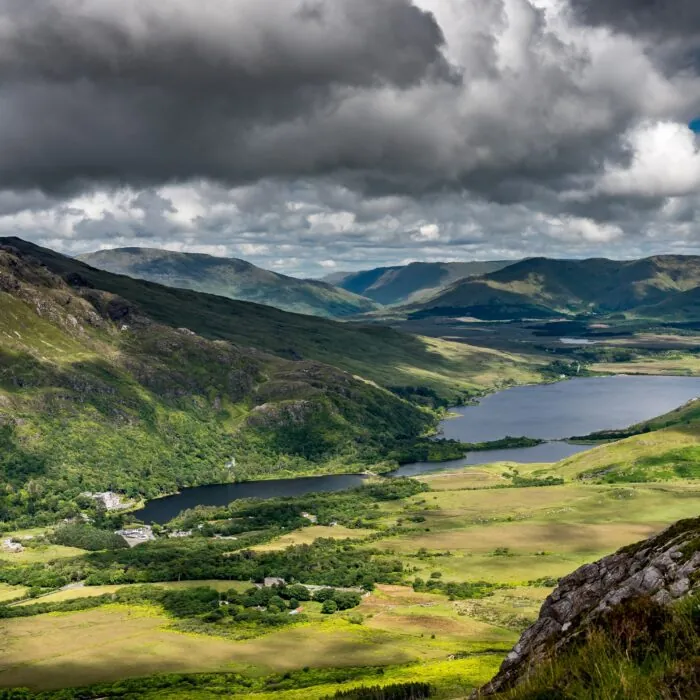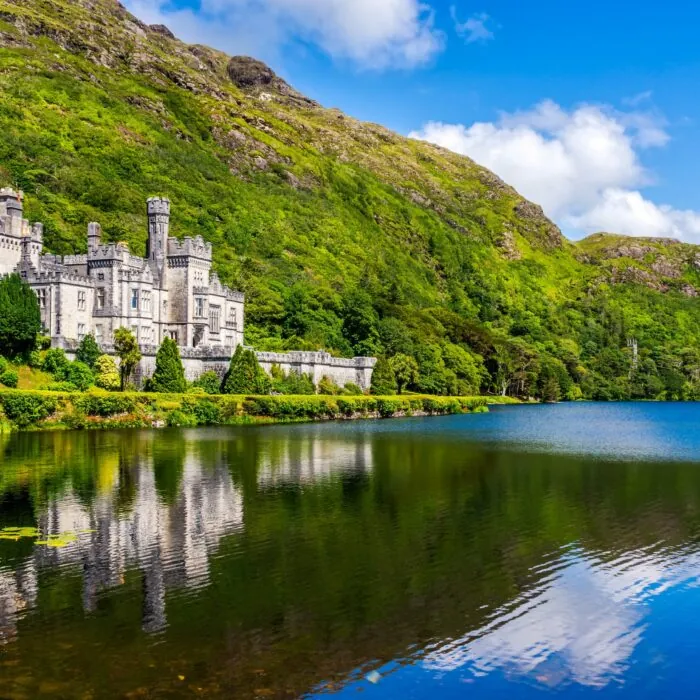

Kylemore Abbey is a Benedictine abbey based in the former Kylemore Castle in the heart of Connemara since 1920. The site remains home to a community of nuns who continue a tradition founded on prayer, education, hospitality and the preservation of this remarkable estate in County Galway.
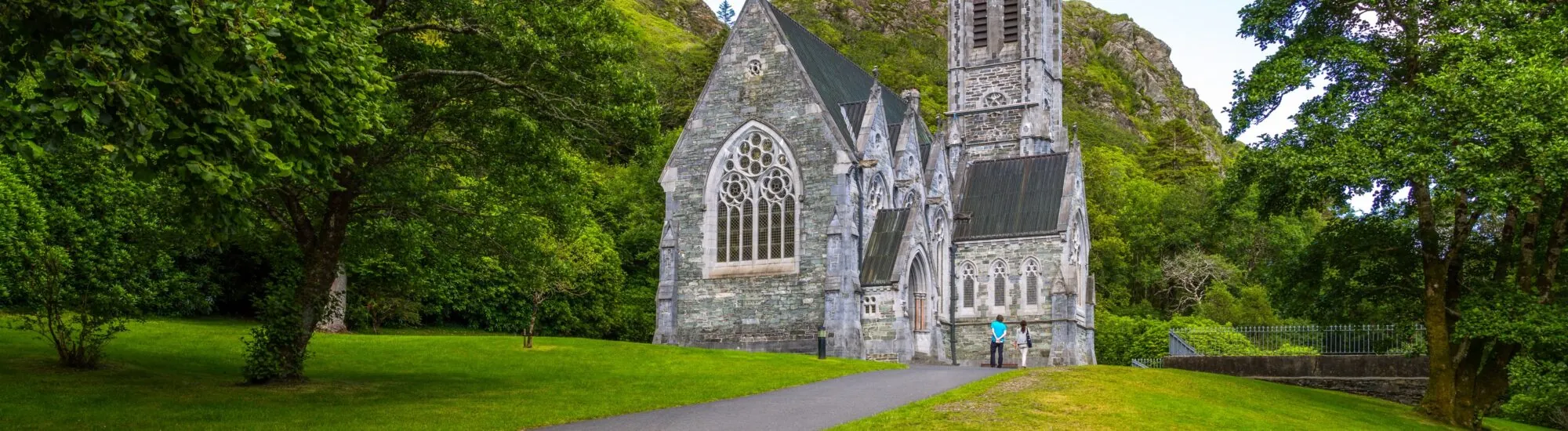
One common misunderstanding should be cleared up: Kylemore Abbey does not refer solely to the small ‘miniature cathedral’ visible beside the lake. That building is Kylemore’s neo-Gothic church, built by Mitchell Henry in memory of his wife, Margaret. The abbey refers to the Benedictine community and the former Victorian castle that became its home. A new monastery, opened in 2024, now houses the nuns near the visitor centre.
Kylemore Abbey – © Felipe Garcia
The estate’s history began long before the Benedictines arrived. From 1867, Mitchell Henry built an immense neo-Gothic residence on the shores of Lough Pollacapall. A doctor, industrialist and future Member of Parliament for County Galway, he intended to establish his family there and develop a model estate in a region still deeply marked by the Great Famine.
The castle was designed by the Irish architects James Franklin Fuller and Samuel Ussher Roberts. It had more than 70 rooms, including 33 bedrooms, several drawing rooms, a library, a ballroom and numerous staff areas.
This early period, the building’s architecture and the life of the Henry family are explored in detail in our article on Kylemore Castle.
After the Henrys left, the property was sold in 1903 to the ninth Duke of Manchester and his wife, Helena Zimmerman. However, the couple’s spending and financial difficulties led to a further sale. The estate then passed into the hands of businessman Ernest Fawke before being acquired by a community of Benedictine nuns in 1920.
It was with their arrival that Kylemore Castle became Kylemore Abbey. The change of name did not therefore correspond to the construction of an abbey beside the castle: it marked the conversion of the former family residence into a religious house.
The Benedictine nuns who arrived at Kylemore had a history far older than the Connemara abbey. Their community was founded in Ypres, Belgium, in 1665. At a time when Catholics faced significant restrictions in Ireland, it welcomed Irish nuns and young girls.
The monastery was officially placed under the protection of the Irish nation in 1682. At the request of King James II, the nuns briefly settled in Dublin in 1688. They returned to Ypres, however, after the monarch’s defeat at the Battle of the Boyne in 1690.
For more than two centuries, the ‘Irish Dames of Ypres’ led lives dedicated to prayer and education in Belgium. Their monastery notably welcomed the daughters of Irish Catholic families living on the continent.
The First World War disrupted this way of life. In 1914, the Abbey of Ypres was destroyed during the fighting. The nuns had to flee Belgium, first finding refuge in England and then at Macmine in County Wexford.
Seeking a new permanent home, they acquired Kylemore Castle. On 4 December 1920, exactly 46 years after Margaret Henry’s death, the community arrived in Connemara and transformed the castle into a Benedictine abbey.
The Benedictines organise their lives according to the Rule of Saint Benedict, written in the 6th century. It brings together prayer, work, community life, study and the welcome offered to visitors. The Latin motto Ora et labora, generally translated as ‘pray and work’, sums up this balance without conveying the full richness of the Benedictine tradition.
Since their arrival, the nuns have played an essential role in preserving the estate. They have maintained the castle, restored the neo-Gothic church, revived the Victorian Walled Garden and developed a tourism activity that helps fund the site and support local employment.
The community also produces chocolates, soaps, candles and various craft items. Jams, pastries and other preparations associated with Kylemore recipes continue a tradition of hospitality developed over the decades.
Kylemore Abbey is now owned by the Kylemore Trust, a non-profit organisation run by the Benedictines. Income generated by visits, catering and the shop contributes to the preservation of the estate, as well as the community’s spiritual, educational and social activities.
Education holds a central place in the history of the Benedictines at Kylemore. The nuns opened a school in the first years after their arrival. Officially known as Scoil Áine from 1923, it welcomed boarders as well as pupils from the surrounding area.
Over the course of the 20th century, Kylemore Abbey School gained an international reputation. Girls from Ireland, Europe, Asia and the United States attended the school. Life at the institution combined academic teaching, artistic activities, sport, religious practice and exploration of the estate.
Falling pupil numbers, rising maintenance costs and a decline in the number of teaching nuns gradually weakened the school. Its final pupils sat their examinations in June 2010, before it closed permanently.
There is therefore no longer a girls’ secondary school at Kylemore Abbey in 2026. Part of the visitor route presents photographs, objects and testimonies tracing almost 90 years of education on the estate.
The closure of the school did not bring Kylemore’s educational mission to an end. The community formed a partnership with the American University of Notre Dame, based in Indiana.
Since 2016, the Notre Dame Kylemore Global Centre has welcomed students, teachers and researchers. Seminars, university programmes and interdisciplinary meetings are held there in an environment particularly suited to study and reflection.
This cooperation allows Kylemore to continue its educational tradition while adapting it to contemporary realities. It also strengthens the historic links between Ireland, Europe and North America.
For much of the 20th century, the nuns lived in different parts of the former castle. The closure of the school and the reorganisation of the building subsequently led them to occupy several dwellings scattered across the estate.
The construction of a permanent monastic home then became a priority. The new Monastery of the Immaculate Conception was completed and blessed on 17 August 2024 by the Archbishop of Tuam, Francis Duffy.
The project brings together a monastery, an educational centre and spaces dedicated to spiritual retreats. It allows the nuns to return to communal life in a building suited to their needs, while further developing their mission of welcome.
This opening holds particular importance in the country’s religious history. The new complex is described as the first enclosed women’s monastery built in Ireland in almost 400 years.
The monastery itself is the community’s private living space and cannot be visited as a tourist attraction. Visitors and worshippers may, however, enter the monastic church for Mass, Vespers and certain events.
The community welcomes visitors to its monastic church, located near the estate entrance. Except for changes linked to religious feasts or exceptional events, Mass is celebrated daily at 12.15 pm, following Midday Prayer at 12 noon.
Vespers is usually celebrated at 5 pm on Mondays and at 6 pm from Tuesday to Sunday. These services offer an opportunity to experience Benedictine spirituality in a living setting, very different from the usual visitor route.
Silence, areas reserved for the community and the religious character of the celebration should be respected. Times may change during Holy Week, Christmas and major liturgical feasts. A webcam also allows some services to be followed remotely.
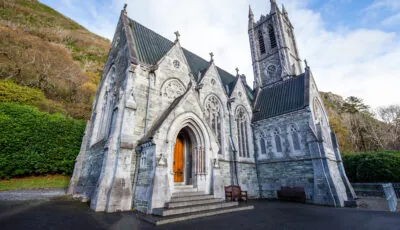
The small church visible on the lakeshore is often incorrectly called ‘Kylemore Abbey’. Yet it was built several decades before the Benedictines arrived and is not an abbey. Its official name is the Neo-Gothic Church, or Kylemore neo-Gothic church.
Its history began after Margaret Henry’s death. In 1874, Mitchell Henry travelled to Egypt with his wife and several members of their family. Margaret contracted dysentery and died on 4 December, aged 45.
Deeply distressed, Mitchell had her body returned to Connemara. He then commissioned James Franklin Fuller to create a memorial church expressing his devotion to Margaret and placing her memory within the Kylemore landscape.
Work began in 1877 and was completed in 1881. The building adopts the proportions and architectural vocabulary of a Gothic cathedral, but on a reduced scale. This appearance earned it the nickname ‘miniature cathedral’.
The church is built from sandstone and features a narrow nave supported by delicate marble columns. The different shades of stone, pointed arches, vaults and stained-glass windows create an atmosphere that is more intimate than monumental.
James Franklin Fuller replaced several threatening figures usually associated with Gothic architecture with carvings of flowers, birds and angels. These natural motifs are said to have been chosen to evoke Margaret’s personality and the landscapes she loved.
The capitals and decorative elements are well worth close attention. They reveal craftsmanship far more delicate than the building’s restrained exterior suggests. The church’s acoustics also make it possible to hold occasional recitals and musical performances, included with an estate ticket.
The church is undergoing conservation work in 2026, but is still listed as open to visitors. Some areas may nevertheless be temporarily protected or less visible depending on the progress of the works.
Margaret Henry’s body lies in a small mausoleum in the woods, a few metres beyond the neo-Gothic church. Mitchell Henry had requested to be buried beside his wife. After his death in London in 1910, his remains were brought back to Kylemore in accordance with his wishes.
Mitchell and Margaret now lie side by side in this deliberately modest monument. Contrary to some accounts of their story, they are not buried in the crypt of the neo-Gothic church.
The mausoleum can be reached on foot from the former castle by following the path along the lakeshore. The return walk to the church and mausoleum takes around 25 to 35 minutes, excluding visiting time.
There is no separate ticket for the abbey or the neo-Gothic church. Admission gives access to the entire estate open to the public.
The visitor route includes the restored ground-floor rooms of the former castle, the exhibition dedicated to the Benedictines, the neo-Gothic church, the Henry family mausoleum, woodland walks, lakeside paths and the Victorian Walled Garden.
A free shuttle links the visitor centre with the Victorian garden, around 1.8 km away. It does not serve the neo-Gothic church, which can only be reached on foot via the path along the lake.
Free history talks are usually offered at 11 am, 12 noon, 2 pm and 3 pm. Their schedule may change depending on the season and events held on the estate.
A quick visit to the former castle, neo-Gothic church and mausoleum takes around two hours. However, it is best to allow three to four hours for Kylemore Abbey to include the Victorian garden, walks and a break at the café.
Visitors mainly interested in Benedictine spirituality can arrive before noon, visit the exhibition dedicated to the community and then attend the 12.15 pm Mass in the monastic church.
To avoid groups and organised excursions, arriving at opening time is recommended. In summer, the periods from late morning to mid-afternoon are generally the busiest.
These times may change during religious feasts. Access to services should not be confused with tourist admission to the full estate.
Want to extend your visit without having to rush around? Here are a few well-located places to stay near the must-see attractions.
Essential information to help you plan your visit, including key landmarks, access information, and booking options.
Pollacappul, Letterfrack, Renvyle Peninsula, Connemara, County Galway, Republic of Ireland, Tourist sites in Ireland
53.56180401359177, -9.882430166007834
30 minutes
Prices and opening times may change depending on the season. It is recommended that you check the official Kylemore Abbey ticket office before your visit.
Check the opening hours and admission requirements before you leave, especially during peak season or on Irish public holidays.
Compare tickets, guided tours, and excursions available through our partner platforms.