


Built on the shores of Lough Pollacapall, amid the wild landscapes of Connemara, Kylemore Castle seems to sit between water, woodland and mountains. Its granite façade, stretching more than 40 metres, is reflected in the lake at the foot of Doughruagh Mountain, creating one of western Ireland’s most famous sights.
Behind this romantic silhouette lies a history shaped by love, bereavement, political ambition and the upheavals of the 20th century. Built from 1867 for Mitchell Henry and his wife Margaret, the castle became home to a community of Benedictine nuns in 1920. Since then, it has been more commonly known as Kylemore Abbey.
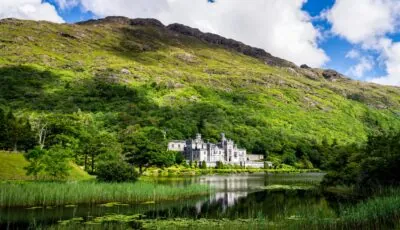
Kylemore Castle – © Dawid
The history of Kylemore Castle is inseparable from that of Mitchell Henry and his wife, Margaret Vaughan. A doctor by training, Mitchell Henry came from a wealthy British family that had made its fortune in Manchester’s textile industry. Following his father’s death, he inherited a considerable estate, enabling him to bring an extraordinary project to life in western Ireland.
Mitchell and Margaret discovered Connemara in the 1840s, shortly after their marriage. According to the estate’s account, Margaret fell in love with the Kylemore valley, its mountains and its lake. Several years later, Mitchell Henry bought Kylemore Lodge and the surrounding land to build a family home there.
The castle is often described as a gift to Margaret. This romantic phrase sums up a more complex reality: Kylemore was intended to be both a family home and a model estate, as well as a symbol of Mitchell Henry’s social and political ambitions in Ireland.
Work began in 1867 and employed around one hundred workers for approximately four years. The castle was sufficiently complete for the family to move in at the beginning of the 1870s, although work on various parts of the estate continued afterwards.
The original text attributed the castle to a certain “John Fuller”. This information is incorrect. Kylemore Castle was designed by the Irish architect James Franklin Fuller, with the involvement of architect and engineer Samuel Ussher Roberts.
James Franklin Fuller was also associated with several major Irish country houses and restoration projects, including Ashford Castle, Farmleigh House and Mount Falcon. At Kylemore, he created a neo-Gothic baronial castle, recognisable by its turrets, battlements, gables and carefully composed asymmetry.
The granite used for the exterior facing is thought to have been brought from Dalkey, near Dublin, while the limestone came in particular from Ballinasloe. Transporting these materials to Connemara was a considerable feat in a region that remained isolated in the 19th century.
The monumental façade stands directly above Lough Pollacapall. Its setting was not merely aesthetic: the lake, mountains and woods were incorporated into the estate’s design to create a romantic landscape in keeping with Victorian tastes.
Kylemore Castle covers around 3,700 m² and had more than 70 rooms. Historical sources mention 33 bedrooms, four bathrooms, several drawing rooms, a ballroom, billiard room, library, office, study, smoking room and armoury, as well as numerous rooms for staff and domestic operations.
The house had facilities that were highly advanced for its time. Running water, a heating system, sanitary installations and safety features all contributed to the family’s comfort. The estate also had its own fire station, workshops, staff accommodation and various farm buildings.
Kylemore was not intended to be merely a pleasure residence. Mitchell Henry hoped to develop a productive estate and provide employment in a region still scarred by the Great Famine. Construction work, farming and upkeep of the property employed many local people from Connemara.
Elected MP for County Galway from 1871 to 1885, Mitchell Henry also championed causes connected with Ireland and improving the circumstances of its people. Yet he remained a wealthy British landowner in an Irish society marked by profound inequalities in land ownership.
In 1874, Mitchell and Margaret Henry travelled to Egypt. Margaret contracted dysentery there and died on 4 December, aged just 45. Her death left Mitchell a widower with their nine children.
Her body was returned to Connemara. She lies in a small mausoleum built in the woods, a few hundred metres from the castle. Mitchell Henry asked to be buried beside her one day. His wish was honoured after his death in London in 1910.
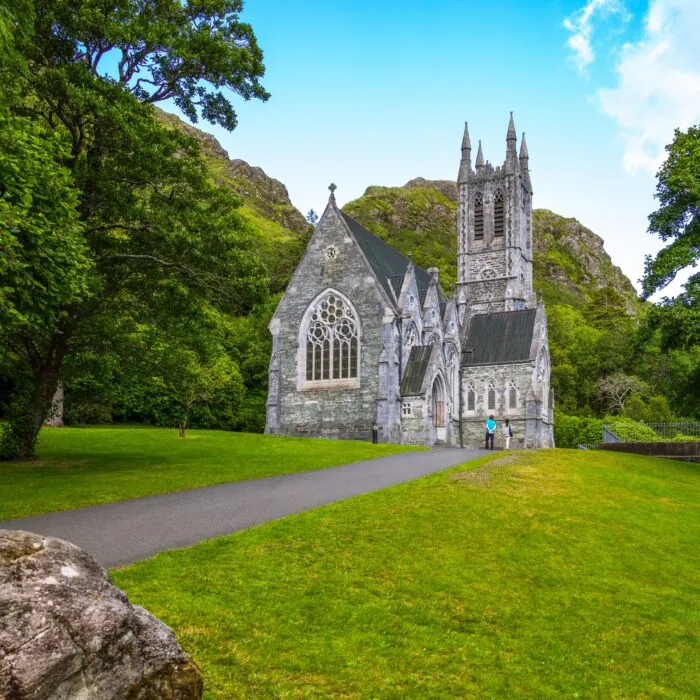
To honour his wife’s memory, Mitchell also had a neo-Gothic church built near the lake. Work began in 1877 and was completed in 1881. Designed by James Franklin Fuller, it is often described as a “cathedral in miniature”.
Contrary to what the earlier version of the article stated, this building is neither an abbey nor the future Kylemore Abbey. It is a memorial church separate from the castle. The name Kylemore Abbey was only adopted after the Benedictine nuns moved into the former castle in 1920.
The family was struck by another tragedy in September 1892. Geraldine, one of Mitchell and Margaret Henry’s daughters, died following a horse-drawn carriage accident on the estate. She did not drown while out walking, contrary to a frequently repeated claim.
The young woman was travelling in a carriage with her baby and a nurse when the horse bolted. Geraldine was seriously injured and did not survive the accident.
Her death reinforced the tragic dimension of Kylemore’s history. However, it would be reductive to claim that it directly caused the estate to be sold. Mitchell Henry’s financial difficulties, the considerable cost of maintenance and changes in his family circumstances also played a decisive part.
Mitchell Henry gradually left Kylemore towards the end of the 19th century. The estate was eventually sold in 1903 to William Angus Drogo Montagu, ninth Duke of Manchester, and his wife Helena Zimmerman.
Helena was the daughter of a wealthy American industrialist. Her fortune helped finance the couple’s lifestyle and the works undertaken at Kylemore. Further improvements were made, but the duke’s spending and the family’s financial difficulties soon led to the property being put up for sale.
Kylemore then passed into the hands of banker and businessman Ernest Fawke, who did not settle there permanently. The castle was therefore not simply left abandoned between the Henry family’s departure and the arrival of the Benedictines, although it went through a period of uncertainty and limited occupancy.
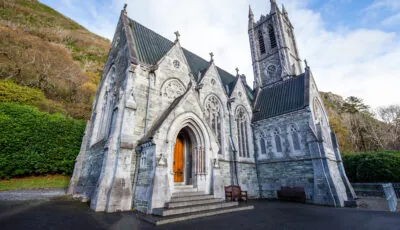
Kylemore Abbey – © Felipe Garcia
On 4 December 1920, a community of Irish Benedictine nuns moved to Kylemore. Known as the “Irish Dames of Ypres”, these nuns had lived in Belgium since the 17th century, where they notably provided education for girls from Irish Catholic families.
Their abbey in Ypres was destroyed during the First World War. Forced to flee Belgium, the Benedictines first found refuge in England, then in County Wexford, before acquiring Kylemore Castle. From the time of their arrival, the former Victorian residence took the name Kylemore Abbey.
The nuns developed an international school for girls there, welcoming Irish and overseas pupils. The establishment earned a strong reputation and continued operating for several generations.
Contrary to the earlier version of the text, this school is no longer in operation. It closed permanently in 2010. The Benedictine nuns still live on the estate, where a new monastery designed for their community was completed in 2024.
The history of the community, its spiritual life and its present-day role are explored in greater detail in our article on Kylemore Abbey.
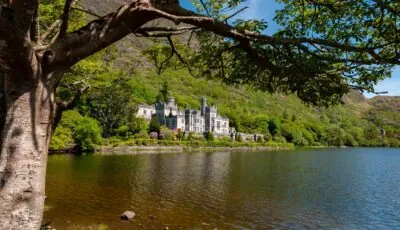
Kylemore Castle – © Serfeo
The castle interior was long presented as a visit limited to four rooms out of 66. This is no longer accurate. A major restoration programme has opened several areas on the ground floor and created a museum trail devoted to the different generations who lived at Kylemore.
Only the historic ground floor is open to the public. The upper floors and certain wings of the building remain closed, notably because of their current uses and the constraints of the building itself.
The route allows visitors to discover rooms recreated in the spirit of the Victorian home. Furniture, objects, documents, photographs and audiovisual displays tell the story of Mitchell and Margaret Henry, the construction of the castle, the Manchester family and the Benedictines.
Mitchell Henry’s library and study are among the most evocative spaces. Animated portraits and sound effects bring the characters to life without turning the castle into an artificial attraction. The experience takes an accessible approach, combining historic settings with contemporary storytelling.
Displays devoted to the Benedictine community, the former school and the estate’s transformations complete the visit. Historical talks are also offered at certain times, depending on the day’s programme.
A visit to the interior of Kylemore Castle takes around 45 minutes to an hour. History enthusiasts may wish to allow more time, particularly when a guided presentation is scheduled.
This duration applies to the castle only. The ticket gives access to the entire estate, which also includes the neo-Gothic church, the mausoleum, woodland trails, lakeside walks and the Victorian Walled Garden.
To make the most of Kylemore, allow around three hours. Half a day is preferable if you wish to have lunch on site, follow the trails or take time to explore the gardens.
The Victorian Walled Garden is around 1.8 km from the castle. It covers approximately six acres, or nearly 2.4 hectares, rather than three hectares as was once stated.
Created at the same time as the estate, it once had 21 heated glasshouses and employed up to 40 gardeners. Its layout separated ornamental gardens, intended for strolling and contemplation, from areas for growing fruit, vegetables and herbs.
Much of the garden was gradually abandoned after the 1920s. The Benedictines launched an ambitious restoration programme in the 1990s. Completed in 2000, the project restored the flower beds, kitchen gardens, gardener’s house, several working buildings and part of the former glasshouses.
In 2025, Kylemore celebrated 25 years since this restoration. The garden is now maintained by a dedicated team: it no longer relies solely on the nuns’ work, although they played a decisive role in its preservation.
A free shuttle regularly links the visitor centre area with the garden. It usually runs every 15 minutes during opening hours, depending on visitor numbers and operating conditions.
It is also possible to reach the garden on foot via a woodland route of around 1.8 km. This option offers a better appreciation of the estate’s landscapes, but takes more time and requires good footwear, especially after rain.
The shuttle serves the garden, not the neo-Gothic church. The church can be reached on foot from the castle via a pleasant walk along the lake.
Kylemore Castle is among Ireland’s most photographed landmarks. Its fame owes as much to its architecture as to its dramatic setting. The dark mountain, woodland and lake reflections give its neo-Gothic façade an almost unreal quality.
Yet the visit is not limited to a beautiful viewpoint. The history of the Henry family reveals the ambitions and contradictions of the Victorian era, while the arrival of the Benedictines tells the story of a community driven from Belgium by war.
The visit will appeal to enthusiasts of castles, history, architecture and gardens. Families can also enjoy trails, natural spaces and occasional activities for children.
Spring and early summer generally bring the finest blooms to the Victorian garden. The long days also make it easier to explore the estate and other sites in Connemara.
July and August are the busiest period. To avoid groups, it is best to arrive at opening time or book a late-afternoon slot, while allowing enough time before last admission.
Autumn brings beautiful colours to the woods surrounding the lake. In winter, the atmosphere can be striking, but opening hours are shorter and some seasonal services may not be available.
Rain is part of the Connemara landscape. It does not make a visit impossible, but waterproof clothing is essential for reaching the church, mausoleum and gardens. Conditions can change very quickly, even in summer.
Want to extend your visit without having to rush around? Here are a few well-located places to stay near the must-see attractions.
Essential information to help you plan your visit, including key landmarks, access information, and booking options.
Pollacappul, Letterfrack, Letterfrack
53.561819, -9.889340
1h30
From 9 March 2026, the published opening hours are as follows:
The ticket includes access to the castle’s restored rooms, the experience dedicated to its history, the neo-Gothic church, the mausoleum, walks around the estate, the Victorian Walled Garden and the shuttle serving the garden.
As prices may vary according to the season and booking method, it is advisable to check the official Kylemore Abbey ticket office before travelling.
Compare tickets, guided tours, and excursions available through our partner platforms.