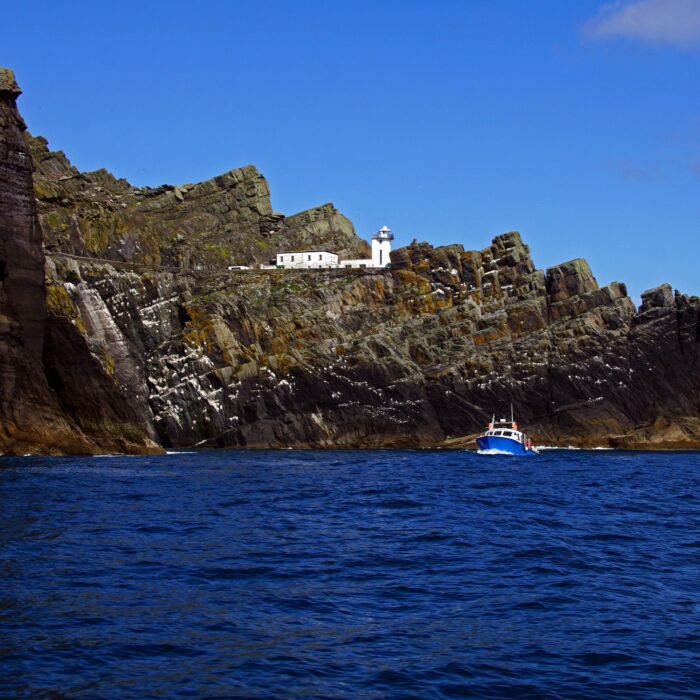


With their uneven stones, dizzying passages and striking views over the Atlantic Ocean, the 618 steps of Skellig Michael offer one of Ireland’s most spectacular climbs. This historic staircase leads to an ancient Christian monastery high on a rocky island, around 12 kilometres off the coast of County Kerry.
The climb is demanding and can be daunting at times. Yet it offers the chance to discover an exceptional place, shaped by centuries of history, swept by the wind and now a UNESCO World Heritage Site. It is an extraordinary adventure, reserved for visitors fit enough to tackle a significant ascent and steps with no guardrails.
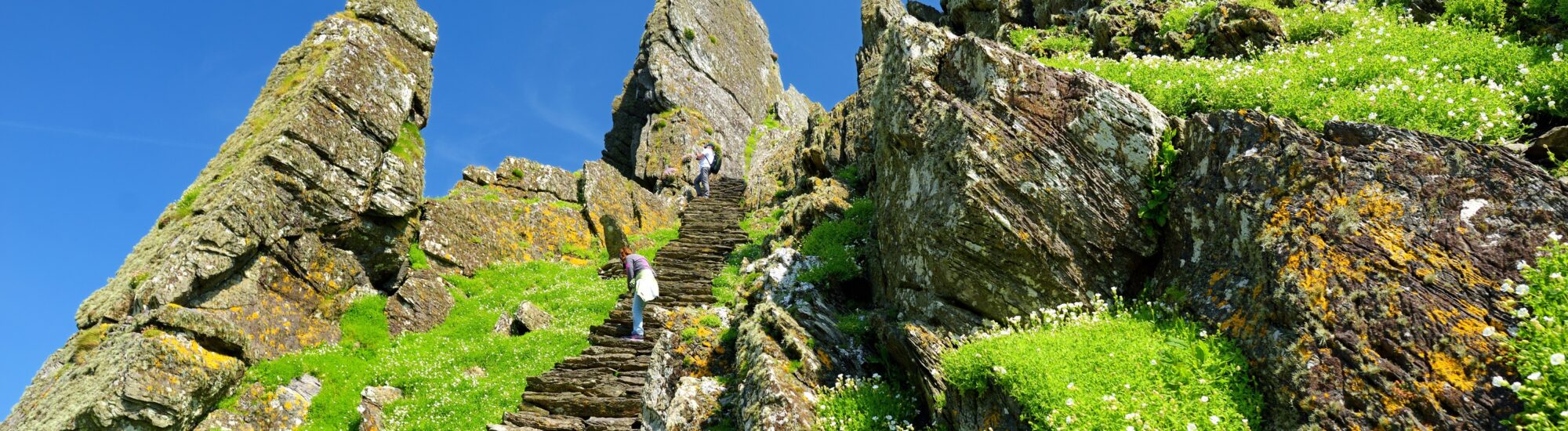
The steps of Skellig Michael are particularly steep – © shutterupeire
Skellig Michael, also known in Irish as Sceilg Mhichíl, is a vast rock rising around 218 metres above the ocean. Its steep terrain accounts for the dramatic appearance of the stairways laid out by the religious community that once occupied the island.
Contrary to what one might expect, the 618 steps do not begin directly at the quay. After landing, visitors first follow a path laid out along the rock. It gradually joins the historic stairways and then the area known as Christ’s Saddle, situated between the island’s two main peaks.
The climb to the monastery involves an ascent of around 180 metres. It alternates between relatively accessible stretches and passages that are much steeper, narrower or exposed to sheer drops. The stones are uneven, sometimes high, and worn smooth over the centuries. Some sections have neither handrails nor guardrails.
This is not simply a tourist staircase. The ascent takes place in a natural setting, on an ancient structure whose layout bears no comparison with that of a modern monument.
A Christian community settled on Skellig Michael during the early Middle Ages. The exact date of its foundation remains uncertain, but monastic occupation of the island most likely dates from sometime between the 6th and 8th centuries.
The monks sought a place far removed from the world, suited to prayer, contemplation and a particularly austere way of life. Skellig Michael perfectly met their desire for isolation. They still needed a way to reach the terraces high up on the island.
The religious community therefore laid out several paths and stairways from the various landing points. The stones were assembled by hand, without modern technical means. Their route had to adapt to the terrain, skirt the steepest cliffs and withstand Atlantic storms as far as possible.
However, it would be inaccurate to claim that each of the 618 steps dates precisely from the 7th century. The access routes were probably built, maintained and altered during several phases of monastic occupation. Some passages were also reinforced over time to make access to the site safer.
Skellig Michael did not have a single staircase. Archaeological research has identified several historic routes corresponding to the main places where monks could land.
These stairways are generally associated with the areas of Blind Man’s Cove, Cross Cove and Blue Cove. Their use most likely depended on wind direction, swell and sea conditions. When landing became too dangerous on one side of the island, another route could be used instead.
Not all of these routes are used by today’s visitors. Tourist access follows a supervised route selected according to its state of preservation and safety requirements. It is strictly forbidden to leave this path to explore the other stairways.
The difficulty of the staircase depends as much on a visitor’s fitness as on their comfort with heights. Those accustomed to hiking may find the climb manageable, but they must still watch every step.
It is important to maintain a steady pace and not try to climb too quickly. The wind can be strong, while the presence of other visitors can sometimes make passing difficult on the narrowest sections.
Breaks should only be taken in areas wide enough to do so. Stopping in the middle of a difficult passage can obstruct other visitors and increase the risk of falling. The guides on the island indicate the areas where it is possible to catch your breath or admire the scenery safely.
The descent also requires close attention. It can seem even more daunting than the climb, as the view looks directly down towards the ocean and rocky slopes. There is no need to rush, even when it is nearly time to return to the boat.
The climb involves genuine risks. The steps are steep, uneven and sometimes slippery when wet. In several places, the absence of side protection means visitors must remain fully focused.
The site may not be suitable for people with a fear of heights, respiratory or heart problems, or mobility issues that prevent them from independently climbing and descending high steps. Children under 12 are not permitted to land on the island. Some boat operators impose an even stricter age limit.
Sturdy, closed shoes with non-slip soles are essential. Sandals, flip-flops, heels and shoes with smooth soles are not suitable for this visit. It is also advisable to keep your hands free and put away your phone or camera during the trickiest sections.
The weather can change very quickly. Even when the sky appears clear, wind, rain or sea spray can make the stones slippery. Visitors must follow the instructions of Office of Public Works staff, who may restrict or halt access when conditions become dangerous.
At the end of the climb, the monastic complex for which Skellig Michael is renowned comes into view. Built on a narrow terrace, it seems almost suspended between sky and ocean.
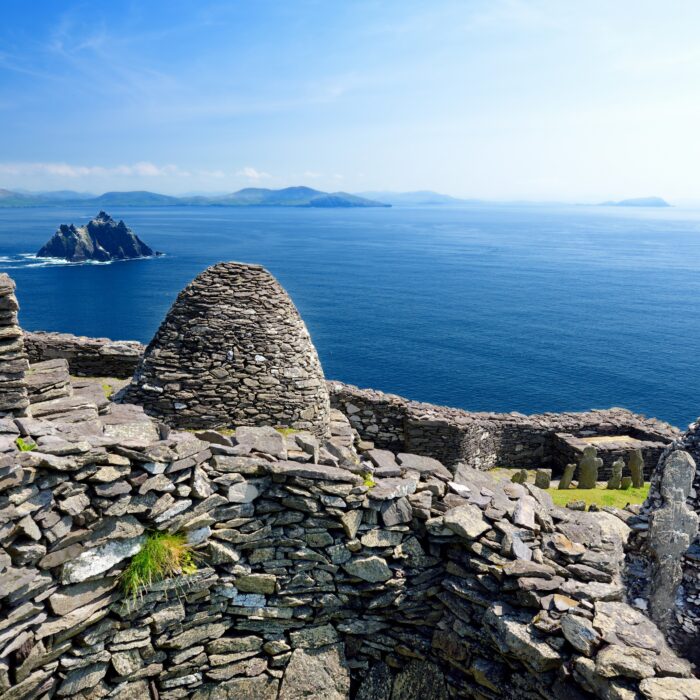
The site includes several dry-stone cells, recognisable by their rounded, beehive-like shape. These dwellings, sometimes called beehive huts, were built by carefully layering stones to form a vault. Their ingenious architecture helped limit water ingress and withstand strong winds.
Visitors can also see two oratories, the remains of a church, stone crosses, a small cemetery and various spaces once devoted to the monks’ daily life. Despite the extreme weather conditions, much of this complex has survived through the centuries.
The monks lived in almost total isolation. Their diet probably consisted of seabirds, fish, eggs and the few plants that could be grown on the terraces. Rainwater was collected in cisterns dug into or built into the rock.
The community gradually left the island, most likely during the 13th century. Skellig Michael nevertheless retained a religious role and later became a place of pilgrimage.
During the ascent, several viewpoints offer views of the Atlantic Ocean and the outline of Little Skellig. This neighbouring island, which is closed to the public, is home to one of the world’s largest colonies of northern gannets.
Depending on the season, Skellig Michael is also home to various species of seabird. Puffins can notably be seen during their nesting period. They move close to the paths and must be observed from a distance, without being touched or disturbed.
The scenery changes constantly with the light and weather. In sunshine, the rock contrasts with the deep blue of the ocean. When clouds and mist envelop the island, the site takes on a much more mysterious appearance.
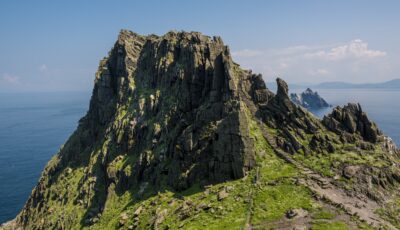
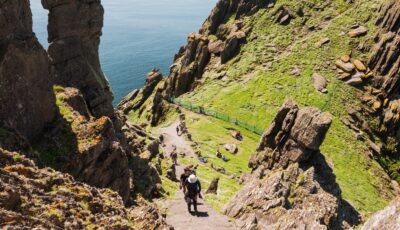
The historic staircase of Skellig Michael – © ClickAlps
The landscapes of Skellig Michael served as the setting for the planet Ahch-To in the third Star Wars trilogy. The island appears at the end of The Force Awakens, when Rey joins Luke Skywalker in his place of exile. It is seen again in The Last Jedi.
The historic stairways, cliffs and stone structures fit naturally into the universe of the saga. Some of the dwellings seen on screen were inspired by the island’s real monastic cells.
The success of the films considerably raised Skellig Michael’s international profile. Access nevertheless remains strictly regulated: the number of boats permitted to land is limited, and heritage conservation remains the priority.
Skellig Michael has been a UNESCO World Heritage Site since 1996. This recognition highlights both the value of its monastic architecture and the exceptional nature of its setting.
The island nevertheless remains particularly fragile. Storms, water ingress, wind and the repeated passage of visitors accelerate the erosion of paths and stairways. Regular work is needed to monitor the structures and reinforce certain sections.
Every visitor helps preserve the site by staying on the authorised route. Do not climb on the monastic cells, sit on the walls, move stones or approach closed areas. All rubbish must also be taken back to the mainland.
These precautions make it possible to discover the 618 steps of Skellig Michael without compromising the preservation of a site more than a thousand years old.
Essential information to help you plan your visit, including key landmarks, access information, and booking options.
51.772744, -10.536648
Half a day
Official season: from 12 May to September, subject to confirmation.
Skellig Michael does not have fixed daily opening hours. Landings depend on weather conditions, sea conditions, and decisions made by the authorities and captains.
Outside the supervised season, the site is not monitored and visits are prohibited. An excursion may also be cancelled on the day if sailing or landing conditions are considered dangerous.
Check dates and conditions before departure on the official Heritage Ireland website.
free
However, the visit requires booking a crossing with a boat operator authorised to land on the island. Prices are set independently by each company.
Children under 12 are not permitted to land on Skellig Michael. Some operators may impose a minimum age of 14.
Cancellation and refund conditions vary by company. It is advisable to check them before booking, particularly because of frequent weather-related cancellations.