Reservations are recommended
Powered by GetYourGuide


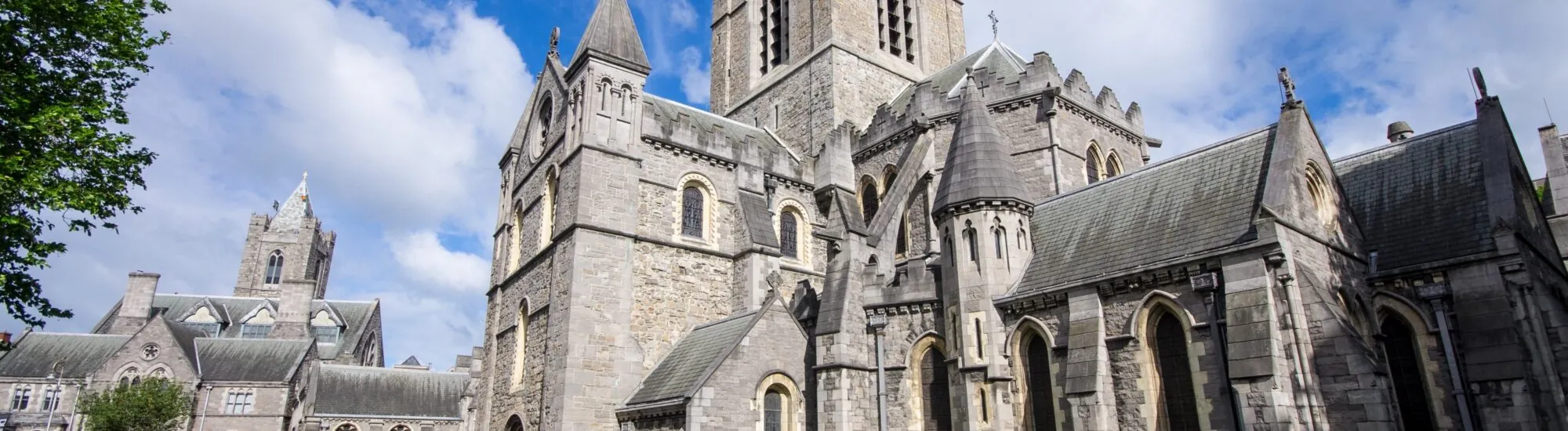
Perched on the hill that once overlooked the Viking city, Christ Church Cathedral has watched over Dublin’s medieval heart for almost a thousand years. Behind its Gothic Revival silhouette lies a more complex monument than it first appears, shaped in turn by Norse rulers, Irish archbishops, Anglo-Norman conquerors and Victorian restorers.
Still used for Anglican worship, Christ Church Cathedral is both the cathedral of the Diocese of Dublin and Glendalough, a major historic site and one of the Irish capital’s must-see attractions. Its 12th-century crypt, the oldest structure still in use in Dublin, holds some decidedly unexpected treasures: the heart of St Laurence O’Toole, an early copy of Magna Carta and even a mummified cat and rat.
Dublin has an unusual arrangement: two medieval Church of Ireland cathedrals stand just a few minutes’ walk from one another.
Christ Church Cathedral is the official cathedral of the Diocese of Dublin and Glendalough. St Patrick’s Cathedral, meanwhile, has the status of national cathedral of the Church of Ireland. Both have belonged to the Anglican tradition since the Protestant Reformation.
The two monuments complement rather than resemble each other. St Patrick’s impresses with its scale, long nave and association with Jonathan Swift. Christ Church stands out more for its Viking origins, Anglo-Norman architecture and vast medieval crypt.
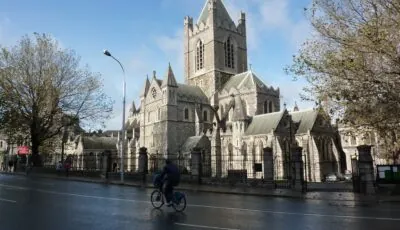
Christ Church Cathedral – Bods – CC
The earliest known manuscript dates the foundation of Christ Church to around 1030. The church was established by Sitriuc, or Sigtrygg Silkbeard, the Norse king of Dublin, and Dúnán, regarded as the city’s first bishop.
The building stood on a rise overlooking Wood Quay, at the heart of the Viking settlement. The city was already largely Christianised, although its inhabitants retained a deeply Scandinavian culture and trading links.
The original church was probably built of wood. It was most likely under the authority of the Archbishopric of Canterbury, reflecting the ties between Dublin and the Anglo-Scandinavian world across the Irish Sea.
In 1152, Christ Church was incorporated into the Irish ecclesiastical structure. A few years later, Laurence O’Toole became Archbishop of Dublin. He reformed the cathedral’s administration and established a community of Augustinian Canons Regular there.
The Anglo-Norman conquest of Dublin in 1170 marked a new chapter in the monument’s history. Richard de Clare, better known as Strongbow, and other powerful lords helped fund its reconstruction in stone.
Under the direction of John Comyn, Dublin’s first Anglo-Norman archbishop, the former Hiberno-Norse church was gradually replaced by an imposing Romanesque cathedral. Work continued throughout the 13th century, as the Gothic style began to take hold.
The crypt, transept and parts of the choir still retain features from this period. However, the present building is not an intact medieval cathedral: it is the result of numerous collapses, reconstructions and restorations.
Laurence O’Toole, or Lorcán Ua Tuathail, is one of the key figures associated with Christ Church. Born in the 12th century, he became Abbot of Glendalough before being appointed Archbishop of Dublin in 1162.
He played a religious, political and diplomatic role during the Anglo-Norman conquest. In particular, he took part in negotiations between the people of Dublin, the Irish king Diarmait Mac Murchada and Strongbow’s forces.
Laurence O’Toole died in Normandy in 1180 and was canonised in 1225. A relic traditionally said to be his heart is kept in the cathedral.
Stolen in 2012 from the metal cage in which it was displayed, the relic was found six years later in Phoenix Park after a particularly mysterious investigation. It has since been returned to Christ Church.
In 1562, the nave vault collapsed, bringing down part of the south wall and destroying the former funerary monument associated with Strongbow. Historical sources do not directly describe the accident as a simple landslide: it probably resulted from structural problems that had accumulated over several centuries.
Emergency repairs were carried out, but they remained temporary. The north wall of the nave, which tilted outwards, still shows a misalignment of around 46 centimetres today.
The cathedral remained in a fragile state for almost three centuries. Some sections were closed off, while others were altered to allow services to continue.
Between 1871 and 1878, Christ Church underwent a spectacular restoration funded by the distiller Henry Roe. The work was entrusted to the English architect George Edmund Street, a specialist in the Gothic Revival style.
Street sought to restore a medieval coherence to the whole, but his approach involved considerable changes. Older sections were rebuilt, new elements added and the interior layout extensively reworked.
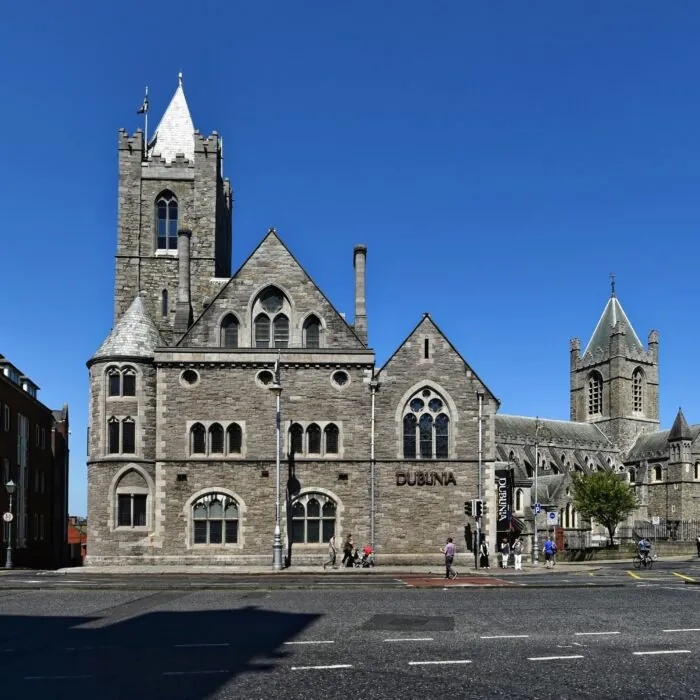
The covered bridge that now links the cathedral to the former Synod Hall also dates from this period. Suspended above the street, it is one of the most recognisable sights in Dublin’s medieval quarter. The Synod Hall now houses Dublinia, an interactive museum devoted to the Viking and medieval city.
The Victorian restoration saved Christ Church from likely disappearance. It also explains why the building’s present appearance owes as much to the 19th century as it does to the Middle Ages.
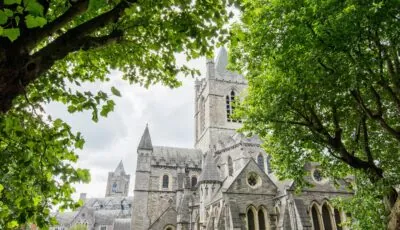
Christ Church Cathedral – © puckillustrations
The visit begins in the great nave, where the soaring arches contrast with the colourful patterns of the floor. Some of the medieval tiles uncovered during restoration work have been retained, while others were reproduced in the 19th century.
The route takes in the choir, chapels, funerary monuments and several carved details. Some capitals are decorated with faces, animals or fantastical figures that evoke the medieval imagination.
Christ Church remains a working cathedral. Areas open to visitors may therefore vary during services, choir rehearsals, concerts and private ceremonies.
Richard de Clare, known as Strongbow, was one of the leading figures in the Anglo-Norman conquest of Ireland. His arrival on the island in 1170 helped usher in several centuries of English intervention in Irish affairs.
Strongbow died in 1176 and is said to have been buried at Christ Church. However, his original monument was destroyed when the nave collapsed in 1562.
The recumbent effigy now presented as his tomb is thought to have come from another church, probably in Drogheda. It was installed at Christ Church shortly after the disaster to replace the lost monument. It cannot therefore be regarded as Strongbow’s original medieval tomb.
A second, smaller carved figure nearby is sometimes presented as Strongbow’s son. This interpretation is largely based on popular tradition.
Built from the late 12th century onwards, the crypt extends beneath almost the entire cathedral. With its stone vaults and rows of pillars, it is one of the most impressive parts of the visit.
Its use has changed greatly over the centuries. It has served as a religious space, storehouse, market and meeting room. In the 17th century, some of its vaults even housed shops selling beer, wine and tobacco.
The crypt now hosts the Treasures of Christ Church exhibition. Visitors can discover liturgical objects, manuscripts, sculptures and various records of the cathedral’s history.
Among Christ Church’s curiosities are a naturally mummified cat and rat. The two animals are said to have been found trapped in an organ pipe in the 19th century.
The cat was probably chasing the rat when they became trapped. The dry conditions inside the pipe are thought to have preserved their bodies.
The pair are sometimes known locally as “Tom and Jerry”. James Joyce is also said to refer to them in Finnegans Wake, mentioning a Dublin cat chasing a mouse through an organ pipe.
Displayed in a case in the crypt, these two unlikely residents have become one of the cathedral’s most photographed attractions.
The crypt displays a rare early copy of Magna Carta Hiberniae, the Irish adaptation of the famous English charter. It bears witness to the introduction of the Anglo-Norman legal system in Ireland.
Visitors can also see pieces of religious silverware donated to the cathedral. Some are associated with King William III, who attended a thanksgiving service at Christ Church after his victory over James II at the Battle of the Boyne in 1690.
The exhibition also includes several costumes made for the historical series The Tudors, some scenes of which were filmed in the cathedral. Their presence adds a more contemporary touch to the visit.
Christ Church’s bell tower houses a set of bells renowned in the bell-ringing world. The oldest date from the 18th century, while the heaviest weigh several tonnes.
The cathedral has an exceptional number of bells, allowing full-circle ringing. The Christ Church Cathedral Society of Change Ringers, founded in 1670, keeps this tradition alive.
Some guided tours offer access to the bell tower and an introduction to bell-ringing. The experience is reserved for visitors aged 12 and over who are able to climb the 86 steps of a narrow staircase. It is not recommended for visitors with vertigo, claustrophobia or mobility difficulties.
Christ Church is first and foremost a place of worship. Prayers, eucharists and choral services are held throughout the week. On Sunday mornings, the cathedral hosts its main eucharist.
Musical tradition plays an important role in the life of the monument. In 1742, the choirs of Christ Church and St Patrick’s Cathedral joined together for the world premiere of Handel’s Messiah, held in nearby Fishamble Street.
Admission is free for those attending a service. However, this is not a way to visit the cathedral free of charge: sightseeing and photography are not permitted during celebrations.
The crypt, mummified animals and Viking stories make the visit accessible for children. There is also an area where families can try on costumes inspired by monks, knights and Tudor-era figures.
A combined ticket allows visitors to see Christ Church Cathedral and Dublinia. This pairing is particularly coherent: the cathedral presents an authentic monument, while Dublinia places its history within the everyday life of the Viking and medieval city.
Allow around one hour to explore the cathedral and its crypt. The combined visit with Dublinia takes closer to two and a half hours, or longer with children.
The standard ticket includes a self-guided visit and an audio guide. The latter is available in several languages, including French, English, German, Spanish, Italian, Polish and Portuguese.
Several themes offer historical, political, musical and spiritual perspectives on the cathedral. A more inclusive, sensory version is also available for children and visitors less familiar with religious history.
Guided tours are offered in English, subject to guide availability. Some include access to the bell tower and an introduction to bell-ringing. They can be booked at the welcome desk, subject to availability.
Essential information to help you plan your visit, including key landmarks, access information, and booking options.
Christchurch Pl, Wood Quay, Old city, Dublin, County Dublin, Republic of Ireland, Tourist sites in Ireland
53.343484, -6.271077
45 minutes
In January and February:
In March:
From April to June:
In July and August:
In September:
In October:
In November and December:
Last admission for sightseeing is 45 minutes before closing. Services, concerts and visiting choirs may lead to early closure, especially on certain summer days.
Check the official Christ Church Cathedral opening hours before your visit.
Check the opening hours and admission requirements before you leave, especially during peak season or on Irish public holidays.
Admission prices at the cathedral:
Reduced prices available online:
Combined Christ Church Cathedral and Dublinia ticket:
The standard ticket includes access to the nave, crypt, Treasures of Christ Church exhibition and audio guide. The combined ticket with Dublinia must be purchased at the reception desk of either site.
Guided tours with access to the bell tower may incur an additional charge. They are offered in English, depending on times and availability.
Admission is free to attend a religious service. During celebrations, sightseeing, free movement around the cathedral and photography are not permitted.
As prices may change, check the rates on the official Christ Church Cathedral ticket office.
Compare tickets, guided tours, and excursions available through our partner platforms.