
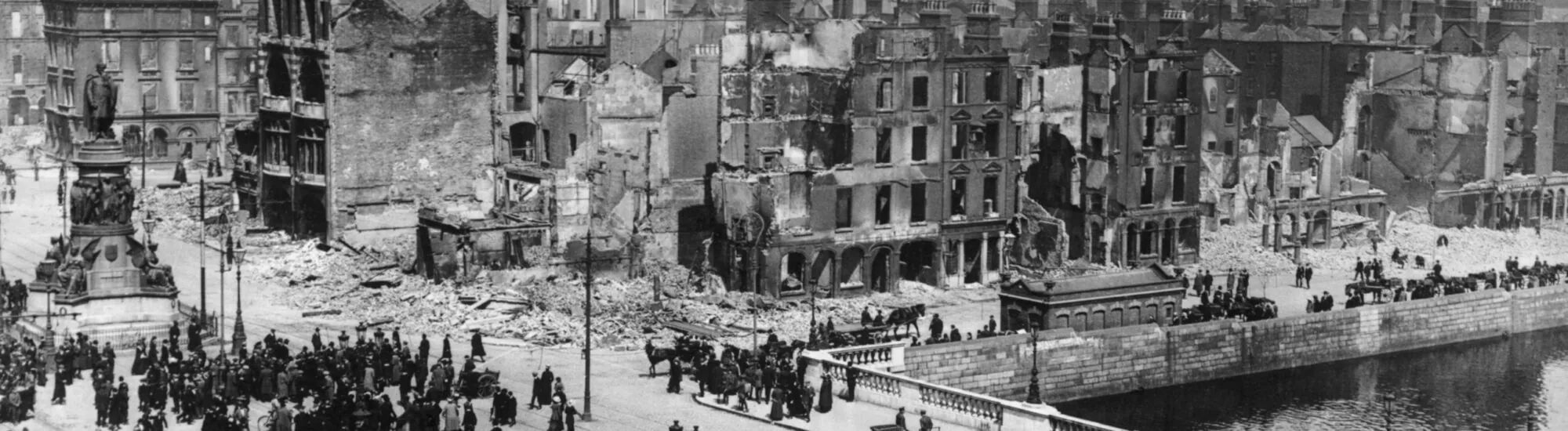
The Irish War of Independence took place mainly between January 1919 and July 1921. It pitted the Irish Republican Army, or IRA, against the forces of the British Crown: the regular army, the Royal Irish Constabulary, the Black and Tans and the Auxiliaries.
More than a succession of battles, the conflict took the form of a guerrilla war. Ambushes, intelligence operations, arrests, reprisals and destruction marked these two and a half years of struggle. At the same time, the independence movement sought to build a parallel state, with its own parliament, courts and administration.
The truce of 11 July 1921 brought the fighting to an end. A few months later, the Anglo-Irish Treaty paved the way for the creation of the Irish Free State. However, the agreement did not meet all republican aspirations and caused a fresh rift, soon followed by the Irish Civil War.
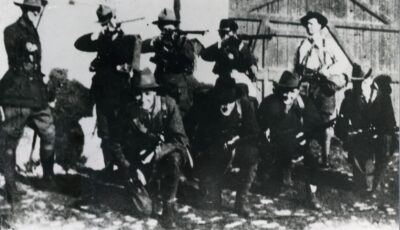
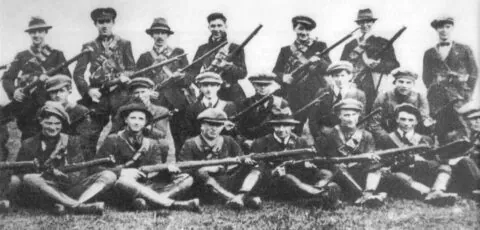
Irish Volunteers – Public domain
The origins of the conflict stretch back well beyond 1919. Anglo-Norman intervention in Ireland began in the 12th century, before English, and later British, authority gradually extended across the entire island.
Land confiscations, the settlement of British colonists, religious discrimination and successive campaigns of repression fuelled deep resentment. A number of uprisings broke out, notably in 1798, 1803, 1848 and 1867, but none succeeded in ending British rule.
In the 19th century, part of the nationalist movement favoured a parliamentary strategy. Its main objective became Home Rule, a plan for internal self-government that would have allowed Ireland to have its own parliament while remaining within the United Kingdom.
Several bills were introduced from the 1880s onwards. The first two failed, but a third was finally passed in September 1914. Its implementation was immediately suspended following the outbreak of the First World War.
Home Rule did not grant Ireland independence. It provided only limited autonomy, while London retained control of defence and foreign affairs, among other matters.
The proposal for self-government provoked fierce opposition in north-east Ireland. Many Protestant unionists in Ulster feared becoming a minority in an Ireland governed from Dublin.
In 1912, almost half a million people signed the Ulster Covenant and associated declarations in opposition to Home Rule. The following year, unionists founded the Ulster Volunteer Force, or UVF. At its height, this paramilitary organisation had around 100,000 members, although not all were armed or available for mobilisation.
In response, nationalists formed the Irish Volunteers in November 1913. Their initial aim was to defend the implementation of Home Rule. A smaller socialist organisation, the Irish Citizen Army, had also been founded in Dublin to protect workers during the 1913 labour dispute.
When the First World War broke out, the Irish Volunteers movement split. The majority followed nationalist leader John Redmond and agreed to support the British army. A minority retained the name Irish Volunteers and refused to take part in the British war effort.
It was within this minority that the Easter Rising of 1916 was prepared.
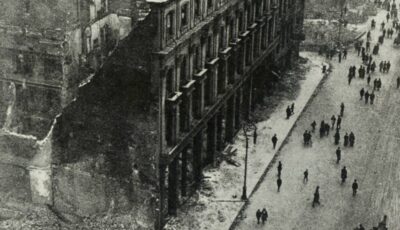
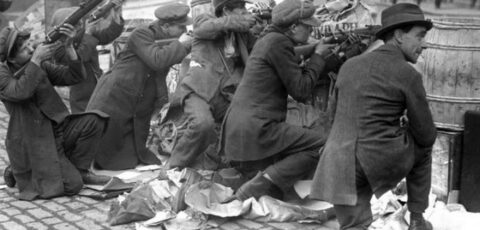
Dublin after the Easter Rising – Public domain
On 24 April 1916, several hundred members of the Irish Volunteers, the Irish Citizen Army and the secret Irish Republican Brotherhood took control of strategic buildings in Dublin.
From the General Post Office, Patrick Pearse proclaimed the Irish Republic. James Connolly, meanwhile, commanded the rebel forces in Dublin. Other operations were organised in several counties, but the uprising remained largely concentrated in the capital.
After six days of fighting, the insurgents surrendered in the face of British military superiority. Part of central Dublin was destroyed, and several hundred fighters and civilians were killed.
The Rising did not yet mark the beginning of the War of Independence. It was, however, one of its principal preludes.
In the weeks that followed, the British authorities executed 15 leaders of the uprising in Dublin. Roger Casement, arrested before the Rising, was hanged in London in August 1916. Thousands of people were also arrested or interned.
Initially, part of the Irish population had reacted to the uprising with incomprehension, even hostility. The severity of the repression gradually transformed public opinion. The insurgents now appeared as martyrs to a national cause.
Michael Collins, who had fought in the General Post Office, did not narrowly escape execution, contrary to what some accounts sometimes claim. His role in the Rising was still secondary at that point. He was arrested, interned at Frongoch camp in Wales, then released in December 1916.
In December 1918, Sinn Féin won a landslide victory in Ireland in the British general election. The party secured 73 of Ireland’s 105 seats.
Its elected representatives refused to take their seats at Westminster. On 21 January 1919, those who were neither imprisoned nor on the run gathered at Dublin’s Mansion House and formed their own assembly: the Dáil Éireann.
The first Dáil proclaimed Ireland’s independence and claimed sovereignty over the whole island. It also adopted a democratic programme and addressed a message to the nations of the world in an effort to secure international recognition.
The proceedings and debates of this founding session are preserved in the Irish Parliament archives.
The British government refused to recognise the assembly, which was subsequently declared illegal. Two authorities then began to face one another: the official British administration and the Irish Republic proclaimed by the Dáil.
On the same day as the first meeting of the Dáil, 21 January 1919, members of the Irish Volunteers attacked a convoy carrying explosives at Soloheadbeg, County Tipperary.
Two Royal Irish Constabulary officers, James McDonnell and Patrick O’Connell, were killed. The operation was carried out in particular by Dan Breen, Seán Treacy, Séumas Robinson and Seán Hogan.
The attack had not been authorised by the Dáil and was not the result of a national order issued by Michael Collins. Nevertheless, it is generally regarded as the first engagement of the War of Independence.
The Irish Volunteers gradually came to be known as the Irish Republican Army, or IRA. Their relationship with the Dáil government was sometimes ambiguous: the political authorities sought to exercise control over an organisation made up of numerous local brigades with considerable autonomy.
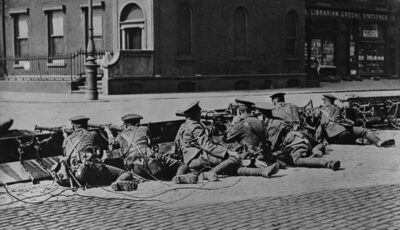
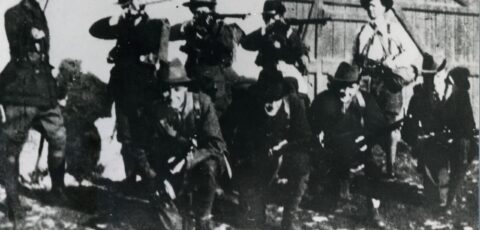
Irish War of Independence – Public domain
The IRA had neither the manpower nor the weaponry required to confront the British army in conventional battles. It therefore adopted a guerrilla strategy based on mobility and knowledge of the terrain.
Small units known as flying columns organised ambushes against patrols, attacked barracks and seized weapons. They moved through the countryside with the help of local networks that provided food, shelter and intelligence.
Fighting was particularly intense in the counties of Cork, Kerry, Tipperary, Clare, Limerick and Dublin. Tom Barry became one of the conflict’s best-known commanders after several operations led by the West Cork Brigade.
The Kilmichael ambush, on 28 November 1920, resulted in the deaths of 17 members of the Auxiliary Division. A few months later, in March 1921, the Crossbarry ambush enabled around a hundred IRA fighters to escape a major British operation in west County Cork.
In other regions, the IRA remained less active. The intensity of the war therefore varied considerably from county to county.
Michael Collins held several key roles. He was Minister for Finance of the proclaimed Republic, Director of Organisation for the Volunteers and, above all, Director of Intelligence for the IRA.
He developed a network of informers within British administrative and police services. The intelligence gathered enabled the IRA to anticipate arrests, protect its leaders and identify agents working against the republican movement.
Collins also set up a clandestine unit known as the Squad. It was tasked with neutralising British agents and people regarded as informers.
Its importance was considerable, but Michael Collins did not direct the entire war alone. Richard Mulcahy served as IRA Chief of Staff, Cathal Brugha as Minister for Defence, and many local commanders conducted their operations with great independence.
The struggle was not confined to the military sphere. The Dáil sought to make the British administration progressively ineffective and replace it with the institutions of the Irish Republic.
Republican courts were created in different regions. They settled civil disputes, land disputes and certain criminal cases. Their success weakened the official British courts.
Local authorities pledged allegiance to the Dáil, while collections helped fund the underground government. The population also took part in a boycott of the Royal Irish Constabulary.
In May 1920, railway workers refused to transport British troops and military equipment. This campaign disrupted travel, although it did not entirely paralyse the security forces.
The conflict thus became a struggle for legitimacy. To prevail, the independence movement had to show that it was capable not only of fighting, but also of governing.
Faced with the weakening of the Royal Irish Constabulary, the British government recruited thousands of veterans of the First World War.
Some joined the police and were nicknamed the Black and Tans, after their uniforms made up of dark green and khaki elements. Former officers, meanwhile, joined the RIC’s Auxiliary Division, a separate and better-paid force.
These units quickly acquired a grim reputation. In response to IRA attacks, homes, businesses and public buildings were set on fire. Civilians were beaten, arrested or killed. Some towns, including Balbriggan and Cork, suffered extensive destruction.
In December 1920, part of central Cork was set ablaze by members of the Crown forces following an IRA attack. City Hall and the Carnegie Library were among the buildings destroyed.
Republican fighters also committed violence against police officers, soldiers, suspected informers and some civilians. The war gradually descended into a spiral of reprisals, in which the distinction between justice, revenge and intimidation sometimes became difficult to draw.
On the morning of 21 November 1920, IRA units linked to Michael Collins’s network attacked several addresses in Dublin. Their aim was to neutralise British agents and officers involved in intelligence work.
Those targeted are often grouped under the name ‘Cairo Gang’, although the origin and accuracy of this term remain disputed. Fourteen people were killed in the morning operations and several others were injured.
That afternoon, thousands of spectators attended a Gaelic football match between Dublin and Tipperary at Croke Park. Members of the Royal Irish Constabulary, including Black and Tans and Auxiliaries, entered the area around the stadium.
Police then opened fire on the crowd. Contrary to some accounts, no tank fired on the spectators. Fourteen people died and several dozen were injured. The victims included Michael Hogan, a Tipperary team player. A stand at Croke Park now bears his name.
That evening, three prisoners, Dick McKee, Peadar Clancy and Conor Clune, were killed at Dublin Castle. The authorities claimed they had tried to escape, a version of events that would be widely challenged.
This day, during which around 30 people lost their lives, remains known as Bloody Sunday. It should not be confused with Bloody Sunday in Derry, which took place in 1972.
At the end of 1920, the British government placed several counties in southern Ireland under martial law. Arrests multiplied and military forces intensified their operations.
Executions also became an instrument of repression. On 1 February 1921, Cornelius Murphy became the first IRA fighter to be executed by a British firing squad during the conflict. Other prisoners were subsequently shot or hanged.
On 25 May 1921, the IRA set fire to Dublin’s Custom House, home to several British administrative offices. The operation had strong symbolic value, but resulted in the arrest of many republican fighters.
As summer 1921 approached, neither side seemed capable of securing a swift military victory. The IRA was short of ammunition and under increasing pressure. At the same time, maintaining tens of thousands of soldiers and police officers represented a significant political, human and financial cost for the United Kingdom.
International condemnation of the violence, changing public opinion and mediation efforts gradually encouraged the opening of negotiations.
Contacts were established between the British government and Irish representatives during the first half of 1921. Éamon de Valera met Prime Minister David Lloyd George in London in July.
A truce came into effect on 11 July 1921. This date marked the effective end of the War of Independence, although no final political agreement had yet been reached.
The fighters ceased their operations and preparations for negotiations began. In the Irish countryside, the truce was greeted with relief, but also caution. Many feared that fighting would resume if the talks failed.
The precise number of victims remains disputed. Contemporary historical research records more than 2,000 conflict-related deaths, including IRA members, British soldiers, police officers and many civilians.
Official negotiations opened in London in October 1921. The Irish delegation included Arthur Griffith, Michael Collins, Robert Barton, Eamonn Duggan and George Gavan Duffy.
Éamon de Valera did not take part directly in the talks, a decision that would remain the subject of debate for many years.
The Anglo-Irish Treaty was signed on the night of 5 to 6 December 1921. It provided for the creation of the Irish Free State, with dominion status within the British Empire. This status offered broad autonomy, comparable to that of Canada, but did not amount to the fully sovereign republic sought by the independence movement.
Members of parliament in the new state were required to take an oath connected to its Constitution and recognise King George V within the framework of the relationship between Ireland and the Crown. The United Kingdom also retained several strategic ports on a temporary basis.
Partition was not created by the Treaty. The Government of Ireland Act of 1920 had already established Northern Ireland, comprising six counties. The Treaty gave it the option not to join the Free State, an option its Parliament exercised in December 1922.
The Dáil ratified the agreement on 7 January 1922 by 64 votes to 57. For Michael Collins and Arthur Griffith, the Treaty represented a step towards greater freedom. For Éamon de Valera and his supporters, it amounted to an abandonment of the Republic proclaimed in 1916.
The War of Independence therefore ended in an incomplete victory. Most of Ireland gained its own administration and saw British forces withdraw, but the country remained divided and retained a link with the Crown.
This rift triggered the Irish Civil War a few months later. Former comrades-in-arms were then divided between supporters and opponents of the Treaty, giving rise to one of the most painful conflicts in modern Irish history.