
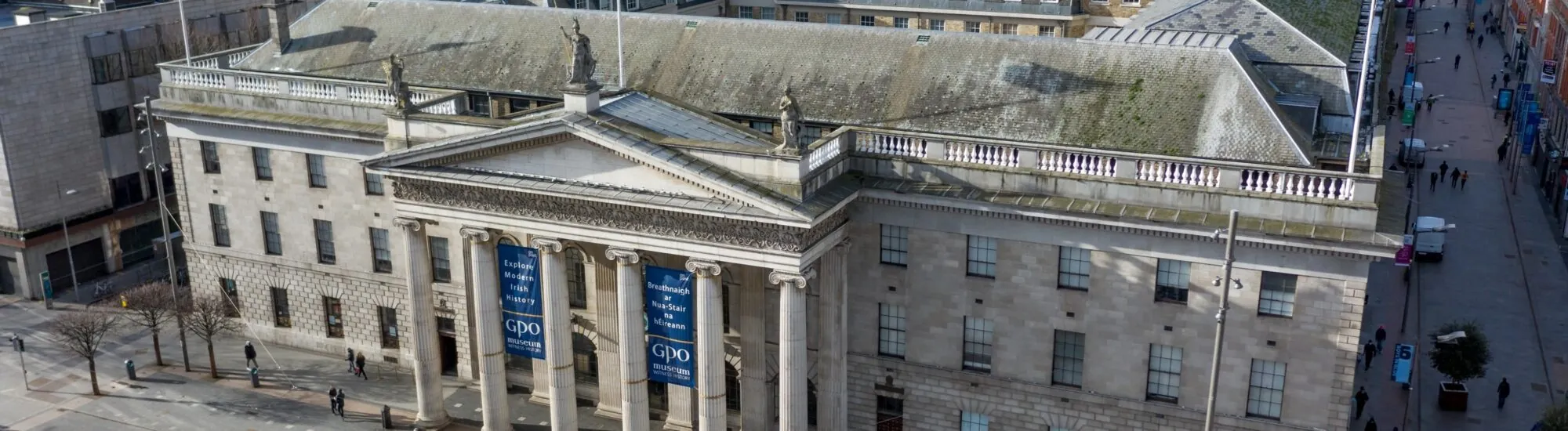
Six monumental columns dominate O’Connell Street. Bullet marks in their stone recall that, in April 1916, Dublin’s General Post Office was far more than a post office: it became the headquarters of an uprising intended to proclaim an Irish republic.
Still in operation, the GPO now serves An Post customers, travellers drawn by its architecture and visitors to the GPO Museum. A few metres from the Spire, the building remains one of the capital’s most striking landmarks: at once a public service, a place of remembrance and a symbol of Irish independence.
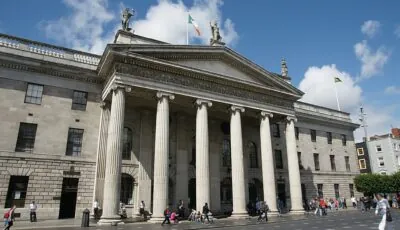
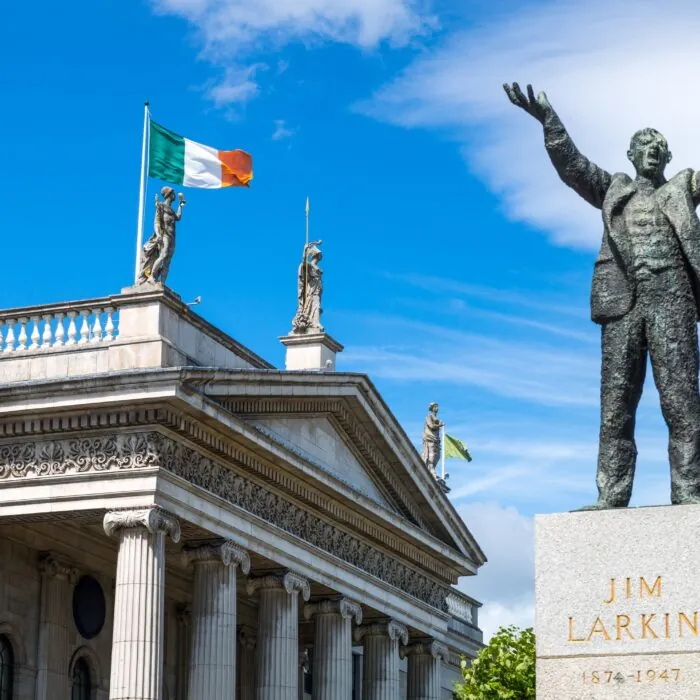
Dublin’s General Post Office – © Stefan Jürgensen
The General Post Office, usually known as the GPO, stands on O’Connell Street Lower, the main thoroughfare in central Dublin. Its neoclassical façade and vast portico immediately set it apart from the neighbouring commercial buildings.
The GPO houses the headquarters of An Post, Ireland’s national postal operator. It is not, strictly speaking, a post bank, although An Post now offers a range of financial, banking and administrative services.
The grand public hall remains a working post office. Visitors can buy stamps, send letters or parcels, and use the services available at the counters. Entry is free during post office opening hours.
Another part of the building houses the GPO Museum, formerly known as GPO Witness History. This ticketed museum traces the Easter Rising, the War of Independence, the Civil War and several other episodes that shaped modern Ireland.
At the beginning of the 19th century, Dublin’s central post office occupied premises on College Green and later in various streets across the capital. The growth of postal services and communications made a larger building necessary.
The architect Francis Johnston, who was born in County Armagh, was commissioned to design the new building. Already known for several Irish public buildings, he envisaged a monument intended to convey the power and stability of the administration.
The foundation stone was laid in August 1814 by Charles Whitworth, Lord Lieutenant of Ireland. Construction took almost three and a half years. The building finally opened to the public in January 1818.
The GPO quickly became the heart of communications in Ireland. Postal services were gradually joined by the telegraph, telephone and financial services provided by the Post Office Savings Bank.
The GPO façade is dominated by a portico of six Ionic columns. They support a broad triangular pediment topped by three statues representing Mercury, Fidelity and Hibernia, the allegorical figure of Ireland.
The central section is clad in Portland stone, whose pale tone contrasts with the granite used on the rest of the façade. The ensemble reflects the neoclassical taste of the early 19th century, inspired by the architecture of ancient Greece and Rome.
Francis Johnston’s original design was arranged around a courtyard where vehicles carrying mail could circulate. Passages leading to Henry Street made it easier for mail coaches to arrive and depart.
The building visible today is not, however, entirely the one completed in 1818. Much of its interior was destroyed during the Easter Rising and rebuilt in the 1920s.
When the organisers of the Easter Rising devised their strategy, the GPO offered several advantages. It stood in central Dublin, held a commanding position on Sackville Street, the former name of O’Connell Street, and controlled an essential part of the country’s postal, telegraphic and telephone communications.
The uprising was not organised by an Irish government, as Ireland was then governed from London. It was prepared in secret by members of the Irish Republican Brotherhood, with the involvement of the Irish Volunteers, the Irish Citizen Army and the women’s organisation Cumann na mBan.
The rebels planned to seize several strategic buildings across Dublin simultaneously. The GPO was to become their headquarters and the symbolic seat of the provisional government of the proclaimed Republic.
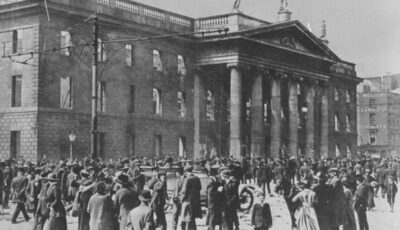
The Easter Rising, 1916 – Public domain
On 24 April 1916, Easter Monday, several hundred fighters took over the General Post Office. They included Patrick Pearse, James Connolly, Thomas Clarke, Joseph Plunkett and Seán Mac Diarmada.
From the steps of the GPO, Patrick Pearse publicly read the Proclamation of the Irish Republic. The text announced the creation of a provisional government and proclaimed the Irish people’s right to independence.
Inside the building, the rebels organised their command, set up an infirmary and attempted to maintain communications with their various positions across the city. Women from Cumann na mBan and the Irish Citizen Army notably carried out liaison and nursing duties.
The green flag bearing the words “Irish Republic” and the Irish tricolour were raised on the roof. Their presence above the GPO immediately gave the building symbolic importance.
British forces gradually surrounded the rebel positions. Artillery bombarded central Dublin from several points, including the banks of the Liffey.
On Friday 28 April, the GPO was devastated by fire. Flames spread to the upper floors and caused part of the roof to collapse. The smoke and heat made the position impossible to hold.
The rebels then broke through the walls of neighbouring buildings in order to move forward without exposing themselves directly in the streets. They eventually reached Moore Street, where the command retreated.
Patrick Pearse agreed to surrender on 29 April to prevent further civilian losses. Fifteen leaders of the uprising were subsequently executed by the British authorities, including fourteen at Kilmainham Gaol. Roger Casement was hanged in London a few months later.
Several visible marks on the columns and exterior walls are commonly associated with gunfire during the Easter Rising. They give the façade an almost documentary quality.
These marks are not always easy to identify at first glance. The stone also bears the effects of erosion, restoration work and two centuries of exposure to urban pollution. The clearest marks can be seen on the columns and in the lower sections of the portico.
The building is therefore one of the few places in central Dublin where physical traces of the fighting of 1916 can still be observed directly in the cityscape.
After the fighting, the façade and portico remained standing, but most of the interior had been destroyed. For several years, the central post office operated from temporary premises.
The War of Independence, the Anglo-Irish Treaty and then the Civil War delayed reconstruction. Work could only truly begin after the creation of the Irish Free State.
The project was entrusted to a team from the Office of Public Works led by the architect T. J. Byrne. The historic sections were retained while the building was enlarged and adapted to the needs of a modern postal administration.
The new public hall combines certain neoclassical elements with décor influenced by Art Deco. The restored GPO officially reopened in 1929, at a ceremony presided over by W. T. Cosgrave.
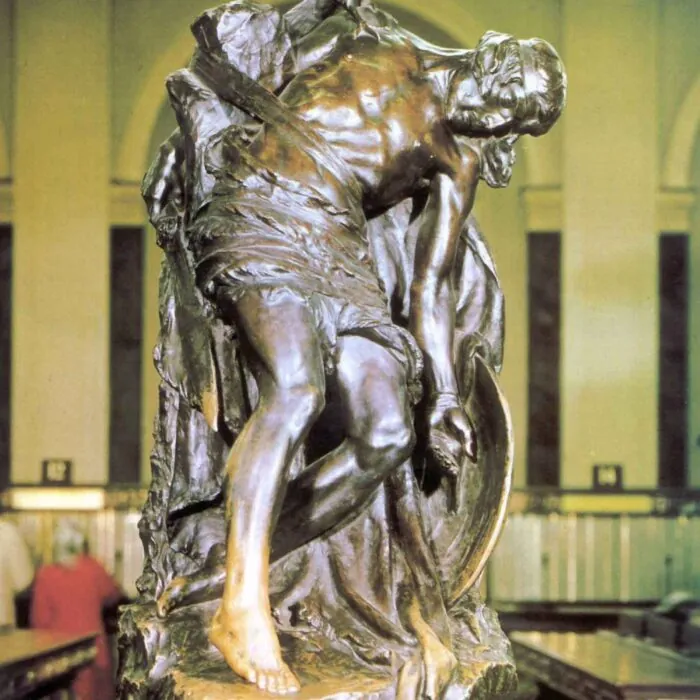
In the GPO hall stands The Death of Cúchulainn, a sculpture by Oliver Sheppard depicting the death of the hero of Irish mythology.
Mortally wounded, Cúchulainn ties himself to a stone so that he can die standing, facing his enemies. The image of the warrior refusing to fall gradually became associated with the sacrifice of the 1916 rebels.
The sculpture was not installed immediately after the rebellion. It was chosen by Éamon de Valera as the official memorial to the Easter Rising and unveiled in the GPO in 1935.
It stands before a window overlooking O’Connell Street, visible from both the hall and outside. Its image also appears on Irish 10-shilling coins struck for the fiftieth anniversary of the uprising in 1966.
The GPO Museum, opened in 2016 under the name GPO Witness History, occupies part of the historic building. It is not simply a postal museum: its exhibition mainly focuses on the events that led to Irish independence.
The exhibition places the Easter Rising in its political and social context. It presents the rebels’ objectives, the British military response and the experiences of civilians caught in a city transformed into a battlefield.
The story continues with the War of Independence, the Anglo-Irish Treaty negotiations, the Civil War and the building of the Irish state. The exhibition also addresses the conflict in Northern Ireland and the peace process that led to the Good Friday Agreement in 1998.
Interactive screens, recordings, photographs and historic objects offer different perspectives. An immersive film recreates the course of the uprising in central Dublin.
The museum displays documents relating to the Proclamation of the Republic, the 1916 fighters and those affected by the clashes. The exhibition design gives considerable space to individual testimonies.
Visitors can use several interactive displays, compose a newspaper page or try sending a message in Morse code. These installations help explain the strategic role played by communications during the uprising.
The exhibition also seeks to go beyond an exclusively military interpretation. It examines the consequences of the fighting for residents, the destruction in the city centre and the diversity of opinions running through Irish society at the time.
In 2026, the museum is notably hosting the temporary exhibition Peace Heroines, devoted to the role of thirty women in the peace process in Northern Ireland. It runs until 31 August 2026 and is included in the admission ticket.
Access to the main post office hall is free during An Post opening hours. Visitors can observe the décor, see the statue of Cúchulainn and use postal services.
This free entry does not, however, include access to the GPO Museum. A ticket is required to visit the historical exhibition.
Please respect the operation of the post office. The counters serve genuine customers, and the hall should not be regarded as an exhibition space devoted entirely to tourists.
Seeing the façade, postal hall and statue of Cúchulainn may take around fifteen minutes. However, allow between one and two hours to explore the GPO Museum and make the most of its interactive displays.
The museum can be visited independently. Themed guided tours are also offered on certain dates, notably on the Easter Rising, Michael Collins or women involved in political and peace movements.
An audio guide is available in several languages, including French. Depending on the arrangements in place at the time of the visit, it may also be available as an app.
Information and bookings are available on the official GPO Museum website.
Essential information to help you plan your visit, including key landmarks, access information, and booking options.
O'Connell Street, O'Connell Street (County Dublin) - Republic of Ireland
53.349359, -6.260732
An Post post office opening hours:
GPO Museum opening hours:
Allow between one and two hours to explore the museum. The post office and exhibition opening hours may change independently.
We recommend checking with An Post and the GPO Museum.
Check the opening hours and admission requirements before you leave, especially during peak season or on Irish public holidays.
These prices apply to tickets purchased online. Prices charged on site may be €2 to €5 higher, depending on the category selected.
Access to the General Post Office public hall remains completely free. Only a visit to the GPO Museum requires a ticket.
Special guided tours and certain events may have separate pricing. Online booking is recommended to secure the best price and guarantee entry.
Prices may change. Book via the official GPO Museum website.