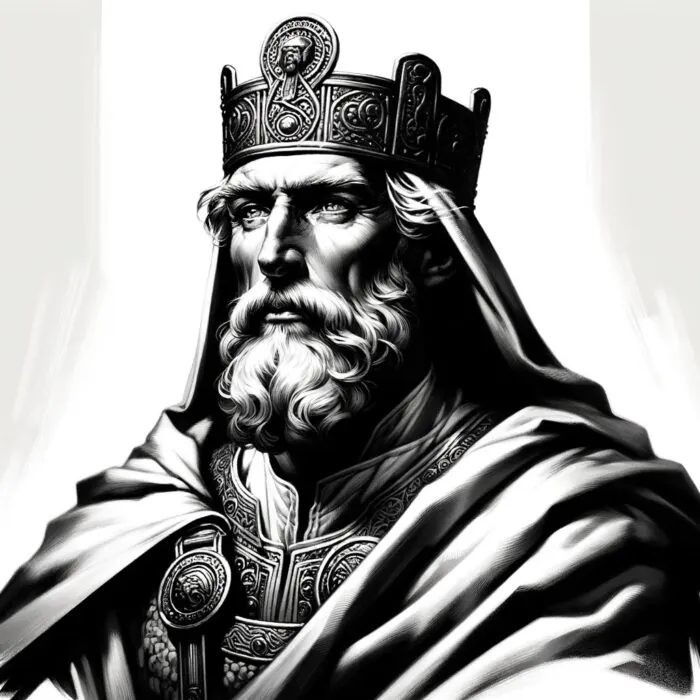

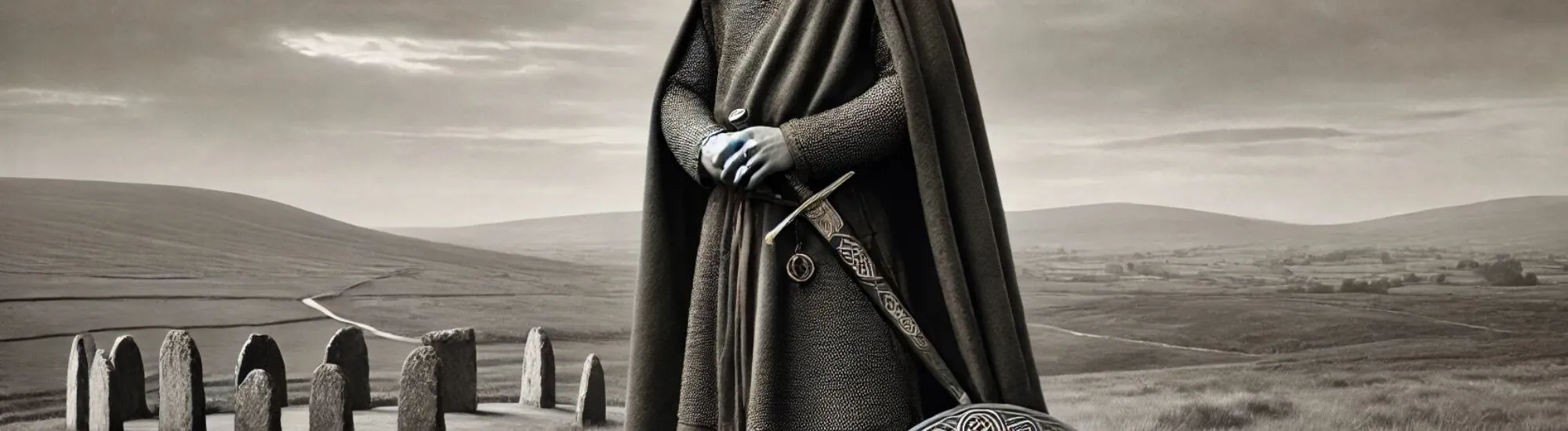
Ireland’s history is filled with kings bearing legendary names, epic battles, and tales tinged with myth. Among them, Lóegaire mac Néill holds a special place. High King of Ireland in the 5th century, he is best known as the reigning monarch at the time of Saint Patrick’s arrival, the central figure in the island’s Christianization. This sovereign, son of the legendary Niall of the Nine Hostages, represents a pivotal moment in Irish history: the clash between ancient Celtic pagan traditions and the emerging Christianity.
Lóegaire mac Néill belonged to the Uí Néill dynasty, one of the most powerful Gaelic lineages in medieval Ireland. His father, Niall Noígíallach, is a semi-legendary figure whose name means “of the Nine Hostages,” referring to the practice of taking hostages from vassal kings’ children to ensure their loyalty. This Niall is considered the ancestor of many royal families in northern Ireland, notably the O’Neill clan.
Lóegaire grew up surrounded by power, prestige, and warrior traditions. From a young age, he was groomed to rule Tara, the symbolic and religious capital of Ireland.
It’s important to understand that 5th-century Ireland was not a unified kingdom as we conceive it today. The country was divided into several regional kingdoms, often at war with each other. The High King of Ireland (Ard Rí na hÉireann), a title held by Lóegaire, was not an absolute monarch. Instead, he held symbolic authority over the entire island, notably through religious influence and the organization of major assemblies such as those held at Tara.
Lóegaire mac Néill became High King amid political tensions and power struggles between clans. He likely ruled intermittently between 428 and 458, although dates vary depending on sources.
The most significant event of Lóegaire’s reign was undoubtedly his confrontation with Saint Patrick, the apostle of Ireland. According to hagiographic accounts, especially the “Vita Sancti Patricii” written by Muirchú, Patrick lit a paschal fire on the Hill of Slane, visible from the royal hill of Tara, defying a royal prohibition.
This symbolic act marked a turning point. Patrick’s fire shone in the pagan night, signaling not only the presence of the new Christian faith but also its boldness in challenging established royal and religious power. Lóegaire, furious at this transgression, reportedly summoned Patrick to Tara to assert his authority and defend the old gods.
However, according to legend, Patrick stood his ground. He preached before the king, performed miracles, and converted part of his court. This highly symbolic narrative depicts a power struggle between Christianity and ancient Celtic beliefs. Some versions suggest Lóegaire resisted conversion but tolerated Patrick’s mission, perhaps compelled by supernatural signs or increasing political pressure.
Lóegaire mac Néill was not a caricatured opponent of Christianity. Although most sources were written by Christian monks long after the events, they reveal a more complex figure. He likely did not actively persecute Patrick but sought to preserve his authority by maintaining a degree of religious neutrality.
His position was delicate. On one hand, he had to contend with druids and ancestral traditions that legitimized his rule. On the other, Christianity was gaining popularity, especially among intellectual and administrative elites. Ignoring this new religion could weaken his position, but embracing it too soon might jeopardize his traditional authority.
According to tradition, Lóegaire even requested to be buried standing, armed, and facing his enemies in Leinster, symbolically blocking their path even in death. If true, this gesture speaks volumes about his attachment to warrior values and the old order.
Although posterity often pits Lóegaire against Saint Patrick, his reign represents a major transitional phase in Irish history. He was the last fully recognized pagan High King before Christianity firmly established itself within the island’s political and social structures.
Through his descendants, he also indirectly contributed to the spread of Christianity. Several members of his lineage embraced the Christian faith and helped integrate the new religion into Gaelic dynasties. One of his successors, Diarmait mac Cerbaill, played a key role in the widespread adoption of Christian monasticism.
Culturally, Lóegaire has inspired numerous works, legends, and studies. He embodies an Ireland caught between two worlds: that of the old gods and that of the one God. He symbolizes an era when royal authority could no longer rest solely on myths and swords but had to reckon with a new force: faith and literacy.
Lóegaire mac Néill’s reign reminds us that Ireland’s history is not a simple opposition between pagans and Christians, Celts and Romans, druids and bishops. It is a mosaic of powers, cultures, shifting alliances, and resistances.
Often reduced to a mere footnote in history books, this king deserves our full attention. He stands at the crossroads of an ancient civilization and a new world. He may not have been a great builder or a flamboyant conqueror, but he was one of the last guardians of an old order that Christian faith would profoundly transform.
Lóegaire mac Néill, a king between two worlds, invites us to rethink Irish history not as a series of fixed events but as a fluid narrative shaped by beliefs, strategies, and complex political choices. – High K