Just a few steps from O’Connell Street, behind the stalls and shopfronts of one of Dublin’s oldest shopping streets, four houses tell the story of the final hours of one of the defining events of modern Ireland. Numbers 14 to 17 Moore Street, associated with the last moments of the 1916 Easter Rising, are set to become the heart of a new museum and commemorative centre devoted to the uprising.
Long delayed, the project has just reached a new stage. According to information released in September 2026, the Office of Public Works (OPW) now plans to seek contractors for the work before the end of the year. The current aim is to complete the project around 2028, although no final opening date has yet been guaranteed.
For Dublin, the stakes extend far beyond the creation of another museum. Moore Street is closely bound up with the final days of the Easter Rising, but also with the capital’s popular and commercial history. The redevelopment of the site is intended to preserve several historic buildings while making their story accessible to visitors.
Moore Street, the final headquarters of the 1916 insurgents
Ordinary houses at the heart of a defining moment in Irish history
To understand the importance of Moore Street, it is necessary to return to the final days of April 1916. Since the start of the uprising, the General Post Office, now better known as the GPO, had served as the insurgents’ main headquarters in central Dublin.
But on Friday 28 April, the building was ravaged by fire and became impossible to defend. Patrick Pearse and the other fighters then evacuated the GPO and made their way towards Moore Street under British fire.
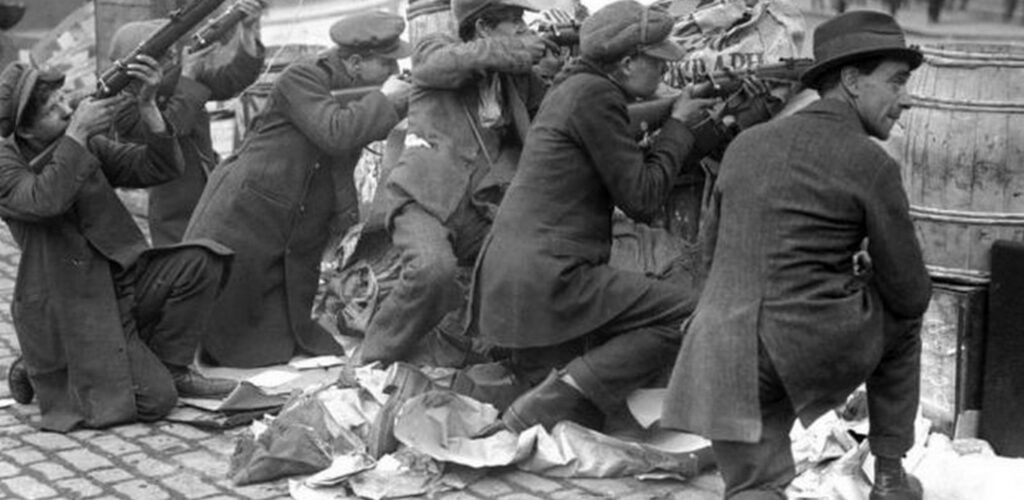
To avoid exposing themselves directly in the street, the insurgents moved from one building to another by breaking passages through the walls of adjoining houses. Several hundred fighters thus found themselves in the area.
Number 16 Moore Street, then occupied by a poultry shop, eventually became their final headquarters. It was here, in particular, that the leaders of the uprising discussed whether to continue fighting and the consequences this might have for the civilian population.
On 29 April 1916, the decision was finally made to seek terms of surrender.
Elizabeth O’Farrell, a nurse and member of Cumann na mBan, then left Moore Street carrying a white flag in order to make contact with British forces. Patrick Pearse subsequently met General William Lowe before accepting the surrender.
Moore Street thus became the setting for the very final hours of the Easter Rising leadership.
Houses 14 to 17 Moore Street are to be restored
A national monument transformed into a visitor attraction
The four historic houses at numbers 14 to 17 Moore Street were designated a National Monument in 2007.
For several years, their preservation has been the subject of significant debate in Dublin, particularly because of the various property development projects proposed around Moore Street and the neighbouring streets.
The current project provides for the conservation and restoration of these historic buildings before they are opened to the public.
However, the future site will not be limited to the four houses.
A new facility is also to be built directly behind them, at numbers 8 and 9 Moore Lane. This additional building will make it possible to create a fully fledged visitor experience around the historic houses.
The future centre is expected to include an exhibition devoted to the 1916 Rising and the events that took place on Moore Street. Historic objects may also be displayed to the public.
Spaces for cultural events, commemorations, school groups and local associations are also planned.
An outdoor area is also expected to provide a link between the historic Moore Street buildings and the new Moore Lane facility.
A museum originally planned for 2016
Ten years of delays and controversy
The story of the future museum is almost as eventful as that of the neighbourhood itself. Opening the buildings to the public was originally intended to be one of the major projects associated with the centenary of the Easter Rising in 2016.
However, the Irish State did not acquire the houses until 2015.
A few weeks later, legal proceedings brought in particular by descendants of participants in the uprising and heritage campaigners led to the project being halted.
They sought, in particular, for the protection granted to the National Monument to cover a larger part of the historic Moore Street area.
In March 2016, the High Court brought work to a halt. That decision was subsequently overturned by the Court of Appeal in February 2018.
Other regulatory and administrative procedures, however, continued to slow the delivery of the project.
In 2024, a new ministerial approval became necessary in particular because of the time that had elapsed since the initial approvals. The business case also had to be reassessed in order to comply with the rules applying to major public projects.
As a result, the centre that was originally intended to accompany the 1916 centenary may ultimately welcome its first visitors more than twelve years after the date initially hoped for.
An opening now envisaged around 2028
The OPW remains cautious about the timetable
In September 2026, however, the timetable is beginning to take more concrete shape.
The Office of Public Works plans to launch the process of selecting contractors capable of carrying out the work before the end of 2026.
Completion of the centre is currently envisaged for 2028. Caution is still warranted, however: no firm date for opening to the public has yet been announced.
The final cost of the project is also not yet known. An estimate made in 2022 put the scheme at around €16.25 million, but this figure is likely to have changed since then because of inflation and rising construction costs.
The OPW is expected to wait until the tender process has taken place before releasing a more precise estimate.
Moore Street could become a major stop on historic Dublin’s trail
From the GPO to the final hours of the Easter Rising
For travellers interested in Irish history, the opening of Moore Street will above all complete a particularly coherent historical itinerary through central Dublin.
The GPO already tells the story of the outbreak of the Easter Rising and the building’s role as the rebels’ main headquarters.
Moore Street will carry the story through to its final chapter, in the very houses where the insurgents took refuge after evacuating the GPO.
The two sites are only a few minutes’ walk apart.
But Moore Street also has an identity that extends far beyond the history of 1916.
The street has long been known for its market and its traditional shops. Fruit, vegetables and foodstuffs have been sold here for generations, giving the area an atmosphere very different from the main tourist thoroughfares of central Dublin.
This overlap between national history and everyday life also explains why the future of the neighbourhood remains such a sensitive issue.
The challenge is as much about preserving the traces of the Easter Rising as it is about retaining the popular, commercial identity that still gives Moore Street its character today.
Can you visit the Moore Street museum yet?
The future centre is not yet open to the public
No. In September 2026, the future Moore Street museum is not yet open to visitors.
The current announcements concern the project’s progress and the forthcoming works. There are therefore no tickets yet available to access the historic houses as part of this new museum experience.
It is, however, entirely possible to explore Moore Street and include the area in a walking tour of sites associated with the Easter Rising.
Its location is particularly convenient: the street lies immediately beside O’Connell Street and the GPO, in the very heart of Dublin.
If the current timetable is met, houses 14 to 17 Moore Street could therefore become one of the Irish capital’s major new historic attractions in the coming years.
Practical information
The future Moore Street centre
- Address: 14-17 Moore Street and 8-9 Moore Lane, Dublin 1
- Project: a historical and cultural centre devoted in particular to the 1916 Easter Rising
- Status in September 2026: site under development, not yet open to the public
- Tender process: planned before the end of 2026
- Expected completion: around 2028
- Opening to the public: no final date announced