
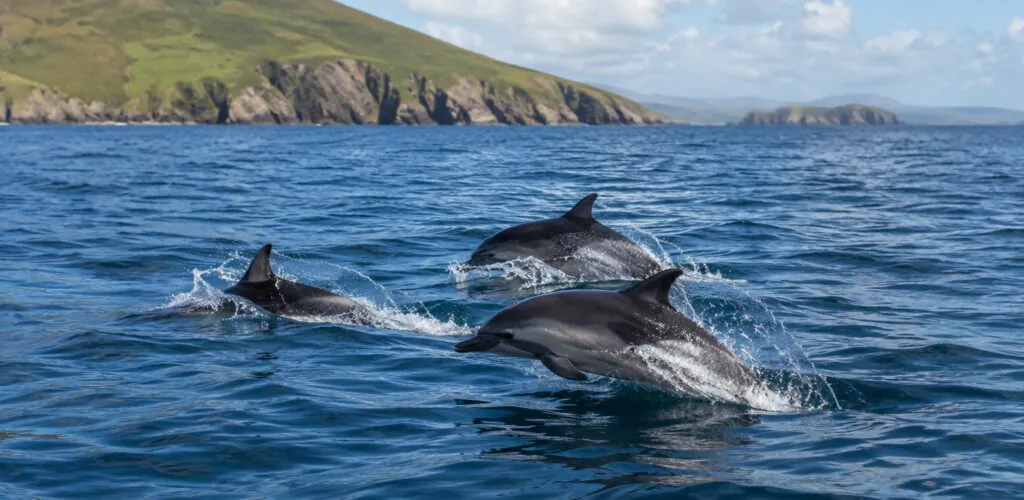
A major community effort was launched on a beach in west Kerry after a group of common dolphins became stranded. Residents, tourists, specialists and Gardaí joined forces to return the surviving animals to the water. In total, twelve dolphins made it back to sea. Sadly, nine others did not survive.
Dolphins stranded on a beach on the Dingle Peninsula
An urgent rescue operation
The incident took place on Wednesday 12 August 2026 at Trá na Feothanaí, in the Corca Dhuibhne area of western County Kerry. The animals involved were common dolphins (Delphinus delphis), a species found in Irish waters.
The alert quickly brought people able to assist the animals to the scene. Members of the Irish Whale and Dolphin Group (IWDG), local residents, tourists and Gardaí were among those involved in the operation.
The situation was particularly delicate. Several dolphins had already died by the time help arrived, while the animals still alive had to be handled carefully and kept in an appropriate position.
Using stretchers and with the help of many people, eight dolphins were initially carried into sufficiently deep water to regain buoyancy. They then headed out to sea and began swimming in the right direction.
Four other animals had already been returned to the water during the operation, bringing the number of dolphins saved to twelve. Those present continued to monitor the area to ensure they did not return and become stranded again. According to information released after the operation, they had not been seen again on the beach. Nine dolphins, however, died during the stranding.
Why did so many dolphins end up on the beach?
Ocean-going animals that can become trapped close to shore
The reasons for a mass stranding are rarely easy to establish with certainty. Illness, disorientation, underwater terrain, tides, environmental conditions and group behaviour may all play a part.
In the Kerry case, one explanation put forward by specialists concerns the search for food. Unlike bottlenose dolphins, which are frequently seen in coastal environments, common dolphins are more closely associated with offshore waters.
However, these animals can follow shoals of fish into much shallower areas. A beach with sandbanks and a falling tide can then become a trap: the dolphins pursue their prey, the water recedes, and their route back to open sea is cut off.
More broadly, the IWDG notes that live strandings can have multiple causes. The organisation cites the animal’s health, age, the strong social bonds of cetaceans, navigational errors, environmental factors, the search for food and certain human activities.
These social bonds are especially important among dolphins. An animal in difficulty may be accompanied by other members of its group, which can sometimes turn the stranding of a single individual into a mass stranding.
What should you do if you find a stranded dolphin in Ireland?
Do not attempt to return it to the water yourself
For a traveller who finds a live dolphin, porpoise or whale on an Irish beach, the first instinct may be to push the animal straight back into the sea. This is precisely what you should not do without trained people on hand.
The Irish Whale and Dolphin Group recommends immediately notifying its specialist stranding network. For a live animal, the Live Stranding Hotline can be reached on 097 28118.
While waiting for help, keep some distance, keep dogs away, and avoid noise or disturbance around the cetacean. A photograph or short video taken from a distance, along with the exact GPS location, can also help specialists assess the situation more quickly.
Never pull a dolphin by its fin or tail. Moving such a heavy animal requires suitable equipment and precise technique. Incorrect handling can cause further injuries both to the dolphin and to those trying to help it.
Kerry, a prime region for whale and dolphin watching
Dolphins regularly found off the Dingle Peninsula
The event is also a reminder of the exceptional richness of the waters around western Ireland. Kerry, and the Dingle Peninsula in particular, is an especially interesting area for travellers with a passion for marine wildlife.
Common dolphins, bottlenose dolphins, porpoises and various whale species can be found in Irish waters, depending on the area and the time of year. Their presence is, of course, never guaranteed: they are wild animals that move freely according to food resources and marine conditions.
Wildlife watching should therefore remain respectful. At sea, it is best to choose a supervised trip and avoid any attempt to pursue or deliberately approach the animals too closely.
Finally, the Trá na Feothanaí rescue shows just how much the response of those present can matter. In this kind of situation, helping does not necessarily mean going into the water: raising the alarm quickly and following specialists’ instructions is already the best way to give the animals a chance.
Source: information published by the Irish Whale and Dolphin Group and by Irish media outlets RTÉ, The Journal and Irish Examiner on 13 and 14 August 2026.