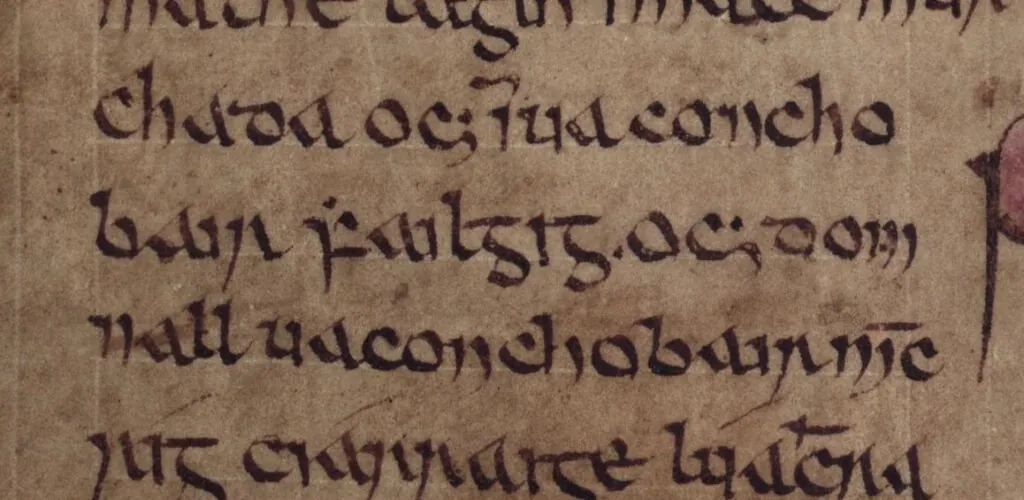
It is one of the most precious written records of medieval Ireland. The Annals of Inisfallen, a manuscript comprising 57 vellum leaves and closely associated with the monks of Killarney, have returned to Ireland for an exceptional exhibition. Held at the University of Oxford for more than 250 years, the original document is being shown to the Irish public for the first time in 40 years.
Vikings, Normans, storms, comets and events on Skellig Michael: across its pages, the manuscript recounts more than a millennium of Irish history. Some entries were written at the very time the events they describe took place, giving it exceptional historical value.
The Annals of Inisfallen make an exceptional return to Ireland
The original manuscript is on display in Cork
From 2 September 2026, visitors can see the original Annals of Inisfallen at University College Cork (UCC), as part of an exhibition at the Glucksman.
Entitled Recording the Past: The Annals of Inisfallen and the Making of Irish History, the exhibition will remain open for two months, until 1 November 2026.
The event is exceptional. It is the first public display of the manuscript in Ireland in 40 years.
The document is normally held at the Bodleian Library at the University of Oxford, which has kept it for more than 250 years.
For this exhibition, the original has travelled to Cork and is displayed in a specially designed case. A digital version also allows visitors to explore its contents more easily.
What are the Annals of Inisfallen?
57 vellum leaves telling the story of Ireland
The Annals of Inisfallen are a bound manuscript made up of just 57 vellum leaves. Yet behind this relatively modest format lies one of the major written sources for understanding medieval Ireland.
The texts are written in Latin and Irish and take the form of a chronological sequence of events.
The annals address the history of Ireland as a whole, but give particular prominence to Munster.
Their account spans more than a thousand years, from a period before the arrival of Saint Patrick to the final additions made in the 15th century.
They record the deaths of important figures, as well as conflicts, invasions, natural phenomena and events extraordinary enough for scribes to consider them worthy of being recorded.
A manuscript closely associated with the monks of Killarney
The annals were kept on Inisfallen Island
The manuscript takes its name from Inisfallen Island, a small island on Lough Leane, the largest of the Killarney lakes.
The ruins of an ancient monastery can still be seen there today, in the heart of Killarney National Park.
The manuscript’s exact history is, however, more complex than one of writing carried out entirely on this island.
Specialists believe that its first section was probably copied at the monastery of Lismore, County Waterford, using, among other sources, documents from the religious communities of Clonmacnoise and Emly.
Between 1130 and 1159, the manuscript was then reportedly transferred to a monastery in western Munster, most likely that of Inisfallen.
Many of the later entries are therefore associated with the monks who lived in this region.
Vikings and Skellig Michael appear in the annals
The monks recorded the events that shaped their time
The Annals of Inisfallen are not simply a chronology of kings and religious figures.
The manuscript also recounts some of the violent events that marked medieval Ireland, including Viking raids and the arrival of the Normans.
The places mentioned even include Skellig Michael, the spectacular monastic island off the Kerry coast.
Religious communities on Ireland’s coasts and islands were particularly exposed to raids from the sea. The annals thus preserve the memory of an era when some of Ireland’s most peaceful and popular visitor sites today lay at the heart of a particularly turbulent period.
Comets and ‘great snow’: the monks also recorded the weather
Some events seem surprisingly familiar
The scribes were also interested in unusual natural phenomena.
The annals mention the appearance of comets and several notable weather events.
Among them was a ‘great snow’ in 1047.
Such entries are particularly valuable to historians. Beyond battles and political successions, they offer an insight into what people in the Middle Ages considered extraordinary enough to be preserved in writing for centuries to come.
A King of Scotland is said to have given a camel to Ireland
One of the manuscript’s most surprising anecdotes
It is probably one of the most unusual details preserved in the Annals of Inisfallen.
In 1105, the scribes report that a camel was said to have been given by the King of Scotland to a great-grandson of Brian Boru.
The presence of such an animal in 12th-century Ireland would, naturally, have attracted attention.
This brief mention also illustrates the value of the annals: alongside major political events, unexpected details sometimes emerge, lending a far more human dimension to medieval history.
Some 30 people contributed to their writing
Generations of scribes followed one another
The Annals of Inisfallen are not the work of a single author.
From the 11th century until the 14th century, different people continued the work in succession. Researchers have identified the contributions of around 30 scribes.
This feature is essential: for part of this period, the annals are no longer simply a compilation of ancient events.
The scribes recorded events from their own time. For certain periods, the document therefore becomes a contemporary account of the events it relates.
Later additions would extend the historical account to the 15th century.
The Annals of Inisfallen are also a treasure of the Irish language
The manuscript charts the shift from Latin to Irish
The document’s value is not limited to political or religious history.
It is also a particularly important source for specialists in the Irish language.
The manuscript combines Latin and Irish, and gradually demonstrates the use of Irish as a language of learning and historical transmission.
The linguistic features of certain sections of the annals still allow researchers today to study the evolution of the language during the Middle Ages.
How did the manuscript end up in Oxford?
The annals left Ireland several centuries ago
After several centuries in the religious communities of Munster, the manuscript’s trail becomes much harder to follow.
It is known to have eventually entered the collection of Sir James Ware, the Irish historian and politician who died in 1666.
It was subsequently acquired by Richard Rawlinson, a major British collector of manuscripts in the 18th century.
On his death, Rawlinson bequeathed his extensive collection to the Bodleian Library at the University of Oxford.
The Annals of Inisfallen have been held there for more than 250 years under the reference Rawlinson B. 503.
Their temporary return to Cork in 2026 is therefore a particularly rare heritage event.
Can you still visit Inisfallen Island in Killarney?
The island where the annals were kept still exists
The manuscript’s story has a fascinating aspect for travellers: its setting still exists.
Inisfallen Island lies on Lough Leane, in the heart of Killarney National Park. The island retains the ruins of its former abbey and is now one of the most distinctive historic sites on the Killarney lakes.
It is not connected to the shore by road or bridge. It can therefore be reached by boat.
A visit to the Annals of Inisfallen in Cork can thus be followed by a trip to Killarney and the island that still bears their name, placing this exceptional document back in the landscape where part of its history unfolded.
Prices
How much does the Annals of Inisfallen exhibition cost?
- Exhibition: free admission to the Glucksman.
- University College Cork: access to the campus and museum is free during opening hours.
Some events or organised visits connected with the exhibition may, however, require advance booking.
Opening times
When can you see the Annals of Inisfallen in Cork?
- Exhibition opens: 2 September 2026.
- Exhibition closes: 1 November 2026.
- Venue: The Glucksman, University College Cork, Cork.
The original Annals of Inisfallen are displayed in a case throughout the exhibition. A digital version of the manuscript is also available to visitors.
Main sources: RTÉ News, University College Cork and CELT – Corpus of Electronic Texts.