Mark Zuckerberg has acquired a spectacular piece of Irish heritage. The Meta chief executive and his wife, Priscilla Chan, have bought Strancally Castle, a vast 19th-century Gothic Revival residence on the banks of the Blackwater in County Waterford. Surrounded by around 178 hectares of land and woodland, the property is reportedly valued at between €20 million and €30 million.
Mark Zuckerberg buys a castle in Ireland
Strancally Castle becomes the Meta chief executive’s new property
It is a property acquisition that has not gone unnoticed. Mark Zuckerberg and his wife Priscilla Chan are now the owners of Strancally Castle, an imposing historic estate in south-east Ireland.
The news was made public on 20 August 2026. The purchase is believed to have been completed several weeks earlier in an off-market transaction.
The exact amount paid by the couple has not been disclosed and had not yet appeared in Ireland’s property transaction register when the news emerged. However, the estate is estimated to be worth between €20 million and €30 million.
A spokesperson for Mark Zuckerberg confirmed the acquisition, saying that his family wanted to continue caring for the historic residence and planned to spend time there during visits to Ireland.
Where is the castle bought by Mark Zuckerberg?
A vast estate on the banks of the River Blackwater
Strancally Castle is in County Waterford, on the banks of the River Blackwater, one of southern Ireland’s major waterways.
The estate lies around 20 kilometres north of Youghal, the coastal town in County Cork. The area is far more rural than Ireland’s major tourist destinations, characterised by farmland, woodland and the grand historic estates lining the Blackwater Valley.
The castle is surrounded by around 440 acres of land, or nearly 178 hectares. The estate combines pasture and woodland, extending down to the river, where it has its own jetty.
With its Gothic architecture and vast grounds, Strancally closely matches the image one might have of an Irish castle set deep in the countryside.
What does Strancally Castle look like?
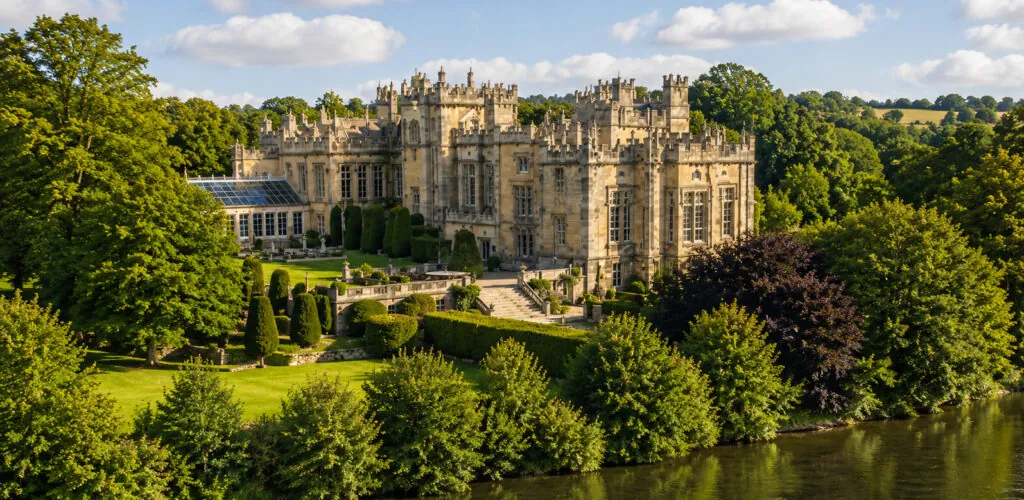
A Gothic Revival residence of nearly 1,500 m²
Despite its name, Strancally is above all a grand aristocratic residence built in the 19th century in the Gothic Revival style.
The present building is believed to have been constructed from 1827 for John Keily, a former MP and High Sheriff of County Waterford. Its design is attributed to the architects James and George Richard Pain, two important figures in 19th-century Gothic Revival architecture in Ireland.
The residence extends over three storeys and covers around 16,000 square feet, or nearly 1,500 m².
Its architecture is distinguished by its towers, battlements and decorative features directly inspired by medieval architecture. The estate also includes several historic remains and structures, including a folly resembling a medieval tower house, the ruins of former pleasure gardens, a Chinese pagoda and the remains of an aviary.
A castle fully restored before its acquisition
More than 20 years of work carried out by the previous owners
Mark Zuckerberg is not buying a romantic ruin requiring complete reconstruction.
Strancally Castle had belonged for more than 20 years to Michael Alen-Buckley, co-founder of the investment firm RAB Capital, and his wife Giancarla.
The couple bought the property in the early 2000s before undertaking an extensive restoration of the estate. The work modernised the residence while preserving much of its historic architectural character.
The present castle is therefore a restored, habitable property rather than an abandoned monument.
Why is Mark Zuckerberg buying a property in Ireland?
The Meta chief executive has significant professional ties to the country
The acquisition does not, however, signal that Mark Zuckerberg is moving to Ireland.
The billionaire and his family are expected to retain their main residence in the United States and use Strancally Castle during their stays in Ireland.
His connection to the country is notably professional. Meta has its international headquarters in Ireland. Facebook established itself in Dublin as early as 2009, and the group now has several operations in the country.
Meta has around 1,500 employees in Ireland, based in Dublin, Cork and County Meath among other locations. The group also has Reality Labs operations in the Cork area and a major data centre in Clonee.
Strancally Castle could therefore become a residence used by the Zuckerberg family during certain business or private trips to Ireland.
A castle linked to a striking Irish legend
The current residence should not be confused with the old Strancally Castle
The story becomes even more intriguing when going back several centuries. But one distinction is essential: the castle bought by Mark Zuckerberg is not the old Strancally Castle associated with the famous local legend.
The ruins of the medieval castle stand around 4.5 kilometres further upstream on the Blackwater. This former stronghold was associated with the powerful Desmond family.
A particularly dark legend tells how some guests were allegedly lured into a room in the castle before being thrown through an opening into the river.
This story contributed to the reputation of the old Strancally Castle and its famous “murder hole”. However, it should be regarded as a historical legend, rather than an episode established with certainty by historians.
The residence acquired by Mark Zuckerberg is far more recent: it dates from the 19th century and stands on a different site.
The Blackwater Valley attracts great fortunes
Mark Zuckerberg is not the only billionaire to have settled in the area
The acquisition also casts light on a part of southern Ireland rarely associated with the world of Silicon Valley.
Yet the Blackwater Valley is home to several grand residences and historic estates, including Lismore Castle, Cappoquin House, Ballynatray House and Salterbridge House.
Mark Zuckerberg is not the first wealthy figure to take an interest in the area. British entrepreneur and inventor James Dyson bought Ballynatray House, another grand property in the valley, in 2024.
The arrival of the Meta chief executive therefore reinforces a discreet trend: in recent years, several international fortunes have chosen to invest in vast historic properties in Ireland.
Can you visit Strancally Castle?
It is not a tourist castle open to the public
Mark Zuckerberg’s purchase of Strancally Castle does not, of course, turn the property into a new tourist attraction.
The estate is a private residence and should not be confused with the many castles open to visitors in County Waterford and the Blackwater Valley.
For travellers intrigued by the region’s history, several publicly accessible sites nevertheless offer the chance to discover this heritage. Lismore Castle and its gardens are among the major heritage attractions in this part of County Waterford.
The town of Youghal, further south, also has a significant historic heritage and makes an interesting stop on the east coast of County Cork.
A new chapter for Strancally Castle
A residence nearly two centuries old changes hands
The purchase of Strancally Castle brings together two rather unexpected worlds: that of grand 19th-century Irish residences and that of one of Silicon Valley’s most influential entrepreneurs.
While the final amount of the transaction remains confidential, the estimate of between €20 million and €30 million gives an indication of the exceptional value of this 178-hectare property.
The new owner has above all said he intends to continue maintaining the historic residence. For Strancally, built nearly two centuries ago on the banks of the Blackwater, a new chapter in its history has therefore just begun.