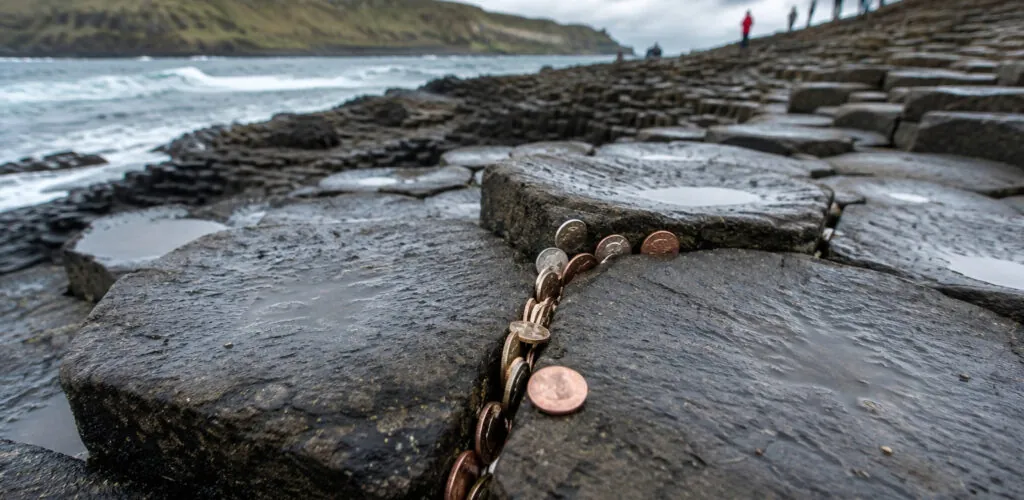
A curious tourist tradition has become a genuine conservation problem at the Giant’s Causeway in Northern Ireland. For years, visitors have wedged coins into the cracks between its famous basalt columns. More than 10,000 coins have now been removed in an effort to limit the damage caused to this UNESCO World Heritage Site.
More than 10,000 coins removed from the Giant’s Causeway
A particularly delicate clean-up
It may seem harmless: slipping a coin into a crack, making a wish and leaving with the feeling of having left a small mark of your visit. At the Giant’s Causeway, however, this practice, repeated over several decades, has become a serious problem.
The teams responsible for conserving the site have removed the equivalent of more than 10,000 coins wedged between the basalt columns. According to information released in August 2026, this amounts to more than 20 kg of metal extracted from the natural monument.
The problem is not merely aesthetic. Coins are often lodged deep within the rock’s natural joints, sometimes after being forced in. They must therefore be removed with great care to avoid causing further damage.
Why do coins damage the Giant’s Causeway?
Metal rusts, expands and puts pressure on the rock
The Giant’s Causeway is made up of thousands of basalt columns formed around 60 million years ago during major volcanic episodes. As the lava cooled, it fractured into distinctive geometric shapes, creating the famous columns seen today.
It is precisely the natural cracks separating these blocks that some visitors have used to wedge in their coins.
When exposed to moisture, sea spray and salt, coins corrode quickly. Some may then deform and increase considerably in thickness.
The National Trust explains that this expansion puts pressure on the surrounding basalt. It can cause the rock to crumble or flake, while leaving rust marks and deposits linked to the oxidation of copper, nickel or iron.
A study by the British Geological Survey had already concluded that coins inserted between the columns had both a physical and visual impact on the site.
A conservation operation carried out coin by coin
Simply pulling out the coins was not an option
Removing the coins proved far more complicated than it might seem. Some were so corroded or deeply wedged that forceful extraction could have dislodged fragments of basalt.
Specialists therefore used suitable tools and worked gradually, sometimes coin by coin. Where removal posed too great a risk to the rock, some coins were left in place.
The work undertaken by the National Trust and its partners follows trials carried out in several areas of the site to determine how to intervene without worsening the damage.
The problem had become so extensive that the overall cost of the removal programme had been estimated at more than £30,000.
Only a small proportion of the coins can still be used
Coins from around the world
In their own way, the recovered coins also reflect the Giant’s Causeway’s international visitors. Many came from the United Kingdom or the eurozone, but coins from North America, Asia and other parts of the world were also found.
Most, however, were too badly damaged to be used again. After years in a salty environment, some were rusty, bent or partly disintegrated.
Above all, this accumulation shows how an apparently insignificant individual act can take on considerable proportions when repeated by thousands of visitors.
Why do tourists wedge coins into rocks?
A tradition with no real connection to the site’s history
Unlike the legend of Finn McCool, which is closely associated with the Giant’s Causeway, slipping coins between the columns is not an ancient Irish tradition connected to the monument.
The practice appears instead to have developed gradually, probably through imitation: one coin appears in a crack, then other visitors copy the behaviour, believing it to be a lucky charm or a local custom.
The phenomenon illustrates a well-known problem at major tourist sites. A seemingly harmless practice can quickly become damaging when several hundred thousand people visit the same places.
The National Trust now asks visitors not to leave coins
The rule is simple: leave no trace
The message for travellers is now very clear: coins must no longer be inserted into the columns of the Giant’s Causeway.
The National Trust encourages visitors to follow the Leave No Trace principle: enjoy the place without leaving objects behind or altering its environment.
This recommendation does not, of course, apply only to coins. It is also best not to move stones, carve into rocks, leave litter or take natural objects as souvenirs.
The Giant’s Causeway has more than 40,000 basalt columns and benefits from several levels of protection. It is a UNESCO World Heritage Site and one of Northern Ireland’s most iconic natural landmarks.
Can you still visit the Giant’s Causeway as normal?
Yes, the site remains open to travellers
This conservation operation does not affect visits to the Giant’s Causeway. The site remains accessible, and travellers can still make their way down to the famous rock formations in County Antrim.
It is simply important to remember that this is a fragile natural environment. The columns can also become particularly slippery when wet from rain or sea spray.
To plan a full visit, it is best to consult the practical information for the Giant’s Causeway on access, parking, the Visitor Centre, opening times and prices.
A useful reminder for all major natural sites
The most lasting souvenir is sometimes the one you do not leave behind
With more than 10,000 coins removed, the matter has taken on striking proportions. Above all, though, it is a reminder of an essential rule of responsible tourism: at a natural site, an action repeated by thousands of visitors can ultimately alter the landscape for good.
At the Giant’s Causeway, the best way to leave a mark of your visit is therefore probably to take a photograph… and leave with all your coins still in your pocket.