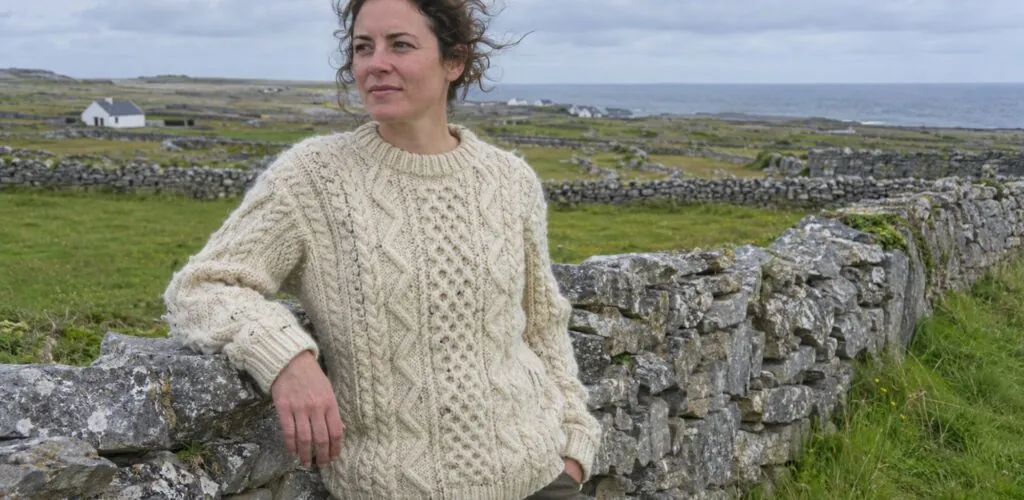
In Kilronan, on Inis Mór, an Aran sweater is recognisable before you have even read the label. Cables stand out against the ecru wool, diamonds run down the body and the recesses of the knit catch the shadows. Yet the garment visitors now take home from the Aran Islands has a more recent history than the dry-stone landscape with which it is so readily associated. Its iconic form developed in the 20th century, when the archipelago’s knitters turned a domestic practice into a craft that could find buyers far beyond Galway Bay.
Why is the Irish sweater named after the Aran Islands?
From workwear knits to cable sweaters
Off the coast of Galway, Inis Mór, Inis Meáin and Inis Oírr belong to a maritime world in which garments and techniques alike travelled. The gansey, a fisherman’s working sweater found along British coasts, offers a useful comparison. It was generally dark and tightly knitted. The Irish sweater that became famous as the Aran is distinguished by thicker, often ecru yarn and raised patterns covering much of the garment. The National Museum of Ireland points to links with fishermen’s knits from Scotland and the Channel Islands. These connections shed light on the movement of techniques; they identify neither a single inventor nor a design simply copied by the islands.
In 1891, the government established the Congested Districts Board to support the poorest parts of western Ireland. Among the activities it encouraged were weaving and knitting for sale. The Victoria and Albert Museum places the development of the complex patterns that became the Aran’s hallmark in this context. This is where the archipelago’s name takes on its meaning: it denotes the place where knitters developed these textured designs and gave the garment its recognisable form. The island origins of the style do not mean that every stitch within it was born on the islands.
In the 1930s, knitting reaches Dublin
The move from island homes to Dublin shop windows changed the scale of this production. In the 1930s, Muriel Gahan, who supported rural crafts, helped bring Aran knitwear to buyers in the capital. Heinz Edgar Kiewe, a dealer in needlework supplies, discovered the garment in Dublin and helped introduce it to Britain. The sweater travelled, and printed patterns soon made it possible to reproduce its designs far from the archipelago.
A piece held by the National Museum of Ireland provides a tangible reference point: a red cardigan knitted for the museum in 1937. The colour is surprising when Aran is associated solely with ecru wool. It is a reminder that the texture of the stitches could already define the garment, whatever its shade. From the 1960s onwards, export campaigns, particularly to the United States, gave this knitwear a very different level of visibility.
Did cables make it possible to identify missing fishermen?
In Synge’s play, the clue is a sock
It is said that each Aran family had a secret pattern and that a drowned fisherman could be identified by his sweater. Nothing documents such a practice. The legend does, however, recall a scene from Riders to the Sea, J. M. Synge’s play first performed in 1904. A man has disappeared at sea; his sister recognises a sock by a knitting detail she remembers making. There is no mention of either a sweater or a catalogue of family patterns. The similarity helps explain how the story may have taken hold, without proving that the play was its origin.
Other interpretations see rope in the cable stitch or promise prosperity through the diamond. These may be read as images drawn from island life. There is, however, no evidence of a universal code passed down from one family to another. The similarities Kiewe believed he recognised between these patterns and ancient Celtic art helped lend the garment an antiquity not confirmed by surviving pieces.
How can you discover this craft on a trip to Aran?
On Inis Meáin, read the label as closely as the knit
On Inis Meáin, Tarlach de Blácam and Áine Ní Chonghaile founded the Inis Meáin Knitting Company in 1976, notably to create employment on the island. The company continues to design and make knitwear there. Before making a detour, check the opening hours of its shop: on the islands, it is best to confirm opening times before fitting a visit between two ferries.
If you would like to take home a sweater, check what the label says about where it was made, the yarn composition and care instructions. The word “Aran” may describe a style, even on a garment produced elsewhere. If the place matters to you, ask where the sweater was knitted. And if it is presented as handmade, ask which stages were done by hand: knitting the garment and hand-finishing do not describe the same work. Try on two different weights of knitwear, and you will also know which one you will actually wear when you get home.