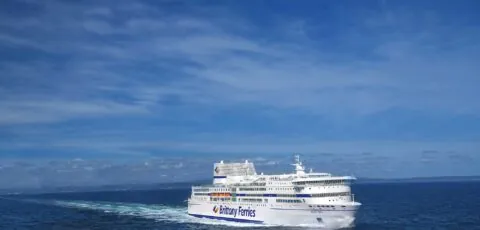



Board in Roscoff in the evening and wake up on Cork’s doorstep: it is hard to imagine a more refreshing start to an Irish road trip. The Roscoff–Cork route operated by Brittany Ferries links Brittany directly with southern Ireland, without the detour through Great Britain. Whether you are travelling with a car, van, motorhome, motorbike or simply a backpack, you can cross the Celtic Sea together.
This seasonal crossing is especially appealing for exploring Cork, Kerry, Kinsale, the Beara Peninsula or the start of the Wild Atlantic Way. Here is how to choose your sailing, understand the timetable, prepare for boarding and turn a night at sea into a genuine first stage of your trip.
The route connects the Port du Bloscon in Roscoff, Finistère, with the Ringaskiddy ferry terminal in Cork Harbour. It avoids the two crossings and long drive required when travelling via England or Wales.
| Information | Roscoff–Cork |
|---|---|
| Operator | Brittany Ferries |
| Departure port | Port du Bloscon, Roscoff |
| Arrival port | Ringaskiddy, Cork Harbour |
| Usual duration | Around 12 to 15 hours, depending on the sailing and conditions |
| Route type | Direct and mainly overnight |
| Operating period | Seasonal, with a timetable that varies by year |
| Vehicles | Cars, motorbikes, vans, motorhomes, caravans and bicycles, subject to booking |
The sea crossing is close to 475 kilometres. In practice, it takes up an evening and a night: you dine on board, sleep at sea, then disembark in Ireland the following day. It is longer than flying, of course, but time spent on board replaces part of the road journey and allows you to arrive with your own vehicle.
There is no single timetable valid all year round. The route is seasonal, and its frequency generally ranges from one to two sailings a week depending on the period. Crossings from Roscoff often depart in the evening, but the exact time, sailing day, ship and duration may change over the course of the timetable.
For genuinely useful planning, the best rule is this: allow between 12 and 15 hours at sea and check the time shown in the booking engine for your chosen date. Weather, port constraints and the ship assigned can also affect the arrival time.
Watch the time difference: Cork is on Irish time, one hour behind mainland France. Timetables are normally shown in the local time of each port. An arrival listed as 9am in Cork therefore corresponds to 10am in France.
Give priority to the check-in deadline shown on your confirmation. For an international sailing with a vehicle, allow plenty of time and generally arrive at least 90 minutes before departure. Arriving earlier during school holidays helps absorb traffic delays, a queue at check-in or document checks without turning the start of your holiday into a survival exercise.
Travellers accompanied by an animal, requiring particular assistance or carrying a vehicle with unusual dimensions must follow the specific instructions issued by Brittany Ferries.
Roscoff is naturally well suited to travellers coming from Brittany, Pays de la Loire and part of Nouvelle-Aquitaine. The port can be reached from Morlaix via the D58, which connects to the N12. To compare departure ports for Ireland, look beyond the time at sea: add the drive to the port, fuel, any tolls and the distance between the Irish port and your first stop.
For a trip to County Cork, Kerry, Kinsale, Killarney, the Dingle Peninsula or the west of the island, arriving at Ringaskiddy saves valuable time. Conversely, a trip focused mainly on Dublin, Belfast or north-east Ireland may make an arrival in Rosslare or Dublin more practical.
The ferry becomes particularly worthwhile once your trip lasts around ten days or more. You can bring your luggage without monitoring the weight of every sock, take hiking gear, bicycles, a pushchair or your dog’s belongings, then begin your road trip as soon as you disembark.
It also avoids hiring a car in Ireland. It is not automatically cheaper in every situation: a couple spending four days in Cork may sometimes find a more economical flight. For a family or a long self-drive tour, however, the calculation is often much more favourable by ferry.
The price of the Roscoff–Cork ferry depends on the date, occupancy, number of passengers, vehicle category, its dimensions, cabin and level of flexibility selected. There is therefore no reliable universal fare to display all year round.
To pay less, book as soon as your dates are sufficiently certain, compare nearby sailings and provide accurate details of your vehicle. Roof bars, a roof box, bike rack or trailer can change its chargeable length or height. An incorrect declaration may result in an additional charge or make boarding more complicated.
Guide-Irlande.com also enables its readers to benefit from 10% off the crossing through its Brittany Ferries partner link.
As our guide to the overnight ferry to Ireland explains, on such a long overnight crossing, a cabin is not merely a decorative luxury: it genuinely changes your arrival. A bed, shower and private space allow you to disembark rested before driving on the left. Reclining seats or shared areas may suit travellers on a tight budget, but they offer less privacy and more uncertain sleep.
The categories available depend on the ship and sailing: inside or outside cabin, number of berths, accessible accommodation and sometimes an option suitable for animals. Check the exact facilities before paying, as not every amenity is offered on every crossing.
Once your vehicle has been parked on the car deck, access to it is normally prohibited during the crossing. Before boarding, prepare a small bag containing:
Among our tips for taking the ferry to Ireland, remember this simple one: photograph the deck number, zone and row where your car is parked. When it is time to disembark, all car decks look surprisingly alike before the first coffee.
On arrival at Port du Bloscon, follow the signs for ferries and have all passengers’ documents ready. After check-in and inspections, staff will direct you to a queue, then to the car deck. Vehicles do not necessarily board in order of arrival: their placement depends on their size and the loading arrangements.
Before leaving the car, apply the handbrake, disable the alarm if the ship’s movement could trigger it, and check that you have your overnight bag. Bear in mind, too, that disembarkation can require a little patience: a ferry carrying hundreds of vehicles is not an express drive-through.
Ireland belongs to the European Union but not the Schengen Area. Every traveller must have a valid identity document accepted for their journey. For a French national travelling directly between France and the Republic of Ireland, a valid national identity card or passport is generally required. Nevertheless, check official requirements and those of the operator before departure, especially for minors and travellers of other nationalities.
The driver must also have their driving licence, vehicle registration certificate and relevant proof of insurance. A minor resident in France travelling without one of their parents may need an authorisation to leave the country and a copy of the signatory parent’s identity document.
Animals must be added when booking. The type of accommodation — a suitable cabin, kennel or another option — depends on the ship and crossing. Places are limited and often sell out quickly.
To enter Ireland from France, an animal must comply with Irish health rules: identification by microchip, valid rabies vaccination and a European pet passport. For dogs, treatment against tapeworm administered by a vet within the regulatory time limit before arrival is also required, except where an exception is provided for by the authorities. Have your vet check the documents and time limits well in advance.
The ships are stabilised, but the Celtic Sea can still show a little character. Eat lightly, stay hydrated, avoid too much alcohol and choose an area near the middle of the ship, where movement is less noticeable. Looking at the horizon and getting some fresh air can help.
If you are prone to travel sickness, ask a pharmacist for advice before travelling: some treatments must be taken before departure and can cause drowsiness. Drivers will need to take this into account before getting back on the road in Ireland.
The ferry does not dock in Cork city centre, but at Ringaskiddy, on the western shore of Cork Harbour. The terminal is around 20 kilometres from the centre, depending on the route. The N28 connects it to Cork and the main road network.
As you leave the port, drive on the left and take a few minutes to set up your GPS before setting off. In the Republic of Ireland, distances and speed limits are shown in kilometres. Small rural roads can be much narrower than their classification on a map suggests.
For a first day without excessive driving, Cork, Cobh or Kinsale make excellent stops. Travellers heading straight for Kerry can then continue to Killarney, Kenmare or the Beara Peninsula. Keep your itinerary light, however, if you have not slept properly on board.
The crossing generally takes between 12 and 15 hours. You can also see our comparison of ferry crossing times to Ireland. The exact duration depends on the sailing, ship, direction of travel and sea conditions.
It is a seasonal route. Operating periods and frequencies change according to Brittany Ferries’ annual timetable.
Many sailings depart in the evening and arrive the following day. You should nevertheless check the timetable for your selected date.
Yes, provided you state the correct category and all vehicle dimensions, including accessories, when booking.
Bookings without a vehicle may be available on some sailings. Check availability for your date, as well as your transport options from Ringaskiddy.
Conditions depend on the sailing and ticket, but a cabin is strongly recommended to make the most of the overnight crossing and drive rested on arrival.
Generally allow at least 90 minutes and always observe the deadline stated on your booking confirmation.
Yes, booking through Guide-Irlande.com’s partner link gives you 10% off your Brittany Ferries crossing.
Guide-Irlande.com uses a Brittany Ferries partner link. A booking made through this link may generate a commission for the site, without cancelling the discount offered to the traveller. Timetables, ships, terms of carriage and formalities may change: always check the information displayed when booking.
Prepare an overnight bag before boarding: the car deck remains inaccessible during the crossing. Also photograph the deck number and the row where your vehicle is parked.