
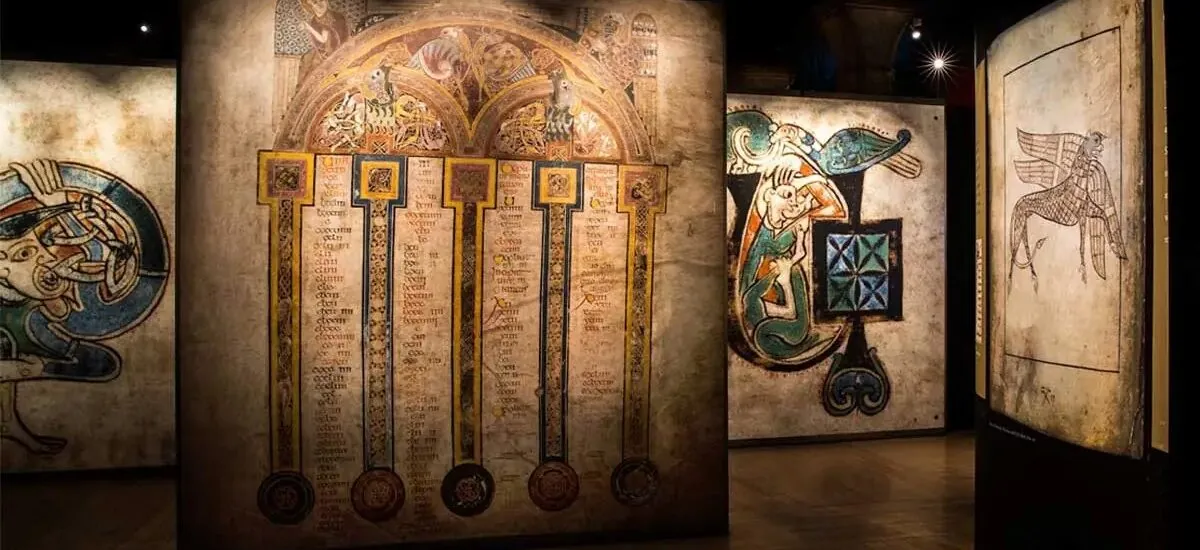
Located at the heart of Trinity College, the Book of Kells Experience offers the chance to admire Ireland’s most famous medieval manuscript before continuing the visit through a series of immersive digital experiences.
The visitor route spans two buildings. It begins in the Old Library, where the Book of Kells and the Long Room are displayed, before continuing to the Red Pavilion, a temporary structure purpose-built on New Square.
Open since January 2024, the Book of Kells Experience does more than display a manuscript over 1,200 years old. It tells the story of its creation, deciphers its illuminations and places Trinity College’s collections within a broader history encompassing religion, literature, science and heritage conservation.
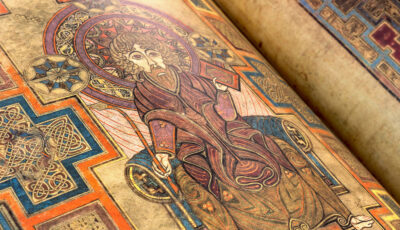
The Book of Kells – © Gerhard Huber
The Book of Kells, or Book of Kells, is an illuminated manuscript created around the year 800. It contains the four Gospels of the New Testament — Matthew, Mark, Luke and John — copied in Latin onto vellum leaves prepared from calfskin.
The manuscript now comprises 340 folios, or 680 pages. Some leaves have disappeared over the course of its history, particularly at the beginning and end of the volume.
The Book of Kells is regarded as one of the greatest masterpieces of Insular art. This artistic tradition developed in Ireland and Britain during the early Middle Ages, at the intersection of Celtic, Christian and Anglo-Saxon traditions.
Its pages combine religious text, interlace patterns, spirals, human figures and animal creatures. Some letters become veritable graphic compositions, concealing birds, snakes, lions, dogs and Christian symbols.
The Book of Kells’ precise origins remain a matter of debate. Scholars believe it was produced, at least in part, at the monastery of Saint Columba, also known as Colum Cille, on the island of Iona.
Located off the west coast of present-day Scotland, this abbey was founded in the 6th century by religious men from Ireland. It became one of the great spiritual and intellectual centres of Insular Christianity.
Viking raids in the early 9th century, however, made the community’s situation particularly perilous. In 806, an attack on Iona resulted in the deaths of dozens of religious men. Some of the monks then retreated to the monastery at Kells, in present-day County Meath.
The manuscript may have been begun on Iona and completed at Kells. It may also have been produced entirely at one of the two monasteries. In the absence of definitive evidence, this uncertainty should be retained.
The book remained at Kells for several centuries. It notably survived a theft in the 11th century, during which its precious cover is thought to have been torn off. In 1661, Bishop Henry Jones presented it to Trinity College to ensure its protection. It has been held by the university ever since.
The manuscript’s colours have long prompted numerous theories. It was notably claimed that its blue came from lapis lazuli imported from Afghanistan, suggesting particularly extensive trade networks.
Analyses carried out by Trinity College’s conservation teams have, however, called this idea into question. The blue pigment used in the Book of Kells probably came from indigo or woad, a plant found in Northern Europe.
The illuminators also used orpiment to produce a vivid yellow, red lead and organic substances for reds, as well as copper-based pigments for certain shades of green.
The artists sometimes layered several colours over the same background layer to create effects of depth. This sophistication partly explains the visual intensity of certain pages, despite the twelve centuries since their creation.
Copper-based pigments have sometimes reacted with humidity and damaged the vellum. Studying them therefore not only helps us understand the illuminators’ techniques, but also adapt current conservation methods.
The first part of the visit takes place in the Treasury, on the ground floor of the Old Library. An exhibition presents the manuscript’s historical context, its production, its iconography and the techniques used by its creators.
The original Book of Kells can then be seen in a climate-controlled display case. The volume was divided into four parts in 1953 to facilitate its conservation. Normally, only one of these volumes is displayed at a time, open at two pages.
The displayed pages change a few times a year, rather than daily. This rotation limits handling and exposure to light. At this pace, it would take around thirty years to display the entire manuscript.
Visitors should not, therefore, expect to leaf through the book or see its most famous pages at the same time. Reproductions, enlargements and a digitised version nevertheless make it possible to examine illuminations not on display on the day of the visit.
Photography is prohibited in the Treasury in order to protect the manuscript and keep the area around its display case flowing smoothly.
After seeing the Book of Kells, the route leads upstairs in the Old Library to the celebrated Long Room. This gallery, nearly 65 metres long, was built in the 18th century to house Trinity College’s collections.
Its tall wooden bookcases, barrel vault and busts of philosophers and writers have made it one of the world’s most recognisable libraries.
The Long Room no longer looks as it usually does, however. As part of the Old Library Redevelopment Project, around 90% of its books have been removed for cleaning, cataloguing and temporary safekeeping. Only the first bays still retain some of their books.
This transformation may surprise visitors drawn by historic photographs of fully stocked shelves. It does, however, offer an unprecedented view of the room’s architecture and an insight into the scale of the heritage project.
The Long Room will remain accessible until the end of 2027. Major works are then due to begin, and the Book of Kells will be temporarily moved to the restored Printing House, the third-oldest building on campus.
During the transition period, the Long Room hosts Gaia, a monumental installation by British artist Luke Jerram.
This illuminated reproduction of Earth floats beneath the library vault. Based on detailed images of our planet’s surface, it creates a striking contrast with the room’s dark wood panelling.
The installation invites reflection on the fragility of the environment and the need to preserve natural and cultural heritage. It also helps visually fill the space left by the removal of the collections.
Gaia is a temporary installation. Its presence is included in the Book of Kells Experience ticket, but it may be removed or replaced as the works progress.
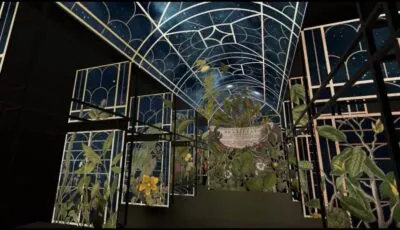
The Book of Kells Experience
The second part of the experience takes place in the Red Pavilion, less than a minute’s walk from the Old Library. Its intense red colour deliberately contrasts with Trinity College’s historic architecture.
The pavilion is a temporary, demountable structure. It was designed to maintain a complete visitor experience while preparations are under way for the library restoration project.
The route brings together three digital presentations: Secret Life of the Collections, Book of Kells 360 and The Long Room Reimagined.
Secret Life of the Collections features figures associated with the history of science, literature and Trinity College’s collections.
Animated digital sculptures give voice to Jonathan Swift, Ada Lovelace and Rosalind Franklin, among others. The exhibition aims to make the archives more accessible by having the figures tell their own stories.
This section goes far beyond the Book of Kells alone. It serves as a reminder that the Old Library holds manuscripts, maps, archives and books spanning several centuries of intellectual history.
Some sequences also explore the 1916 Proclamation of the Irish Republic, a copy of which is held by Trinity College.
The Book of Kells 360 section uses large-scale projections, animations and a soundscape to enlarge the manuscript’s pages to room size.
The interlace patterns, animals and illuminated initials can thus be observed with a precision impossible at the original display case. The animations isolate certain details and reveal sometimes tiny figures hidden within the compositions.
This presentation does not replace an encounter with the manuscript. It complements it by making visible elements that are difficult to distinguish with the naked eye and by offering a more accessible reading of their symbolism.
The final digital experience recreates the Long Room and tells the story of its evolution since the 18th century.
The projections bring back the bookcases, books and the room’s various architectural transformations. They offer a better understanding of how it looked before the collections were removed and allow visitors to imagine its future after restoration.
This sequence takes on its full meaning after walking through the real, partially emptied Long Room. It connects the monument as it stands today with its history and the major conservation programme undertaken by Trinity College.
The Book of Kells remains one of Ireland’s most important cultural treasures. The opportunity to view the original manuscript alone makes the visit worthwhile for enthusiasts of history, medieval art and Irish culture.
The digital experience makes the subject more accessible to families and visitors unfamiliar with illuminated manuscripts. Above all, it offers the chance to examine the book’s details, while only two original pages are visible in the Treasury.
The Long Room currently looks very different from the photographs shown in guidebooks. Most of the shelves are empty, and the Gaia installation occupies the centre of the room. It is important to know this before booking to avoid disappointment.
This arrangement is nevertheless temporary and historically interesting. It offers a glimpse behind the scenes of a vast project designed to protect the building and its collections from fire, pollution, dust and climate fluctuations.
Entry is by a specific timed slot. Online booking is strongly recommended, particularly at weekends and during the high season.
Allow around 1 hour 30 minutes to explore the exhibition, view the Book of Kells, walk through the Long Room and discover the digital pavilion. The route is self-guided, with a free audio guide available on your phone via a QR code.
The audio guide is available in French and several other languages. Remember to bring headphones and ensure your phone has sufficient battery.
Photography is permitted in most of the route, but prohibited in front of the Book of Kells. Flash, tripods and bulky equipment are not permitted.
There are no luggage lockers. Avoid arriving with a suitcase or large bag. Toilets are available towards the end of the route, in the Red Pavilion, but not in the Old Library.
The entire visit is accessible to wheelchair users. Staff assist visitors wishing to use the Old Library lift.
Essential information to help you plan your visit, including key landmarks, access information, and booking options.
The University of Dublin Trinity College, College Green, Dublin, County Dublin, Republic of Ireland, Tourist Attractions in Ireland
53.34390324811439, -6.256744125947346
1 heure
The time slots actually available may vary according to the date, events held on campus and university periods. The online booking site shows the exact availability for each day.
The Long Room and the Old Library are expected to remain accessible until the end of 2027. Once the major works begin, the Book of Kells will be temporarily displayed in Trinity College’s Printing House. The visitor route will therefore evolve.
Check the official Book of Kells Experience website before your visit.
Check the opening hours and admission requirements before you leave, especially during peak season or on Irish public holidays.
Trinity College uses dynamic pricing. The exact amount depends on the date, time, visitor numbers and option selected.
Starting prices are as follows:
The standard Book of Kells Experience ticket includes the exhibition dedicated to the manuscript, viewing the original book, access to the Long Room and the Red Pavilion’s three digital experiences.
A limited option entitled Book of Kells & Old Library Last Minute Access may be available from €19. It does not include the Red Pavilion’s digital exhibitions and availability is very limited.
Reduced rates are available for students and seniors. The exact price is displayed when selecting a time slot on the official booking site.
Purchased tickets are normally non-refundable. Booking should therefore be made only once your visit plans are sufficiently certain.