Viator

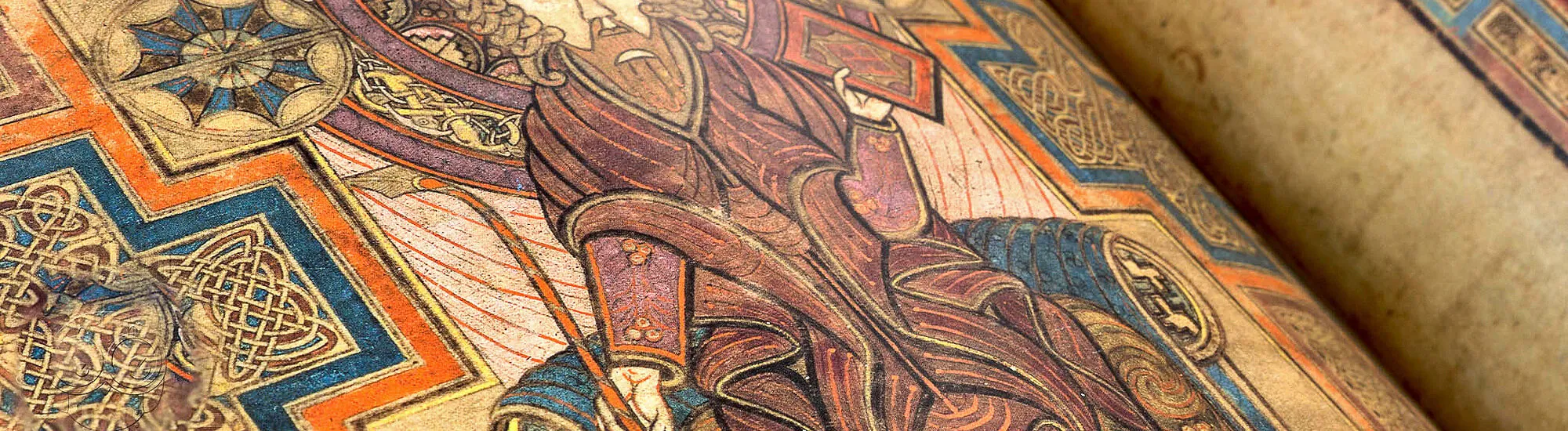
A masterpiece of medieval art, the Book of Kells is an illuminated manuscript produced around the year 800. Its 340 vellum folios bring together the four Gospels in Latin, in a whirl of colour, interlace and tiny creatures. Kept at Trinity College Dublin, this treasure more than 1,200 years old fascinates as much for its virtuosity as for the mysteries surrounding its creation.
The Book of Kells is a Christian Gospel book copied onto vellum, a material made from carefully prepared calfskin. Catalogued as Trinity College Dublin MS 58, it contains the Gospels of Matthew, Mark, Luke and John, together with concordance tables, summaries and introductory texts.
The text is based chiefly on St Jerome’s Latin Vulgate, while retaining passages from earlier Latin translations. The work is incomplete: around 30 folios are thought to have disappeared during the Middle Ages and the modern era. The 340 surviving folios make up 680 pages, although not all are decorated with the same intensity.
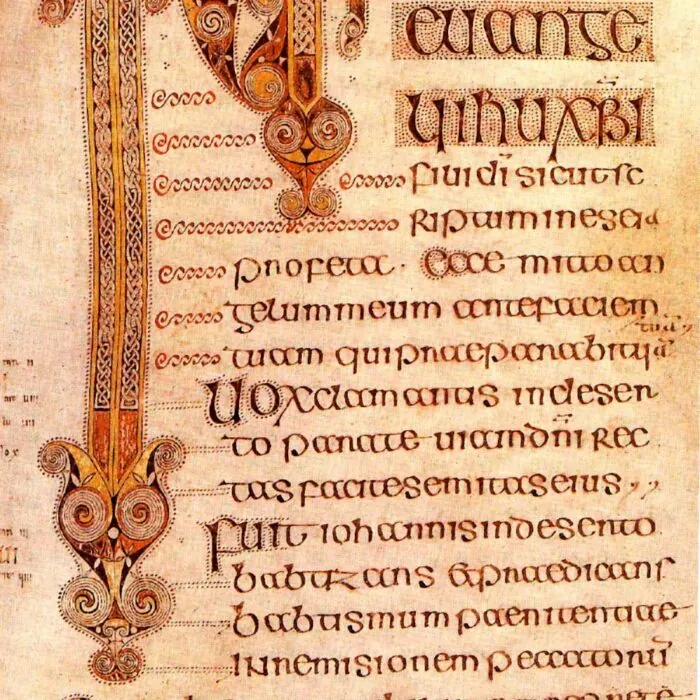
What makes the manuscript extraordinary is not simply its age. Above all, it is the way its artists transformed religious text into a richly abundant visual world. Letters, animals, faces, spirals and geometric motifs echo one another with a precision sometimes so fine that it seems to challenge the human eye.
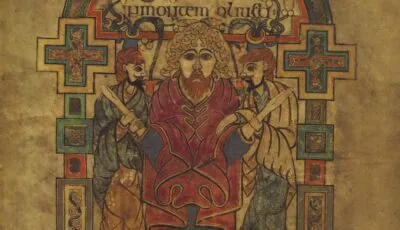
An illuminated page from the Book of Kells – Public domain
The precise date and place of its creation are still debated. Most scholars date it to around the year 800 and associate it with the monastic network founded by St Columba, also known as Colum Cille.
The most widely accepted theory is that work began in the scriptorium of Iona Abbey, on an island off the west coast of present-day Scotland. In 806, a particularly deadly Viking raid struck the community. Some of the monks then moved to Kells, in what is now County Meath, where a new Columban monastery had been established.
The manuscript may therefore have been begun on Iona and continued at Kells. It may also have been produced entirely at one of these two centres, or even across several sites. No evidence currently allows a definitive conclusion. Its present name, in any case, comes from Kells, where it was kept for several centuries.
Creating such an ambitious work required considerable resources. The vellum had to be cleaned, stretched, dried and cut before the scribes could rule the lines intended for the text. The folios now measure around 33 centimetres by 25.5 centimetres, but they were severely trimmed during a binding carried out in the 19th century.
Four principal scribes appear to have taken part in copying the text. Their script, known as Insular majuscule, is characteristic of manuscripts produced in the British Isles during the early Middle Ages. Yet the text contains omissions, repetitions and several copying errors. This apparent carelessness contrasts with the lavish decoration and suggests that the book was intended for exceptional ceremonies rather than everyday reading.
Specialists generally identify the hands of three principal artists in the most ambitious pages. They could devote extraordinary effort to a single initial, filling even the tiniest spaces with knots, serpents, birds or human figures.
The letters do more than introduce a passage: they become images in their own right. Some occupy almost an entire page, drawing the text into their composition. On this scale, calligraphy becomes architecture.
Contrary to a commonly repeated belief, the Book of Kells does not owe its brilliance to the use of gold leaf. The artists created an impression of richness through the density of their motifs, contrasts and a remarkably controlled palette of pigments.
The blue is thought to have come from indigo or woad, rather than lapis lazuli from Afghanistan, as was long claimed. The illuminators also used orpiment to achieve a bright yellow, red lead and organic dyes for reds, as well as copper-based pigments for some greens.
These colours were sometimes applied in several layers. Some have retained astonishing freshness through the centuries; others have reacted to moisture. The copper-based green has notably weakened and pierced the vellum in several places, creating a challenge for conservation specialists today.
The manuscript abounds with real and imaginary animals. Lions, serpents, dogs, cats, birds and hybrid creatures curl around the words. Some contribute to Christian symbolism; others seem to have been slipped in as visual winks.
The four Evangelists are associated with their traditional symbols: the man for Matthew, the lion for Mark, the calf for Luke and the eagle for John. These figures convey the religious meaning of the text while creating a visual spectacle accessible even to those unable to read Latin.
The most famous page is the Chi Rho page, on folio 34 recto. The Greek letters X and P, the first letters of the word Christos, introduce the account of Christ’s birth in the Gospel according to Matthew. They spread across the page, becoming an immense landscape of interlace and hidden figures.
At first glance, the composition impresses through its balance. On closer inspection, a multitude of details emerges: angels, animals, faces and microscopic curves. This double reading, monumental yet almost playful, explains why the Chi Rho page has become an icon of Insular art.
Other major compositions include the symbols of the Evangelists, a depiction of the Virgin and Child, a portrait of Christ, and scenes devoted to his arrest and temptation. The latter are among the oldest surviving narrative scenes in a Western Gospel manuscript.
The portraits of Matthew and John survive, while those of Mark and Luke appear to have been lost. Several large pages were made on separate leaves, which were more likely to become detached through handling and changes of binding.
The Annals of Ulster report that in 1006 the great Gospel book of Colum Cille was stolen from the church at Kells. Regarded as the “principal treasure of the western world”, it is said to have been taken for its precious shrine, or cumdach. The manuscript was recovered a few weeks or months later, hidden beneath the earth, but its decorated cover had disappeared.
This misadventure probably explains the loss of several leaves at the beginning and end of the volume. It also shows that, two centuries after its creation, the book was already regarded as an object of exceptional spiritual and material value.
After the rebellion of 1641, the church at Kells fell into ruin. Around 1653, Charles Lambert, Governor of Kells and Earl of Cavan, had the manuscript transferred to Dublin for safekeeping. In 1661, Henry Jones, Bishop of Meath and Vice-Chancellor of the university, presented it to Trinity College.
The Book of Kells has been held by the university ever since. It was displayed to the public in the Old Library from the mid-19th century. In 1953, it was bound into four volumes to improve its preservation and make it easier to display different pages.
The manuscript bears witness to the intellectual influence of Insular monastic communities at a time often too readily described as dark. Its creation brought together scribes, artists and vellum preparers capable of achieving a prodigious level of technical skill.
The Book of Kells now extends beyond its religious context. Its interlace has influenced the graphic imagination associated with Ireland, from publishing and jewellery to animated film. It nevertheless remains a complex medieval object, designed to glorify the Christian message and impress those privileged enough to behold it.
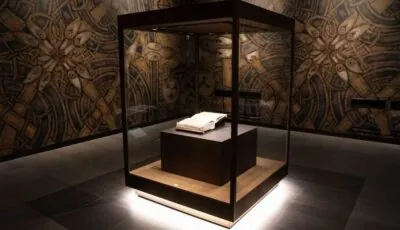
The Book of Kells in its conservation display case
The original manuscript is kept in the Old Library at Trinity College, in the heart of Dublin. To limit its exposure to light and handling, only a few pages are displayed at any one time in a specially controlled case. They are changed several times a year.
It is therefore not possible to leaf through the work or choose the famous page you wish to see. This restriction is also part of the emotion of the encounter: behind the glass is the very vellum prepared, written and painted by artists of the early Middle Ages.
The current visit to the Old Library, the Long Room and the digital spaces is detailed in our separate guide to the Book of Kells Experience. This distinction makes it possible to discover the manuscript’s history here without confusing the medieval work with the contemporary visitor attraction.
Essential information to help you plan your visit, including key landmarks, access information, and booking options.
Old Library, Trinity College Dublin, College Green, Dublin 2, College Green, College Green
53.343950, -6.256846
Entry is by timed slot. Check availability before your visit.
Check the opening hours and admission requirements before you leave, especially during peak season or on Irish public holidays.
Prices vary according to the time slot and option. Online booking is strongly recommended.
Compare tickets, guided tours, and excursions available through our partner platforms.