
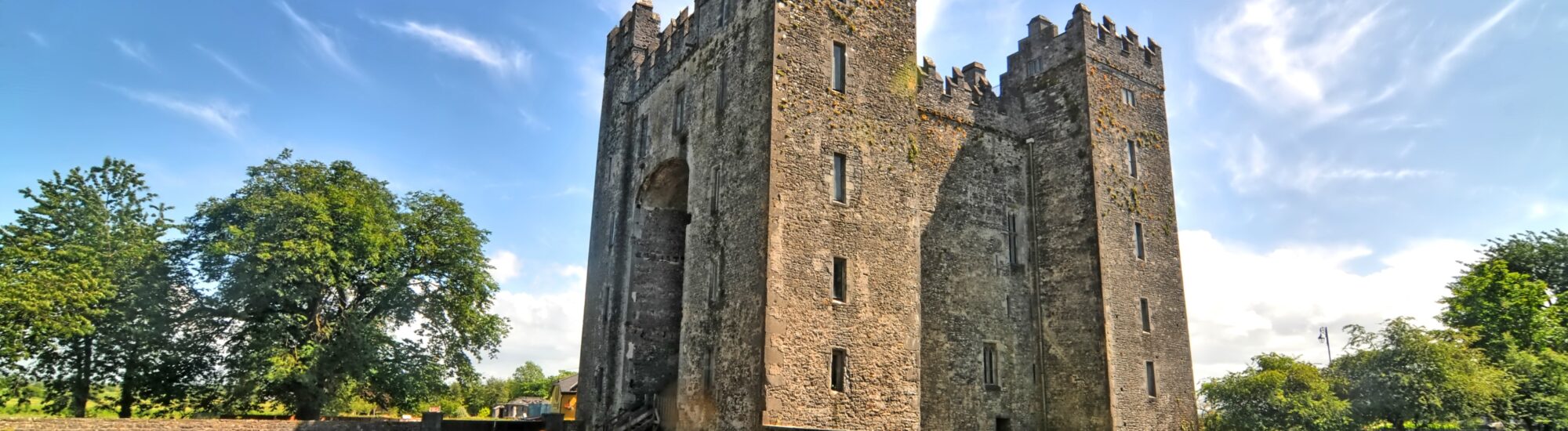
Bunratty Castle is one of Ireland’s best-preserved and most visited medieval castles. Located in County Clare, a few kilometres from Limerick and Shannon Airport, this imposing 15th-century fortress overlooks the Ratty River, not far from where it meets the Shannon Estuary.
Its narrow staircases lead to chambers, reception rooms and a spectacular Great Hall furnished in the style of the late Middle Ages and the Renaissance. The visit continues at Bunratty Folk Park, an open-air museum devoted to everyday life in rural Ireland in the 19th century. In the evening, the castle hosts one of Ireland’s longest-running medieval banquets.
Bunratty Castle – Bea y Fredi – CC BY 2.0
The name Bunratty comes from the Irish Bun Ráite, meaning ‘the mouth of the Ratty’. The castle does not therefore stand directly on the banks of the River Shannon, as is often written, but on the Ratty River, close to the estuary.
This location explains the site’s strategic importance. It made it possible to control a river route, fertile farmland and the roads linking northern Munster with western Ireland. Long before the present castle was built, the surrounding area may have been home to a Viking trading camp as early as the 10th century.
The fortress visible today is the last in a succession of castles built at Bunratty. Earlier buildings were destroyed, abandoned or incorporated into later structures during conflicts between Anglo-Norman lords, Gaelic clans and representatives of the English Crown.
The chronology of the site is complex, and the various fortresses were not all rebuilt to exactly the same plans. Nevertheless, the key stages help explain why Bunratty became one of the region’s most fiercely contested strongholds.
The present castle should therefore not be described as a miraculously preserved 13th-century Anglo-Norman building. It is primarily a 15th-century Irish fortress, built by the MacNamaras according to Irish and European medieval architectural traditions.
Around 1475, Bunratty Castle passed into the hands of the O’Briens, probably through an alliance, marriage or political arrangement rather than a major siege. Descended from Brian Boru, the O’Briens were among the most powerful dynasties in western Ireland.
The castle became one of the main political centres of Thomond, a territory corresponding roughly to part of the present-day counties of Clare, Limerick and Tipperary. The O’Briens enlarged and embellished the fortress, around which gardens, outbuildings and a large estate developed.
In the 16th century, Henry VIII’s policy of ‘surrender and regrant’ transformed relations between Gaelic chiefs and the English monarchy. The O’Briens recognised the sovereign’s authority and received the title of Earls of Thomond.
Bunratty then became an aristocratic residence where Gaelic traditions met the customs of the Anglo-Irish nobility. The Great Hall was used for hearings, meals, ceremonies and receiving the lord’s guests.
In the 17th century, the wars that convulsed Ireland reached Bunratty. During the Confederate Wars, the castle was occupied by a parliamentary garrison commanded by Admiral William Penn, father of the future founder of Pennsylvania.
In 1646, the Irish Confederate forces besieged Bunratty. After the garrison surrendered, the castle changed hands once more. The political upheaval and confiscations accompanying the Cromwellian conquest subsequently brought O’Brien rule over their former fortress to an end.
The estate passed to various plantation families. The Studderts were among its last private occupants. In 1804, they left the increasingly uncomfortable castle and moved into Bunratty House, a Georgian-style residence built nearby.
Without permanent occupation, the castle gradually deteriorated. Its roof and several parts of its structure were under threat, while much of the furniture was removed from the interiors.
Bunratty Castle was rescued in the 1950s. Lord Gort, a medieval history enthusiast with links to the region, bought the fortress in 1953. He undertook a major restoration campaign with the support of the Office of Public Works, Bord Fáilte and Shannon Development.
The collectors and art historians John and Gertrude ‘Putzel’ Hunt played a major part in refitting the interiors. They helped assemble a collection of furniture, tapestries, artworks and domestic objects from Ireland and Europe.
Bunratty reopened to the public in 1962. The restoration sought to recreate the atmosphere of an aristocratic residence of the late Middle Ages and Renaissance. However, it is not an intact preservation of the castle as it existed under the MacNamaras.
The furniture on display today did not necessarily belong to its former occupants. The rooms mainly bring together objects from the 15th, 16th and 17th centuries, selected for their historical coherence and quality. The clothing on display is therefore not attire miraculously preserved from the time of the MacNamaras.
Bunratty Castle has a rectangular plan flanked by four imposing corner towers. Its central block has three main levels, while the towers rise over several storeys connected by particularly narrow stone staircases.
The thick walls, defensive openings, narrow passages and watch points recall the building’s dual purpose. Bunratty was intended both to protect its occupants and to demonstrate the political power of its owners.
The castle is sometimes described as a tower house, although its size and the complexity of its layout exceed those of many Irish buildings in this category. It combines defensive spaces, private apartments, kitchens, stores and reception rooms.
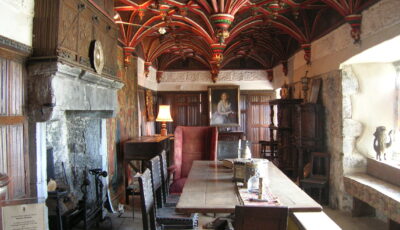
The Great Hall is the symbolic centre of Bunratty Castle. Here, the lord received his allies, administered justice, held ceremonies and hosted banquets.
Today, the roof structure, long tables, tapestries and displayed weapons offer an idea of how power was staged in a Thomond residence. In the evening, this hall provides the setting for the famous medieval banquet.
Other spaces reveal the lordly apartments, bedrooms, kitchens, chapel and various service rooms. The functions attributed to the rooms have sometimes changed over the centuries and during the restoration.
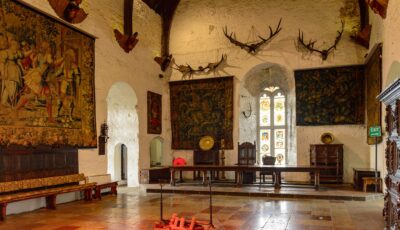
A room at Bunratty Castle – © Anton Ivanov Photo
Bunratty Castle is mainly visited independently, although guides may be present in some rooms. Their availability at a particular time is not guaranteed.
The route begins after a flight of 19 wooden steps leading to the castle entrance. Inside, numerous spiral staircases lead to the different levels. The steps are uneven, sometimes steep and worn by time.
The Great Hall is among the most impressive spaces, with its high walls, tapestries and antique furniture. The private apartments then provide an insight into the everyday life of the nobility, far removed from modern comfort despite the richness of the décor.
The upper levels offer views of the Folk Park, Bunratty village, the Ratty Valley and the County Clare countryside. Access to the highest sections may, however, be restricted depending on weather conditions, visitor numbers or safety measures.
It is best to wear shoes with good grip. Visitors with a fear of heights or mobility difficulties may not be able to complete the full route.
Visiting the castle takes around 45 minutes to an hour. To explore the Folk Park as well, allow at least two hours, ideally two and a half to three hours.
Families can easily spend half a day here thanks to the historic houses, animals, seasonal demonstrations, fairy trail and Viking playground.
The castle closes at 4 pm to prepare for the evening banquets, while the Folk Park generally remains open until 5.30 pm. Arriving late may therefore prevent you from visiting the interior of the fortress, even if the park is still accessible.
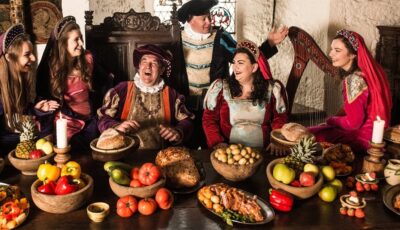
A banquet at Bunratty Castle – www.bunrattycastle.ie
The Bunratty medieval banquet has been held since 1963. The idea came from Brendan O’Regan, an entrepreneur closely associated with the development of Shannon Airport and tourism in western Ireland.
Its original aim was to offer a cultural experience to travellers on transatlantic flights stopping at Shannon. More than three million people are thought to have taken part in these evenings since then, making it one of the region’s longest-running and best-known visitor experiences.
The banquet does not claim to be a scholarly recreation of a 15th-century meal. It is a tourist show inspired by medieval imagery and Irish musical traditions. Coffee, tea and several menu items are, of course, later than the period evoked.
Guests are welcomed by the Earl’s butler and given a goblet of mead. A presentation briefly introduces the history of Bunratty before guests take their seats in the Great Hall.
The evening combines a four-course meal with singing, music, dancing and various theatrical sequences. The Bunratty Castle Singers perform a repertoire inspired by Irish traditions in the spectacular atmosphere of the Great Hall.
The banquet lasts around two hours. It is offered at 5.30 pm and 8.45 pm. The evenings generally take place daily from April to September. Between October and March, their frequency depends on demand and the schedule.
The show is not suitable for children under 4. The long tables, benches and castle staircases should also be considered by visitors with particular needs.
The menu announced for 2026 includes:
Vegetarian and vegan options are available. Allergies and dietary requirements must be declared when booking so that the team can adapt the meal where possible.
Places fill quickly during the high season. Advance booking on the official Bunratty Castle website is strongly recommended.

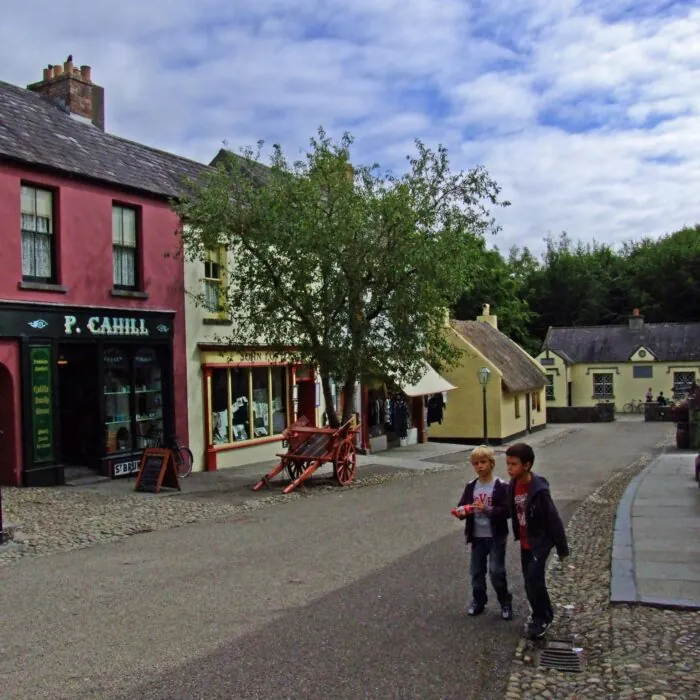
Bunratty Folk Park – © nz_willowherb
A Bunratty day ticket gives access to both the castle and Bunratty Folk Park. This open-air museum covers around 26 acres, or just over 10 hectares.
Contrary to what the previous version of this article stated, the park does not trace Irish life from the Middle Ages to the present day. It focuses mainly on rural and village life in 19th-century and early 20th-century Ireland.
More than 30 buildings are set within a countryside landscape. Some structures were moved from their original locations, while others have been reconstructed from historical models.
The route features thatched cottages, farms, shops, a school, post office, pub, fisherman’s house and homes representing different social groups.
Bunratty House is an elegant residence built in 1804 for the Studdert family, who left the medieval castle after it became too uncomfortable. Its interior presents the lifestyle of a well-to-do family in the early 19th century.
The house is surrounded by a walled garden laid out in the Regency style. Its planting, paths and ornamental spaces provide a far more peaceful walk than the park’s busiest areas.
Costumed characters, musicians and craft demonstrations may be present, particularly at weekends, during school holidays and in high season. Their programme varies according to the day of your visit.
The Folk Park is particularly worthwhile with children. Farm animals, the fairy village, woodland trails and the large Viking-inspired playground complement the discovery of the historic houses.
The grounds are generally accessible for pushchairs and wheelchairs, although some slopes, uneven paths and old houses may require assistance. Dogs are permitted in the Folk Park, but not in the castle or food-service areas, with the exception of assistance dogs.
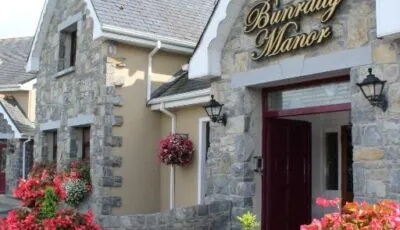
Want to extend your visit without having to rush around? Here are a few well-located places to stay near the must-see attractions.
Essential information to help you plan your visit, including key landmarks, access information, and booking options.
52.696661818741624, -8.812123288764548
3h00
Prices vary according to the date, events taking place and booking method. Online booking usually gives a 10% discount on the standard price.
As exact prices are displayed after selecting a date, check the official Bunratty Castle ticket office before your visit.