

The best walks in Killarney National Park do not all lead to a mountain summit. Some follow the quiet shores of Lough Leane, others wind through moss-covered oak woods or head into the wilder uplands of Kerry. Each, in its own way, reveals a part of this landscape, where water, rock and forest combine to create one of Ireland’s most iconic settings.
The park offers easy walks accessible from Killarney and its main visitor sites, as well as more demanding routes. Choosing the right trail means considering the distance, the nature of the terrain and, above all, the weather, which is particularly changeable in this mountainous region.
| Walk | Distance | Level | Highlight |
|---|---|---|---|
| Knockreer Circular Walk | 5 km | Easy | Meadows, deer and mountain views |
| Ross Island Mining Trail | 3 km | Easy | Ross Castle, woodland and former mines |
| Library Point | Up to 5 km | Easy | Wooded shores of Lough Leane |
| Lakeside Walk | About 5 km | Easy | Muckross Abbey and Lough Leane |
| Muckross Lake and Torc Waterfall | Varies according to the loop | Easy to moderate | Lake, woodland and waterfall |
| Old Kenmare Road | 7 km for the official section | Strenuous | Uplands and wild scenery |
| Mass Path | 4 km one way | Strenuous | Derrycunnihy woodland and a remote setting |
The levels shown follow the park’s official classification. This takes account of trail conditions, not only elevation gain. A relatively short walk may therefore be classed as strenuous when it crosses muddy, flood-prone or uneven ground.
The Knockreer loop is one of the best routes for exploring the park without a car. It begins at Killarney House and Gardens, a few minutes’ walk from the town centre, then follows the River Deenagh before crossing broad meadows.
The route is around 5 km long and takes close to two hours at an unhurried pace. Its ascent is limited to around 40 metres. Yet the path still offers fine views across Lough Leane and towards the MacGillycuddy’s Reeks, whose silhouettes close off the western horizon.
Knockreer’s open spaces are also well suited to deer spotting. The park is home to Ireland’s last native herd of red deer, as well as sika deer introduced in the 19th century. Keep a considerable distance from the animals, particularly during the autumn rut and calving season.
Choose it for: a first introduction to the park, a car-free walk or an accessible family outing.
The Ross Island Mining Trail begins at the car park at Ross Castle, on the eastern shore of Lough Leane. After passing the castle, the route gradually leaves the busiest areas behind and enters the woodland of Ross Island.
This loop of around 3 km follows generally level ground. It reveals traces of former mining activity in an area where copper has been worked since prehistoric times. Interpretation panels line the route, placing these remains in the context of the region’s history.
The appeal of this walk lies as much in its heritage as in its atmosphere. Gaps in the vegetation reveal Ross Castle, the waters of Lough Leane and the slopes of the MacGillycuddy’s Reeks. Despite its proximity to Killarney, the path soon takes on a peaceful character.
Choose it for: combining an easy walk with lakeside scenery and a historical discovery.
Library Point is a limestone formation on Ross Island. The most direct path is just over 2 km from Ross Castle. Adding the former mines loop on the outward or return leg brings the walk to approximately 5 km.
The trail passes through woodland before skirting a small promontory overlooking Lough Leane. Views appear intermittently between the trees, creating a succession of natural windows onto the lake and its islands. This alternation between woodland and shoreline makes for a particularly pleasant walk in calm weather.
Library Point is generally less well known than Ross Castle or Torc Waterfall. It is therefore a good option for getting away from the crowds without taking on a difficult hike.
Choose it for: a peaceful walk, views over Lough Leane and a more secluded atmosphere.
The Lakeside Walk links a park entrance on the N71 with the grounds of Muckross House. The starting point lies around 5.5 km from Killarney town centre, opposite an area used by horse-drawn jaunting cars.
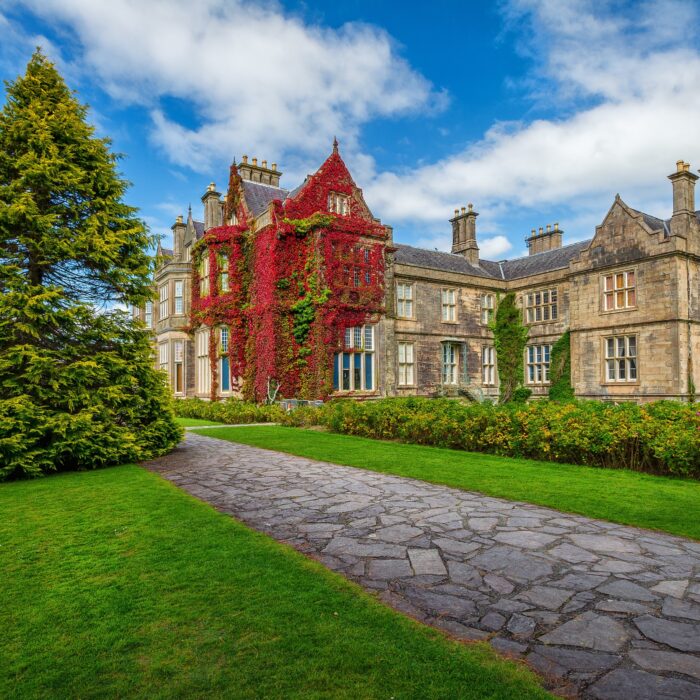
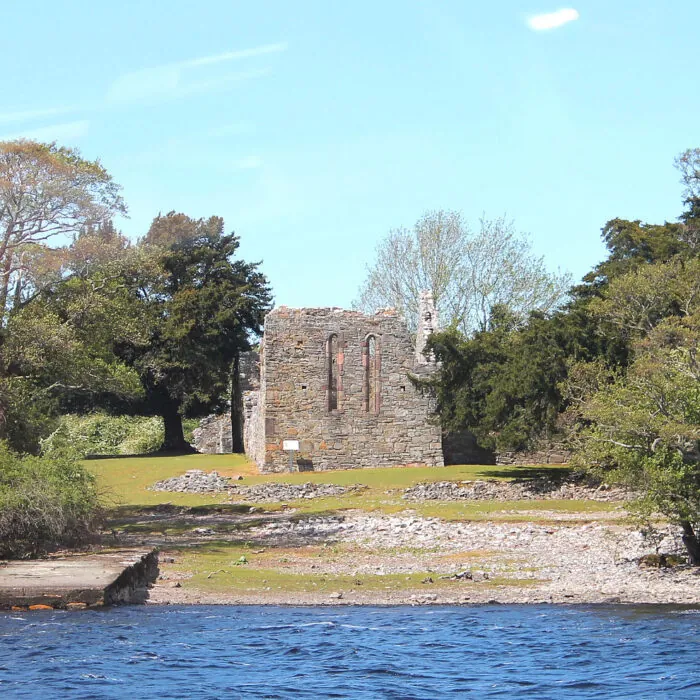
The trail follows the shores of Lough Leane for around 5 km. The ground remains fairly level, though some sections may be uneven or wet. A detour to Muckross Abbey is possible: this former 15th-century Franciscan friary has a cloister arranged around a large yew tree.
This walk is particularly useful for reaching Muckross House on foot without following traffic on the N71. It combines lakeside scenery, woodland and two of the park’s principal historic monuments.
As the route is linear, you will need to plan your return, continue on to another trail or arrange transport from Muckross.
Choose it for: reaching Muckross House on foot and combining walking, lake scenery and heritage.
The Muckross area brings together several paths that can be combined into a loop around the lake. From Muckross House, trails lead to Dundag Point, a small beach, yew woods and the vicinity of Torc Waterfall.
Torc Waterfall, around 18 metres high, lies in damp woodland at the foot of Torc Mountain. It is particularly powerful after several days of rain. Steps allow you to continue above the falls and gain height, but this option is more physically demanding and can be slippery.
Another option is to continue around Muckross Lake towards Dinis Cottage and Old Weir Bridge. Depending on the paths chosen, the walk can then take up much of the day. It is essential to check the exact route on a map before setting off, as several variations and junctions follow one another around the lake.
The immediate surroundings of the waterfall are very busy during the day. Setting off early from Muckross House allows you to enjoy the woodland paths in a quieter atmosphere.
Choose it for: bringing together Killarney’s most characteristic landscapes in a single day.
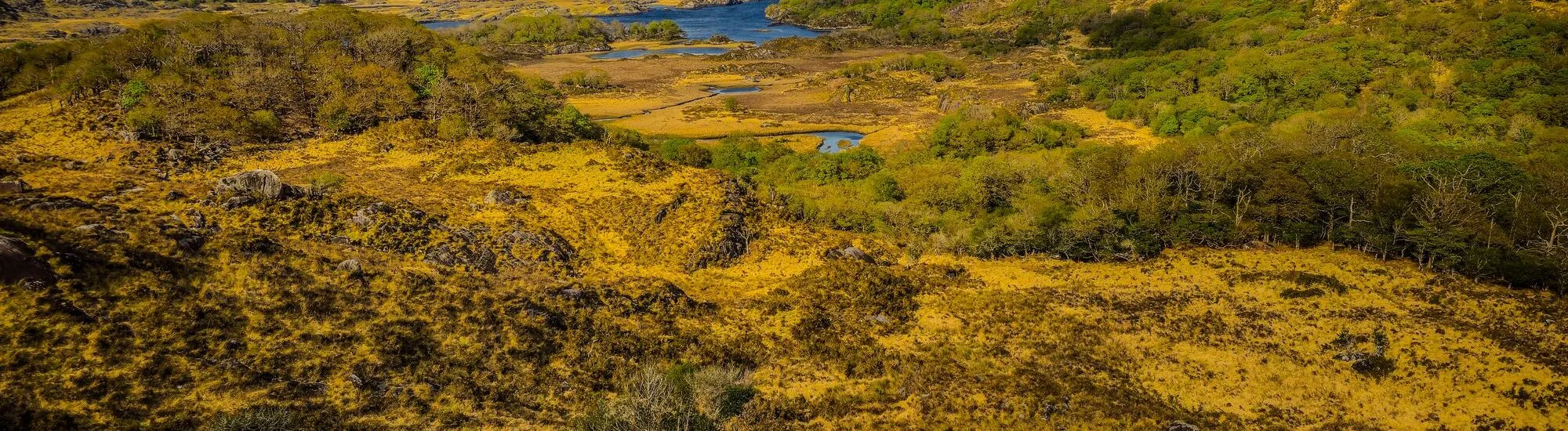
The Old Kenmare Road follows an old route between Killarney and Kenmare. The path is now part of the Kerry Way, the long-distance walking route that crosses the Iveragh Peninsula. In its most accessible section from Killarney, it leaves the forests around Torc for more open landscapes dominated by heathland, bogs and mountains.
The section officially presented by the park measures around 7 km between the upper Torc car park and Incheens. It crosses forest tracks, wooden boardwalks and uneven ground. Some streams must be crossed on stepping stones, while mud can slow progress after rain.
This 7 km section should not be confused with the Old Kenmare Road as a whole. The longer crossing towards Kenmare is considerably farther and requires specific planning, particularly for return transport.
The official classification rates the route as strenuous. Good waterproof footwear, a map and suitable clothing are essential. When clouds descend over the hills, the sense of isolation quickly becomes more pronounced.
Choose it for: discovering the park’s wildest side and walking far from its busiest attractions.
The Mass Path starts near Derrycunnihy Church, along the N71 south of Upper Lake. The trail descends into ancient oak woodland, crosses several streams and passes close to abandoned buildings before continuing towards Lord Brandon’s Cottage.
The route is around 4 km one way. Despite its moderate length, it is classed as strenuous because of its rough terrain and exposure to winter flooding. Boardwalks, roots and wet areas can become slippery after heavy rain.
The Mass Path has a very different atmosphere from the developed walks around Muckross. The woodland feels denser here, and passing Derrycunnihy Cascade reinforces the route’s wild character. The area also offers a possibility, though never a guarantee, of spotting a white-tailed eagle.
As the route is linear, the return journey must be planned in advance. Some visitors include it in an excursion combining walking and boat travel on the lakes, but this option requires booking with a provider.
Choose it for: walkers seeking ancient woodland, a little-used path and a more adventurous experience.
The Knockreer loop is generally the best choice for children used to walking. It is close to Killarney, has little ascent and crosses open areas where deer can sometimes be seen from a distance.
The Ross Island Mining Trail is a shorter alternative, with the added interest of Ross Castle and the former mines. Around Muckross, the Old Boathouse Trail leads to Dundag Point and its small beach on a route of around 1 km.
Even on easy trails, pushchairs are not suitable for every type of terrain. Paths may include mud, roots or stony sections. The paved routes at Knockreer and Muckross remain the most practical for very young children.
Spring and early autumn often offer the best balance of daylight hours, visitor numbers and walking conditions. In summer, the days are long, but the areas around Torc Waterfall, Muckross House and Ross Castle can be very busy.
Winter reveals quieter landscapes, but some paths become muddy or flooded. The Mass Path and boggy areas require particular care at this time. Whatever the season, rain, wind and mist can arrive quickly.
Before tackling any strenuous walk, check the local forecast and the information issued by Killarney National Park. In the mountains, a favourable forecast for Killarney town does not guarantee good conditions on higher ground.
Waterproof footwear is recommended as soon as you leave the developed paths. Take a windproof jacket, water, a few supplies and a map that can be used without a connection. For a remote route, tell someone else your planned route and expected return time.
Ticks are present in the park and can, in rare cases, transmit Lyme disease. It is advisable to stay on the paths, wear clothing that covers the skin in long grass and check your skin after walking. Biting midges, or midges, can also be numerous on mild, damp and still days.
Walkers should keep their distance from animals, take all rubbish away with them and avoid picking plants. Fires are prohibited in Irish national parks. These precautions help preserve Killarney’s ancient woodlands, bogs and exceptional wildlife.
Essential information to help you plan your visit, including key landmarks, access information, and booking options.
52.056831, -9.508254
Pedestrian access to Killarney National Park is open 24 hours a day, all year round. However, it is strongly inadvisable to set out on a remote or strenuous route unless you have sufficient time before nightfall.
Opening hours for car parks and gated areas may change according to the season. Overnight parking and camping are not permitted in the park’s car parks.
Check the opening hours and admission requirements before you leave, especially during peak season or on Irish public holidays.
Access to Killarney National Park and its waymarked trails is free. No permit or ticket is required for the walks featured in this article.
Visits to certain monuments, boat excursions, guided walks, bicycle hire and horse-drawn jaunting car rides are charged for. A boat or transfer may in particular be needed to arrange the return journey after certain linear routes.