Reservations are recommended
Powered by GetYourGuide


A Viking house shrouded in smoke, the noisy stalls of a medieval market and the cries of a city ravaged by the plague: at Dublinia, Dublin’s early history is not viewed through a succession of display cases. It is something you walk through.
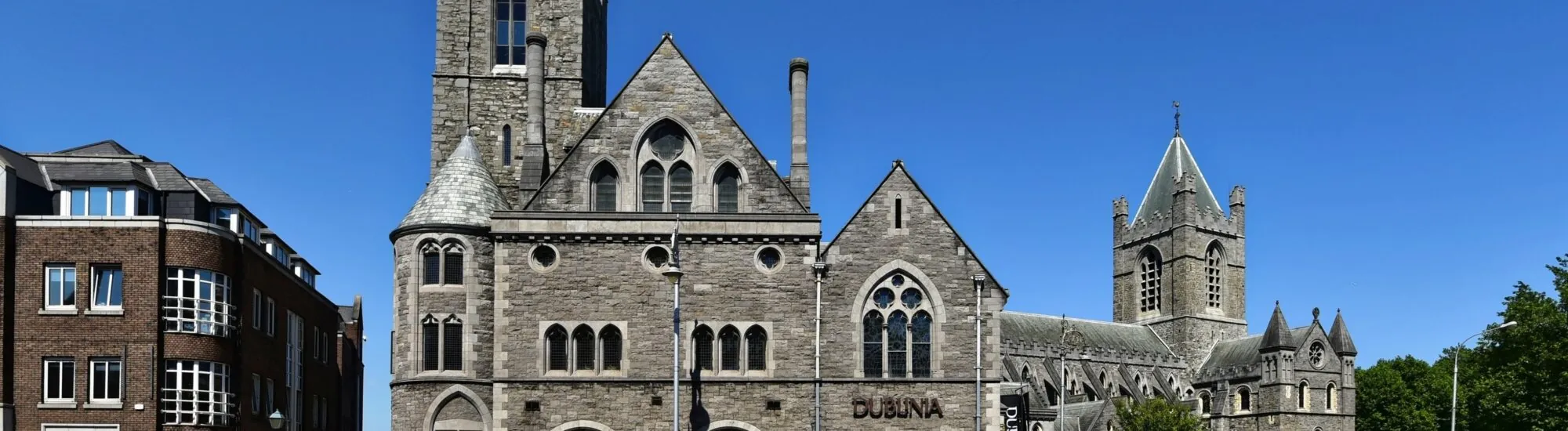
Located opposite Christ Church Cathedral, in the historic Liberties district, this immersive museum recounts almost a thousand years of urban history. Life-size reconstructions, archaeological objects, soundscapes and interactive displays reveal how the Vikings and then the people of the Middle Ages shaped the Irish capital.
Dublinia occupies Synod Hall, an imposing Gothic Revival building on St Michael’s Hill. A covered walkway crosses the road, linking the museum to Christ Church Cathedral.
The exhibition is spread across several levels. The first presents Dublin in the Viking era, the second explores the medieval city, and the third explains the work of archaeologists. The visit concludes with the optional climb up St Michael’s Tower, which offers a panorama over Dublin’s rooftops.
Dublinia relies more on reconstructions than on collections of original objects. Houses, streets, workshops, clothing and scenes from everyday life give tangible form to the knowledge gained from archaeological excavations.
Costumed interpreters and historical activities are offered on certain dates, particularly during school holidays. However, they are not available all the time and should not be regarded as a guaranteed part of every visit.
Dublinia opened in 1993 on the initiative of the Medieval Trust, an independent non-profit organisation. Its aim is to make discoveries relating to Dublin’s Viking and medieval past accessible to the public.
The project draws in particular on the major archaeological excavations carried out in the Wood Quay area during the 1970s and 1980s. These uncovered thousands of objects, as well as remarkably well-preserved remains of Viking houses, streets and workshops.
A permanent exhibition devoted to the Viking world was added in 2005. The displays then underwent a major redevelopment in 2010, expanding the reconstructions and interactive installations.
Today, Dublinia brings together three complementary approaches: reconstructing the early city, presenting everyday life, and explaining the methods used to interpret the remains.
The museum is housed in Synod Hall, designed by the English architect George Edmund Street. He also oversaw the major Victorian restoration of Christ Church Cathedral.
Construction of the building began in 1872 and was completed in 1875. It was intended to house the General Synod of the Church of Ireland, the assembly responsible for debating the life and administration of the Irish Anglican Church.
Synod Hall served this purpose until 1983. Following a major restoration campaign carried out by the Medieval Trust, the building was transformed into a historical interpretation centre.
Its Gothic Revival architecture echoes that of Christ Church. Stone arches, tall windows and monumental spaces provide a particularly fitting setting for evoking the medieval city.
The covered walkway linking Dublinia to Christ Church Cathedral was completed in 1875, at the same time as Synod Hall. It allowed members of the synod to pass directly from the meeting hall to the cathedral without going down to the street.
This bridge suspended above St Michael’s Hill has become one of the district’s most recognisable architectural features. It was therefore not built for the museum, but to meet the religious and ceremonial needs of the Victorian complex.
Visitors with a combined ticket can now use this walkway to reach Christ Church at the end of their visit to Dublinia.
Scandinavians appeared on the Irish coast at the end of the 8th century. Their first expeditions were chiefly raids on monasteries and coastal communities.
Around the middle of the 9th century, they established a permanent base near the Liffey. This settlement, known as a longphort, gradually developed into an important trading centre.
The Vikings are therefore not presented solely as warriors. They were also seafarers, craftspeople, traders and builders. Their network linked Dublin with the British Isles, Scandinavia and various parts of continental Europe.
Trade involved metals, leather, textiles, precious objects and enslaved people. Situated close to the sea and a navigable river, Dublin was ideally placed to become a major port.
The first part of Dublinia recreates several settings inspired by excavations in Viking Dublin. Visitors can enter a dwelling, see its hearth and discover how a family organised daily life.
Houses were generally built of timber, wattle and daub. The interior served as a place to rest, work and prepare meals. The fire provided warmth and light, but also regularly filled the house with smoke.
The exhibition covers metalworking, clothing production, food, runic writing and navigation. A reconstruction also offers a better understanding of the space available aboard a Viking ship.
Interactive displays invite visitors to handle certain objects, identify sounds or try on clothing inspired by the period. These experiences are particularly suited to families, while remaining grounded in archaeological knowledge.
Dublin existed in various forms before the permanent Scandinavian settlement. Christian communities were already present in the area, notably around Duiblinn, the “black pool” that gave the city its English name.
Nevertheless, the Vikings played a decisive role in transforming this area into a true urban and commercial centre. Their settlement is generally associated with the birth of the port city that would become Dublin.
The Irish name for the capital, Baile Átha Cliath, means “the town of the ford of the hurdles”. Both names therefore preserve the memory of neighbouring places that contributed to the formation of the city.
The exhibition also covers the Battle of Clontarf, fought near Dublin in 1014. It pitted the forces of High King Brian Boru against a coalition that included the Viking king of Dublin, Irish chieftains and fighters from outside Ireland.
The battle is sometimes portrayed as a straightforward confrontation between the Irish and the Vikings. The reality was more complex: alliances crossed ethnic lines and included Irish and Scandinavian fighters on both sides.
Brian Boru won the battle but was killed on the same day. The conflict permanently weakened Viking political power without causing the disappearance of Scandinavian populations, who were already deeply integrated into Irish society.
The second part of the museum looks at Dublin after the arrival of the Anglo-Normans in the 12th century. The city became the centre of English power in Ireland and underwent profound political, religious and architectural change.
The city was then enclosed by walls. Within them stood houses, workshops, churches and markets. The streets were narrow, lively and crowded with goods, animals and rubbish.
The exhibition recreates several of these settings. Visitors discover the home of a wealthy merchant, market stalls, the practices of a barber-surgeon and the living conditions of the city’s poorest inhabitants.
The exhibition also addresses justice, disease, religion, trades and leisure. It offers a comparison of daily life across different social groups, from craftspeople to the wealthiest members of the community.
Medieval Dublin was a densely populated city where smells, noise and overcrowding formed part of everyday life. Homes had no modern drainage systems, and animals moved about in close proximity to people.
Disease spread quickly. The Black Death reached Ireland in 1348 and struck Dublin hard. The exhibition explains the beliefs of the time, the treatments used and the limitations of medieval medicine.
Visitors can see the instruments of a barber-surgeon, whose skills ranged from trimming beards to carrying out certain operations. The boundary between treatment, superstition and dangerous practice was particularly thin.
Justice is also explored through the pillory and public punishments. Sentences served as much to punish as to expose the condemned person to the gaze and mockery of the public.
Dublin’s development rested on its merchants and many craftspeople. Blacksmiths, tanners, bakers, carpenters and weavers worked in districts sometimes organised by trade.
Guilds regulated training, professional practices and access to trade. They also played an important political role in the city’s administration.
Dublin’s location made it possible to import wine, spices, fabrics and various products from England and the Continent. These costly goods were mainly intended for the wealthiest groups.
Dublinia’s reconstructions allow visitors to see the tools, raw materials and techniques associated with several medieval occupations.
The third area, known as History Hunters, shows how the knowledge presented in the museum was acquired. It examines the work of archaeologists, historians and laboratory specialists.
A worn shoe, a piece of wood, animal bones or fragments of pottery can provide a great deal of information. Their location, condition and association with other remains can help explain diet, trade or the layout of a dwelling.
The exhibition explains the different stages of an excavation, from the discovery of a site to the cleaning and cataloguing of objects. It also shows how stratigraphy makes it possible to date successive layers of occupation.
This section adds an essential dimension to the visit. It reminds visitors that the Viking and medieval scenes presented on the previous floors are not imaginary, but the result of interpretative work based on material evidence.
From the 1970s onwards, excavations carried out near Wood Quay revealed an exceptional collection of Viking and medieval remains. The damp ground on the banks of the Liffey preserved many organic materials that would normally be destroyed over time.
Archaeologists uncovered the foundations of houses, sections of streets, wooden objects, leather shoes, tools and food waste. These discoveries transformed understanding of the early city.
Part of the site was destroyed during the construction of Dublin City Council offices, despite significant efforts to preserve it. However, the objects and records made during the excavations remain a fundamental source for understanding Viking Dublin.
The visit can end with a climb up St Michael’s Tower. This tower belonged to the former Church of St Michael the Archangel, which once stood on the site of Synod Hall.
There are 96 steps to the upper platform. The climb is via a narrow staircase and is not suitable for people with mobility difficulties.
From the top, visitors can look out over Christ Church Cathedral, the Liberties and Dublin city centre. This view provides a better understanding of the museum’s position at the heart of the former medieval city.
Dublinia is among Dublin’s most family-friendly history museums. The life-size reconstructions and hands-on displays make the information accessible without requiring visitors to read information panels continuously.
Children can try on certain garments, discover runic writing, look inside a dwelling or take part in activities offered during school holidays.
Some displays devoted to disease, punishments and sanitary conditions may unsettle younger children. Nevertheless, the exhibition is designed with an educational and family audience in mind.
The main exhibitions are served by a lift. St Michael’s Tower, however, can only be reached by stairs.
Allow between 1 hour 30 minutes and 2 hours to explore the three exhibitions and climb St Michael’s Tower. Families wishing to try every interactive display can easily spend longer there.
Dublinia can be visited on its own or combined with Christ Church Cathedral with a joint ticket. The covered walkway then allows visitors to move directly from one monument to the other.
Information on exhibitions, events and visiting conditions is available on the official Dublinia website.
Essential information to help you plan your visit, including key landmarks, access information, and booking options.
53.343174, -6.272120
1h30
Dublinia is open Monday to Sunday, all year round.
It is recommended to allow between 1 hour 30 minutes and 2 hours to visit the museum’s three levels and climb St Michael’s Tower.
Opening hours may change during the festive period or for special events. Booking is recommended at weekends and during school holidays.
Opening hours may change. Please check the official Dublinia website.
Check the opening hours and admission requirements before you leave, especially during peak season or on Irish public holidays.
The ticket includes access to the exhibitions on Viking Dublin, medieval Dublin and archaeology, as well as the climb up St Michael’s Tower.
A discount may be available for tickets purchased online. Dublinia also sells combined tickets with Christ Church Cathedral, with prices varying according to the make-up of the group.
Temporary family offers may be available during school holidays. It is recommended to check the conditions online before booking.
Prices may change. Booking and current prices are available on the official Dublinia website.
Compare tickets, guided tours, and excursions available through our partner platforms.