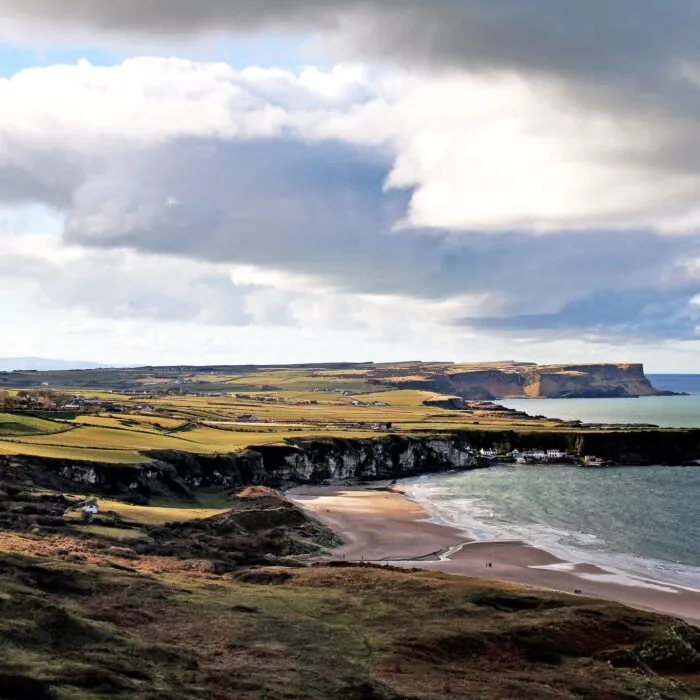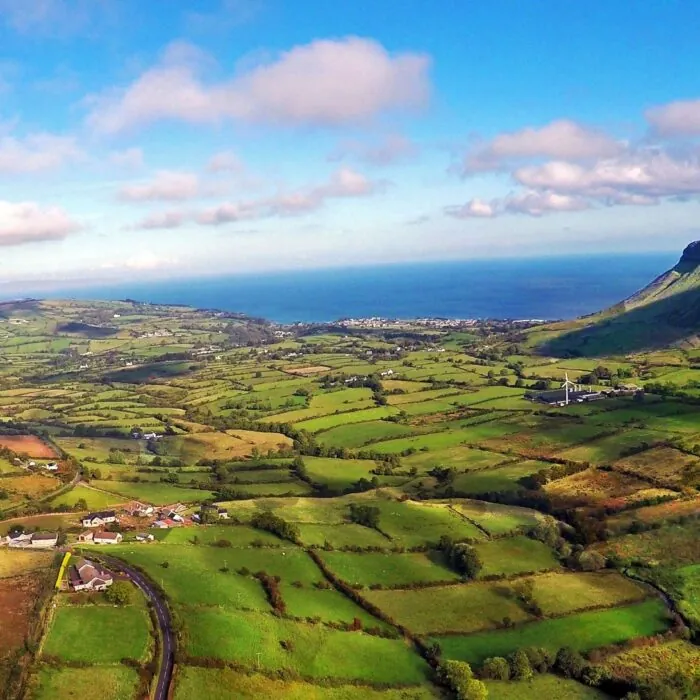


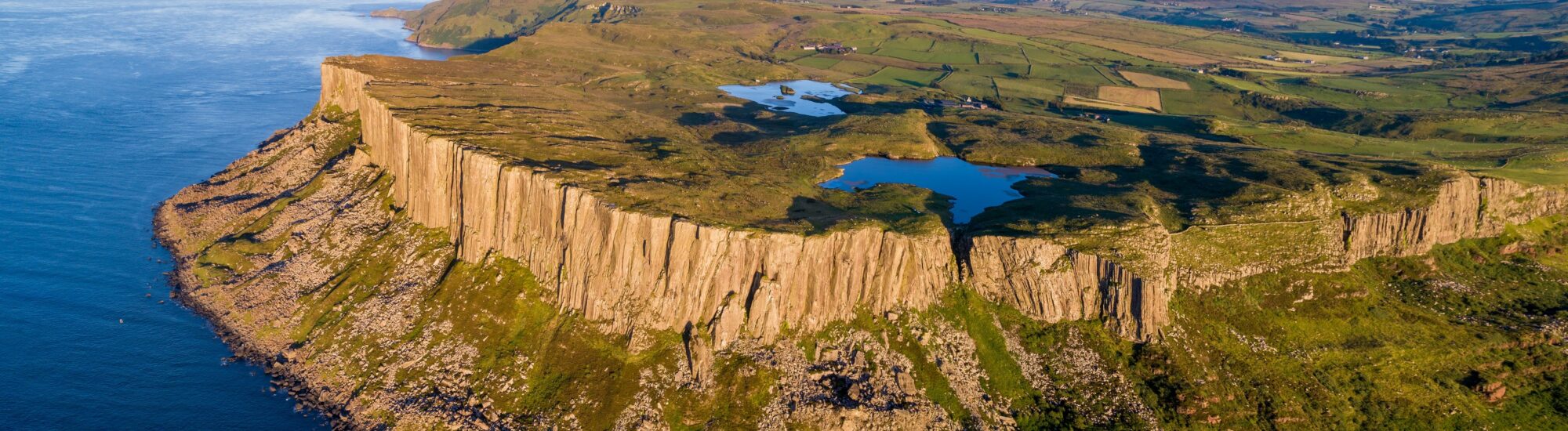
Fair Head (An Bhinn Mhór in Irish) is one of the most spectacular landscapes on the Antrim coast in Northern Ireland. A few kilometres east of Ballycastle, this vast rock wall rises above the sea, overlooking the Sea of Moyle. Wild, vertiginous and remarkably undeveloped, it presents a very different face from the green cliffs usually associated with Ireland.
Here, rock reigns supreme. Fair Head is made of dolerite, an igneous rock formed by the volcanic activity that reshaped the region around 60 million years ago. On the upper part of the cliff, it forms immense vertical columns, weathered and fissured by time and the elements, giving the rock face its distinctive monumental appearance.
Fair Head is now renowned among walkers for its views over Rathlin Island, Ballycastle and Murlough Bay, as well as in the climbing world for its demanding routes. Game of Thrones fans will also recognise the landscape: HBO chose it to portray the cliffs of Dragonstone in season 7 of the series.
Fair Head – Krzysztof Nahlik
Just a few kilometres from Ballycastle, the landscape changes dramatically. The roads become narrower, houses more scarce, and pastureland gradually gives way to a much wilder coastline.
Fair Head then appears like a true natural fortress rising above the ocean.
Unlike the famous Cliffs of Moher, its summit has not been developed to accommodate thousands of visitors. There is no large visitor centre, no barriers running continuously along the precipice, and no string of shops: Fair Head retains a strikingly raw atmosphere.
That is precisely where its charm lies.
The cliff is chiefly made up of dolerite. This igneous rock formed around 60 million years ago, when intense volcanic activity was shaping this part of Ireland. The same geological history gave rise to many of the Antrim coast’s extraordinary landscapes.
At Fair Head, the cooling and fracturing of the rock created impressive vertical structures. Some columns in the upper part of the cliff reach remarkable proportions. Seen from the sea or from certain points along the coast, the rock face resembles a gigantic natural organ.
Fortunately, you do not need to be a climber to discover Fair Head. Several waymarked walking routes allow visitors to explore the plateau and approach the cliffs from above.
The main starting point is at Fair Head Car Park, reached from Fairhead Road. The car park is on a private farm, and a small charge is made for parking.
Several circular routes allow you to tailor the walk to the time available and your ability. The routes range from approximately 2.4 to 5.5 km.
The Lough Dubh Walk, in particular, offers an excellent introduction to Fair Head. This circular walk of around 2.4 km follows the high ground before crossing farmland and passing close to small loughs hidden on the plateau.
The contrast is striking. Just a few dozen metres from the precipice, the cliff’s mineral starkness gives way to grassland, wetlands and small stretches of water surrounded by vegetation.
In clear weather, the views are extraordinary. The eye travels towards Ballycastle, Rathlin Island and beautiful Murlough Bay. When visibility is especially good, the Scottish coast may also appear on the horizon.
The relatively short distance of the routes should not obscure the fact that Fair Head remains a largely undeveloped natural environment.
The paths cross working farmland. It is therefore common to encounter sheep or other livestock. The ground can be uneven, muddy and particularly wet after rain.
Good walking boots are strongly recommended, along with waterproof, windproof clothing. Even when the weather is fine in Ballycastle, conditions can change quickly along this exposed stretch of coast.
During warm, humid periods, particularly in summer, insect repellent for midges can also prove very useful. These tiny biting insects are most active when the air is humid and there is little wind.
There are very few facilities directly along the route. For toilets, shops, cafés or restaurants, the easiest option is to plan a stop in Ballycastle before or after your walk.
For traditional climbing enthusiasts, Fair Head has a reputation that extends far beyond County Antrim.
Its immense vertical dolerite walls offer a multitude of particularly spectacular cracks and lines. The scale of the rock and the highly exposed setting give the site an instantly recognisable character.
But Fair Head is not a place for beginners.
Many routes are long, technical and committing. Access to certain parts of the cliff also requires a sound knowledge of the terrain and local conditions. It is primarily suited to experienced climbers proficient in traditional climbing.
If you would like to climb at Fair Head without knowing the area, it is better to contact a local guide or club than attempt an improvised ascent.
With scenery this spectacular, it was almost inevitable that Fair Head would attract the attention of film crews.
The site was notably used by HBO during the filming of Game of Thrones. In season 7, Fair Head provides the setting for the cliffs of Dragonstone, the ancestral seat of House Targaryen.
The cliffs appear in particular in scenes featuring Jon Snow and Daenerys Targaryen. Fair Head is thus one of the many natural landscapes in Northern Ireland used to bring Westeros to life, alongside Ballintoy Harbour, the Dark Hedges, Cushendun and Downhill Strand.
Even if you are not a fan of the series, it is easy to understand why the production teams chose this place. With its immense rock wall, dark sea and landscapes almost devoid of buildings, Fair Head has an inherently cinematic quality.
Fair Head offers more than remarkable geology and a small piece of television history. The site also belongs to Ireland’s mythological landscape.
The cliffs overlook the Sea of Moyle, the stretch of water separating the Antrim coast from Scotland.
In the celebrated legend of the Children of Lir, four children are turned into swans by their stepmother Aoife. Condemned to live in this form for centuries, they must spend 300 years on the icy waters of the Sea of Moyle.
When you look out over this sea from Fair Head on a windy day, with Rathlin Island on the horizon and waves breaking at the foot of the cliffs, the dramatic power of the legend suddenly makes perfect sense.
Fair Head can be explored throughout the year, but weather conditions have a considerable influence on the experience.
A clear day naturally offers the finest views, particularly towards Rathlin Island, Murlough Bay and, when visibility allows, Scotland.
Wind is, however, an even more important factor than rain. Fair Head is extremely exposed, and strong gusts can make walking near the cliffs uncomfortable or even dangerous.
Fog calls for the same caution. When clouds descend onto the plateau, visibility can deteriorate quickly, making the cliff edge difficult to distinguish.
Before setting off, check the local forecast and do not hesitate to postpone your walk if strong gusts or very poor visibility are expected.
This is undoubtedly the most important thing to know before visiting: Fair Head is a wild natural site, and the cliff edge is not continuously protected by barriers or guardrails.
In some places, the drop is directly beside the path. Keep well back from the edge, especially in windy weather, when the ground is wet or when visibility is poor.
Avoid approaching the precipice to take a photograph or selfie. No picture is worth risking a fall of nearly 200 metres.
With these few precautions, Fair Head remains one of the finest natural experiences on the Antrim coast. Less well known than the Giant’s Causeway and far less developed than Northern Ireland’s major tourist attractions, it offers what visitors often come to this coast to find: space, spectacular nature and that exhilarating feeling of reaching the end of the world.
Essential information to help you plan your visit, including key landmarks, access information, and booking options.
55.220974, -6.154258