Reservations are recommended


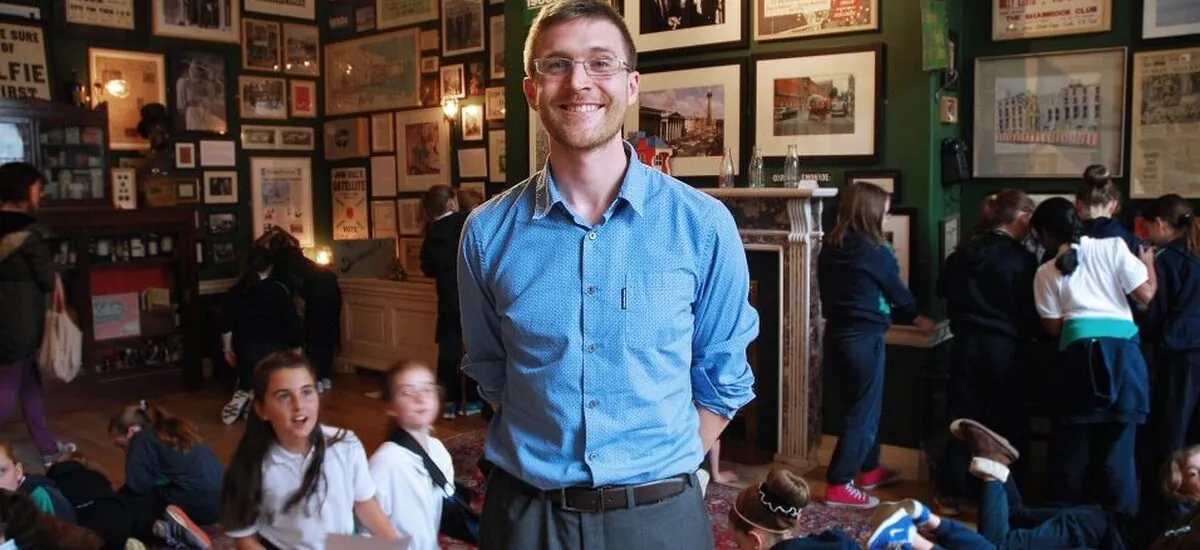
A milk bottle produced for Dublin’s millennium, Bono’s sunglasses, an old telephone directory and the missing finger from an O’Connell statue: at the Little Museum of Dublin, the history of Ireland’s capital is told through objects that major museums might sometimes have overlooked.
Housed at No. 15 St Stephen’s Green, in a red-brick Georgian townhouse, the museum brings together mementoes entrusted by local people. Family photographs, posters, letters, toys, newspapers and everyday objects create a vivid portrait of Dublin, its people and their sense of humour.
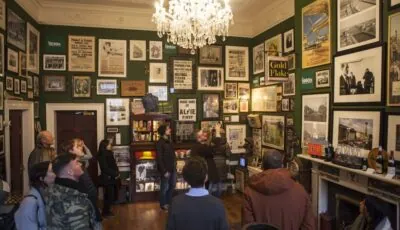
The Little Museum of Dublin
The Little Museum of Dublin is unlike a traditional historical institution. Its rooms retain the atmosphere of a private home, and its collections can sometimes seem arranged like the mementoes of one large family.
The visit is led by guides who recount Dublin’s story with precision, humour and a keen eye for anecdote. Major political events sit alongside music, sport, advertising, television and the small habits of everyday life in the city.
Entry is only possible as part of a guided tour. The museum’s celebrated tour lasts 29 minutes and provides a particularly accessible introduction to the city’s history. Afterwards, visitors can explore the various exhibition spaces included in the ticket.
The Little Museum of Dublin was founded in 2011 on the initiative of Trevor White. Its aim was to create a museum devoted to Dublin and its people, with particular attention to the 20th century.
The institution had one distinctive feature: it opened with almost no collection. Dubliners were invited to lend or donate objects capable of telling the story of a memory, a neighbourhood, a personality or a change in the city.
The response quickly exceeded expectations. Residents brought in photographs, letters, clothing, posters, commercial products and all kinds of family mementoes. These modest objects make it possible to tell a more intimate story than that usually presented in national museums.
The collection now includes more than 6,000 items. Not all are displayed at the same time, but together they form an important social and cultural record of Dublin.
The museum occupies a Georgian townhouse overlooking St Stephen’s Green. Its proportions, sash windows, fireplaces and rooms spread over several floors are an integral part of the experience.
The building recalls the period when Dublin’s elite settled around the grand squares in the south of the city. The house is therefore more than simply a setting: it is itself a fragment of Dublin’s architectural heritage.
Its relatively modest size explains the museum’s name, but also contributes to its charm. Visitors are just steps away from the objects and the guide, in an environment that encourages conversation rather than distant contemplation.
The historic building temporarily closed for major restoration work. During the works, some activities were moved to a temporary space on Pembroke Street.
The Little Museum of Dublin officially reopened on St Stephen’s Green in June 2025, following a €4.3 million project. The house was restored, the exhibition spaces redesigned and new facilities introduced.
A lift now provides access to the different floors. The museum also has a library, archives, a screening space and more extensive educational resources.
The renovation has not erased the institution’s abundant character. Objects remain numerous, closely arranged and displayed in a deliberately domestic atmosphere.
The tour explores the profound changes experienced by Dublin during the 19th and 20th centuries. The city went from being a major city of the British Empire to the capital of an independent state.
The 1916 Easter Rising, the War of Independence and the Civil War are naturally covered. Figures such as Michael Collins and Éamon de Valera appear alongside the writers, journalists, artists and anonymous residents who also helped shape Dublin’s identity.
The museum also considers the decades that followed: the development of neighbourhoods, social change, the influence of the Church, the country’s gradual opening up and the emergence of a new urban culture.
Sport, television, advertising and major popular events all have their place in the narrative. This approach shows how a capital changes not only through political decisions, but also in its living rooms, shops, stadiums and streets.
Much of the museum’s appeal lies in the diversity of its collection. The objects on display do not always have great financial value, but they are highly evocative.
A milk bottle commemorating Dublin’s millennium in 1988 recalls a period when the city began to take a fresh look at its heritage. A telephone directory from the same era still prompts Irish visitors to look for the names of their parents or grandparents.
The collection also includes the marble thumb of an O’Connell statue, accidentally detached during the national football team’s triumphant return after the 1990 World Cup. Kept for several decades by a local woman, the fragment eventually made its way to the museum.
These objects have a particular effect: they tell the story of familiar events on a human scale. National history then gives way to personal memories, chance occurrences and anecdotes that make up a city’s collective memory.
The Little Museum of Dublin has a space devoted to U2 and the history of Irish popular music. It traces the journey of Bono, The Edge, Adam Clayton and Larry Mullen Jr, from their teenage years to international success.
The four musicians met at Mount Temple Comprehensive School after Larry Mullen Jr placed an advertisement to form a band. This story, which has become almost mythical, marks the beginning of a musical adventure deeply connected with Dublin.
The exhibition brings together photographs, posters, records, concert tickets and several objects associated with the band. A Mount Temple class photograph, in particular, offers a glimpse of the future members of U2 before they became famous.
Bono’s sunglasses are among the most popular exhibits. The collection also includes mementoes donated or loaned by people who accompanied the band in its early years.
The space is not limited to U2. It also explores the Dublin music scene more broadly and several major artists, including Sinéad O’Connor, Phil Lynott, Luke Kelly and The Dubliners.
The ground floor hosts an exhibition devoted to Dublin’s golden age. At the end of the 18th century, the city was one of Europe’s most important and elegant. Its squares, grand houses and public buildings bear witness to this prosperity.
The English draughtsman James Malton captured the capital in a series of architectural views. His works depict an orderly, monumental city, before the economic decline that followed the Act of Union of 1800 and the transfer of the Irish Parliament to London.
The exhibition uses these drawings to tell the story of the changing urban landscape. It also offers a better understanding of the architectural setting in which the museum stands.
One room recreates the office of Robert “Bertie” Smyllie, editor of the Irish Times from 1934 to 1954. Known for his colourful personality, he led the newspaper through the Second World War and a period of profound transformation in Irish society.
His desk, lamp and typewriter are displayed alongside old editions of the daily newspaper. The room evokes life in a newsroom, the constraints of censorship and the way Dublin’s press covered international events.
The typewriter was given to the Irish Times by the writer Maeve Binchy. It recalls Dublin’s close ties with journalism and literature.
The renovated tour gives greater prominence to the women who contributed to Dublin’s political, social and cultural transformation. Activists, artists, politicians and ordinary citizens appear throughout the rooms of the house.
This presentation is inspired in particular by a famous statement made by Mary Robinson when she was elected President of Ireland in 1990. She paid tribute to women who, rather than simply “rocking the cradle”, had helped to overturn the system.
The museum also addresses more painful life stories. An installation devoted to Mary recalls, in particular, her time in a Magdalene Laundry and her long struggle for recognition for the victims of these institutions.
Among the most spectacular additions is Tara’s Palace, a monumental dolls’ house inspired by Leinster House, home to the Irish Parliament.
Its construction required more than 20 years of work. The miniature rooms are furnished with furniture, paintings and objects reproduced with remarkable precision.
The work naturally appeals to children, but its richness extends far beyond the realm of toys. It reflects meticulous craft traditions and offers a distinctive representation of Irish architecture.
The Little Museum of Dublin appeals to adults and children alike. Guides regularly engage younger visitors and use objects to make historical stories more tangible.
The new spaces include a display devoted to animals connected with Dublin’s history. Visitors encounter the memory of an elephant from Dublin Zoo and that of a lion that once escaped as far as Fairview Strand.
The relatively short format of the guided tour is well suited to families. Children can then look at the objects and explore the different rooms at their own pace.
Tours are mainly conducted in English. The guides generally speak expressively and use many objects as visual aids, but a good level of comprehension is preferable to appreciate the anecdotes and humour.
The museum should not be approached as a simple self-guided collection: the guide’s storytelling is at the heart of the experience. Visitors who are not comfortable in English can enquire before booking about any resources available in other languages.
The main guided tour lasts 29 minutes. However, it is advisable to allow around an hour to examine the collections, the U2 space and the other exhibitions after the presentation.
The museum is opposite St Stephen’s Green and a few minutes from Grafton Street. A visit can easily be combined with a walk in the park or an exploration of the neighbouring Georgian streets.
The building is now accessible to wheelchair users thanks to improvements made during the renovation. A secure area is also available for leaving larger bags during the visit.
The Hatch & Sons restaurant once occupied the basement of the house. It is no longer among the services offered by the museum and should therefore no longer be presented as the institution’s foodie highlight.
The Little Museum of Dublin currently has no café. However, several restaurants can be found around St Stephen’s Green. The museum ticket entitles visitors to a 10% discount at certain partner establishments, subject to the applicable conditions.
Information on the collections and tours is available on the Little Museum of Dublin’s official website.
Essential information to help you plan your visit, including key landmarks, access information, and booking options.
53.339638, -6.258315
45 minutes
The Little Museum of Dublin is open 7 days a week.
Access to the museum is by guided tour only. The main tour lasts 29 minutes, but it is best to allow around an hour to explore the exhibitions.
Places are limited. Online booking is strongly recommended, particularly at weekends, during school holidays and in the peak tourist season.
Opening times may change for private events. We recommend checking the official Plan your Visit page.
The ticket includes the main guided tour, as well as access to the collections and the exhibition devoted to U2.
Holders of a valid DoDublin sightseeing bus ticket may be eligible for free admission, subject to the partnership terms. This admission cannot be booked in advance and depends on availability when arriving at the museum.
Prices may change. Booking is recommended via the Little Museum of Dublin’s official website.
Compare tickets, guided tours, and excursions available through our partner platforms.