Viator


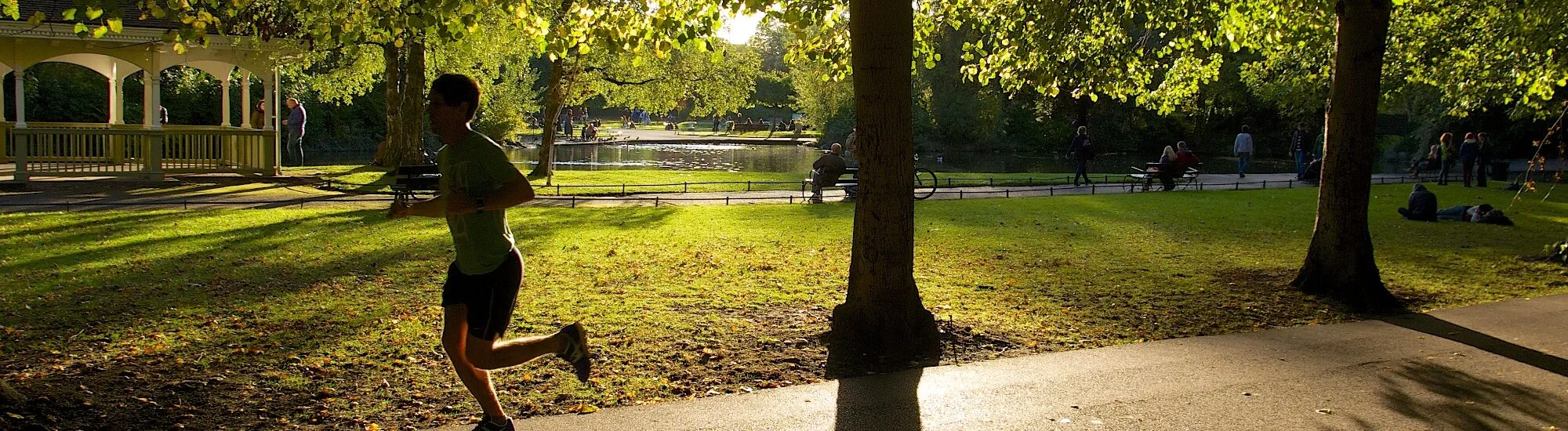
Behind the gates of St Stephen’s Green, Dublin’s bustle seems suddenly to fade away. Buses, passers-by and the shopfronts of Grafton Street give way to lawns, flowerbeds and the rustling of trees. Right in the heart of the Irish capital, this Victorian park of almost 9 hectares offers one of the city’s most enjoyable walks.
St Stephen’s Green is at once a public garden, a place of remembrance and a space deeply woven into the everyday life of Dubliners. Students, families, nearby office workers and travellers come here to stroll, have lunch on the grass or simply take a few quiet minutes between visits.
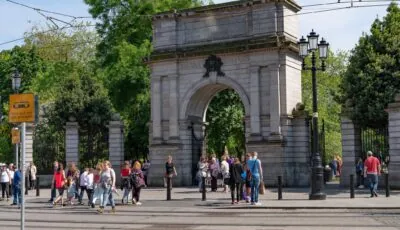
The Fusiliers’ Arch at St Stephen’s Green – © William Murphy
St Stephen’s Green occupies a large quadrangular square south of Dublin’s historic centre. The park lies at the end of Grafton Street, close to the Little Museum of Dublin, the Shelbourne Hotel and the Georgian quarter.
Its winding paths run through lawns, flowerbeds and carefully landscaped wooded areas. An ornamental lake occupies the northern part of the garden, while a waterfall, a Victorian bandstand and several monuments punctuate the walk.
The park can be explored quickly, but it is worth taking your time. Behind its peaceful appearance lies almost four centuries of history, shaped by the development of Dublin, the Guinness family and the fighting of the Easter Rising of 1916.
In the Middle Ages, the area still lay outside Dublin’s city walls. It was then marshland, used in particular for grazing animals. Its name may be linked to an old church or leper hospital dedicated to St Stephen, although the precise origin of the name remains debated.
In the 17th century, the authorities decided to reorganise the area. Land around the Green was divided up and sold to fund its development. Houses gradually began to line the square, which became one of Dublin’s most prestigious addresses during the course of the 18th century.
By the early 19th century, the garden had fallen into serious disrepair. In 1814, its management was entrusted to commissioners representing the owners of the neighbouring houses. New paths were laid out, trees were planted and elegant Victorian railings replaced the old wall.
These improvements came at a cost, however: the park became private. Access was reserved for those able to rent a key, a decision that was poorly received by Dublin’s other residents.
The park’s story changed thanks to Sir Arthur Guinness, a member of the famous brewing family and the future Lord Ardilaun. Raised at Iveagh House, on the southern side of St Stephen’s Green, he knew the garden well and wanted to return it to the public.
In 1877, Arthur Guinness offered to buy back the rights associated with the park, settled its debts and secured the passing of an Act guaranteeing its opening to the public. He then funded a complete transformation of the landscape, at an estimated cost of £20,000, a considerable sum at the time.
The work lasted around three years. The land was reshaped, a lake of almost three acres was created and new paths were laid out. A waterfall, bridge, fountains and flowerbeds completed the design. St Stephen’s Green reopened to the public on 27 July 1880.
The park has since been managed by the Office of Public Works. A statue of Lord Ardilaun, standing opposite the Royal College of Surgeons, recalls the essential role Arthur Guinness played in its history.
The ornamental lake is one of the park’s most popular features. Its planted banks provide a haven for several species of waterbird, including ducks, swans and moorhens. A small bridge crosses one end of it, offering a different view of the garden.
In the west of the park, an artificial waterfall flows through a rocky setting. This structure is made of Pulhamite, an artificial material developed in the 19th century to reproduce the appearance of natural stone in landscaped gardens.
St Stephen’s Green’s ‘Pulham Rockery’ reflects the Victorian taste for picturesque landscapes. Rocks, plants and water combine to create a deliberately wild scene, despite the garden’s very urban setting.
The park also includes a Victorian bandstand, fountains, a children’s playground and a garden designed for visually impaired people. The latter features scented plants and species that can be explored by touch.
The north-west entrance to St Stephen’s Green is dominated by Fusiliers’ Arch. Built at the end of Grafton Street, this monumental arch was unveiled in 1907 in memory of the soldiers of the Royal Dublin Fusiliers who fought in the Second Boer War in South Africa between 1899 and 1902.
More than two hundred names are inscribed on the monument, alongside the principal battles in which the regiment took part. The arch recalls a complex chapter in Irish history, at a time when the island was still part of the United Kingdom and many Irishmen served in the British Army.
Marks of impact associated with the fighting of 1916 are still visible on the stone. They directly connect the monument with the revolutionary events that unfolded in the park nine years after its inauguration.
On Easter Monday 1916, members of the Irish Citizen Army took control of St Stephen’s Green. The group was led by Michael Mallin and included the revolutionary Constance Markievicz.
The insurgents closed off the entrances and dug trenches in the lawns to control this strategic point in central Dublin. The park’s greenhouse was turned into a first-aid post.
The position proved difficult to defend, however. British soldiers stationed on the upper floors of the Shelbourne Hotel overlooked the garden and were able to fire on fighters entrenched in the open spaces. The insurgents gradually abandoned the park and withdrew to the Royal College of Surgeons building on its western side.
Today, nothing in the calm of the lawns suggests the intensity of these clashes. The impact marks preserved on Fusiliers’ Arch and the bust of Constance Markievicz nonetheless place the park within the history of Irish independence.
The park’s paths are home to numerous monuments dedicated to Ireland’s political, military and literary figures. Their presence turns a stroll through the park into a true open-air historical gallery.
Near the north-east entrance stands a monument to Theobald Wolfe Tone, one of the founders of the United Irishmen and a major figure in republican nationalism. The main sculpture is accompanied by large granite stelae, giving it an austere and solemn appearance.
The park also has a memorial to Jeremiah O’Donovan Rossa, a republican activist and member of the Fenian movement, as well as a bust of Constance Markievicz. The first woman elected to the British House of Commons, she took direct part in the fighting around St Stephen’s Green in 1916.
Literature also has an important place here. James Joyce is represented by a bust in the park, while a monument pays tribute to the Irish writer and poet William Butler Yeats, winner of the Nobel Prize in Literature in 1923.
A particularly moving sculptural group evokes the Great Famine. Created by Edward Delaney, the work stands near the north-east corner of the garden and recalls one of the most tragic periods in Irish history.
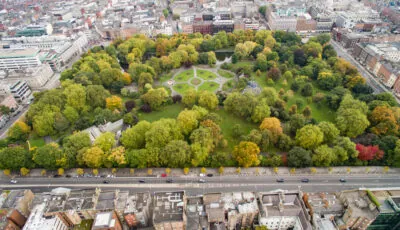
St Stephen’s Green in Dublin – © dronepicr
St Stephen’s Green is best explored on foot. Its paths allow you to walk around the garden, follow the lake and reach the various monuments with ease. A thorough visit generally takes between one and two hours.
In fine weather, the large lawns welcome people who come to have lunch, read or enjoy the sunshine. The park’s central location makes it an ideal stop between a stroll along Grafton Street, a visit to Trinity College and exploring the Georgian quarters.
Children have a playground, while photography enthusiasts will find several interesting compositions around the lake, waterfall and Fusiliers’ Arch. The bandstand occasionally hosts concerts and events, particularly during the summer.
The park’s wildlife should be observed without being disturbed. It is best not to feed the birds bread, as it is unsuitable for their diet and may affect water quality.
The main paths are relatively level and suitable for prams and wheelchairs. Several entrances provide access to the garden from the surrounding streets.
The garden for visually impaired people complements these facilities with plants selected for their scents, textures and ability to be discovered other than by sight.
Not all lawns are accessible at all times. Some may be temporarily closed to protect the grass, particularly after heavy rain or during maintenance work.
St Stephen’s Green is far more than a leafy interlude. Its Victorian landscape tells the story of Dublin’s development, from common land outside the city walls to the transformation of the neighbourhood into a prestigious address.
Its monuments bring together several strands of memory: Irish soldiers who served in the British Army, the revolutionaries of 1916, figures of independence and leading names in literature. Few places in Dublin bring together so many stories in such a compact space.
Yet the park remains full of life. Behind the statues and bullet marks, Dubliners continue to lie on the grass, run beneath the trees and meet loved ones by the lake. It is precisely this balance between memory and everyday life that gives St Stephen’s Green its distinctive character.
Further historical information is available on the official St Stephen’s Green website, managed by the Office of Public Works.
Essential information to help you plan your visit, including key landmarks, access information, and booking options.
53.338148, -6.259012
1 heure
Closing time varies with the seasons and daylight hours. It is displayed at the park’s various entrances. A complete visit generally takes between one and two hours.
Opening hours may change for an event or for safety reasons. It is advisable to check the official Heritage Ireland page.
Check the opening hours and admission requirements before you leave, especially during peak season or on Irish public holidays.
free
Compare tickets, guided tours, and excursions available through our partner platforms.