

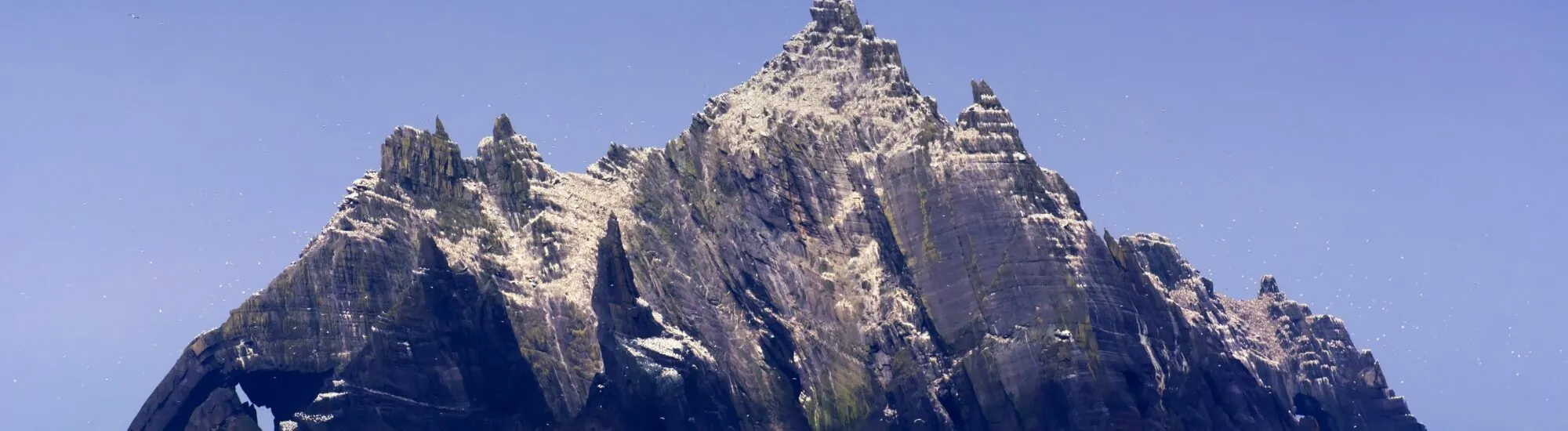
About 11 kilometres off the Iveragh Peninsula, Little Skellig rises from the Atlantic like a mineral fortress. This wild island in County Kerry forms the Skellig archipelago with its famous neighbour, Skellig Michael. Far smaller, it covers just 7.8 hectares, yet its cliffs still rise to 134 metres above the ocean.
Little Skellig is officially known by its Irish name, An Sceilg Bheag. No known permanent human settlement has ever been built there. Even today, visitors are not permitted to land: the island can only be viewed from the sea on a boat trip around the Skellig Islands.
There is no harbour, jetty or visitor trail on Little Skellig. Its cliffs plunge almost vertically into the ocean, and its few ledges are occupied by thousands of seabirds. Unlike Skellig Michael, no tourist boat is permitted to put visitors ashore here.
This restriction is not simply a precaution prompted by rough seas: it protects a bird colony of international importance. Even trips described as ‘landing tours’ only land on Skellig Michael. They may pass Little Skellig, but passengers remain on board close to the smaller island.
The best way to see it is on an eco cruise, often called a Skellig Islands Eco Tour. These trips circle Little Skellig and Skellig Michael without going ashore. The skipper adjusts the viewing distance according to sea conditions, wind and the birds’ behaviour.
Little Skellig lies in the Atlantic Ocean, around 11 kilometres from the Kerry coast and less than 3 kilometres from Skellig Michael. It is generally the first island to come into view as boats approach from Portmagee.
The island is made chiefly of Old Red Sandstone, with small amounts of slate and veins of white quartzite. Erosion, waves and storms have shaped arches, fissures and tiny rock platforms used by birds.
Vegetation is extremely sparse. The limited amount of soil and the intensive occupation of ledges by northern gannets prevent most plants from becoming established. A few species that withstand sea spray can nevertheless grow in spaces too narrow to accommodate a nest.
From the boat, the rock may look black when wet, then almost white during the breeding season. This change in appearance does not come from the rock itself: it is caused by the birds’ pale plumage and guano accumulated on the cliffs.
Little Skellig has been an official nature reserve since 1988. It is owned by a private landowner and managed with the involvement of BirdWatch Ireland. Together with Skellig Michael and the surrounding waters, it also forms part of the Skelligs Special Protection Area, designated under the European Birds Directive.
Since 2024, Little Skellig has also been included in the natural area brought together within Páirc Náisiúnta na Mara, Ciarraí, Ireland’s first marine national park. This protection allows for better coordinated conservation of the islands, marine habitats and seabird colonies along the Kerry coast.
One common misunderstanding remains: Little Skellig is not a UNESCO World Heritage Site. The designation granted in 1996 applies solely to Skellig Michael and its monastic settlement. Little Skellig has other national and European protections, mainly linked to its ornithological importance.
Little Skellig is home to Ireland’s largest northern gannet colony and one of the largest in the world. Heritage Ireland still describes it as the world’s second-largest colony of this species.
The presence of these birds on the island has been documented since the 18th century. The colony numbered around 500 pairs in 1850, nearly 10,000 in the mid-20th century and 35,294 in 2014, the year of the site’s largest survey.
The latest official count available, conducted in 2023, estimated the population at 26,958 breeding pairs. This represents a 24% decline since 2014, probably linked to the highly pathogenic avian influenza outbreak of 2022. Despite this reduction, Little Skellig still holds around 60% of Ireland’s northern gannet population.
The sight remains striking. Adults, recognisable by their white plumage, black wingtips and slightly yellow heads, occupy almost every available platform. Their wingspan can approach two metres. When they spot a shoal of fish, they dive into the ocean at high speed, their bodies becoming veritable arrows.
Close to the island, the noise of the birds becomes impressive, and their presence can even be detected by smell. Binoculars make it possible to observe pairs, courtship displays, chicks and sometimes turbulent arrivals on the ledges.
Northern gannets overwhelmingly dominate the colony, but they are not the only birds present. In 2024, ornithologists counted around 1,678 guillemots on Little Skellig, along with 395 pairs of kittiwakes. Northern fulmars also nest on some of the ledges.
The Skelligs Special Protection Area is also home to European storm petrels, Manx shearwaters, razorbills and Atlantic puffins. Their distribution, however, differs from one island to another.
Contrary to what is sometimes reported, puffins are not considered to breed on Little Skellig. The latest conservation objectives from the National Parks and Wildlife Service state that, within this protected area, they breed exclusively on Skellig Michael. It is still possible to spot them at sea during the crossing or around the larger island, mainly before the beginning of August.
Seals can occasionally be seen in the water or on the lowest rocks. Dolphins sometimes accompany boats, while whales and basking sharks are rarer encounters. Naturally, no marine mammal sighting can be guaranteed.
Most trips depart from Portmagee Marina on the Iveragh Peninsula. A few operators may also offer departures from Valentia Island or other parts of the coast, depending on the season.
From Portmagee, the crossing to the Skelligs generally takes between 45 minutes and an hour. A full eco cruise lasts around 2 hours 30 minutes. It usually includes the journey to the islands, a pass around Little Skellig, views of Skellig Michael from the sea and the return to the mainland.
Boats remain subject to Atlantic conditions. A trip may be delayed or cancelled even when the weather appears relatively calm in Portmagee. Wind, swell and visibility offshore matter more than the weather seen from the harbour.
Booking well in advance is strongly recommended between May and September. It is also important to check the operator’s cancellation policy: if the crew cancels a trip because of weather conditions, operators generally offer a refund or an alternative date, though their terms may vary.
The first northern gannets return to Little Skellig as early as February or March. The ledges fill up through spring, with egg-laying generally taking place in April and May. A large proportion of chicks hatch in June.
May, June and July offer intense activity around the nests. In August and September, young birds grow and gradually begin to leave the ledges. Most of the colony heads back offshore before the end of October.
Tourist cruises operate mainly from April to October. To combine sightings of Little Skellig’s northern gannets with Skellig Michael’s puffins, it is best to travel between May and July.
Even on a sunny day, it can feel cool on the Atlantic. A waterproof, windproof jacket, several layers of clothing, non-slip footwear and sun protection are recommended. It is also useful to bring water and a light snack.
Cameras and binoculars should be secured with a strap. A telephoto lens allows you to take good photographs while maintaining the distance needed to avoid disturbing the birds. Using a drone near the colony should be avoided because of the disturbance it may cause.
The crossing can be rough. Those prone to seasickness can ask a pharmacist for advice before departure and should follow the recommended timing for taking any medication. It is best to avoid a very heavy meal just before boarding.
Accessibility depends on the boat chosen. Some vessels have accessible facilities and toilets, while others are more cramped. Families with young children and people with reduced mobility should check the facilities directly before booking.
A boat trip can be combined with exploring Portmagee, the small harbour village from which many boats depart. Staying overnight nearby makes early departures easier and offers more options should a trip be postponed because of the weather.
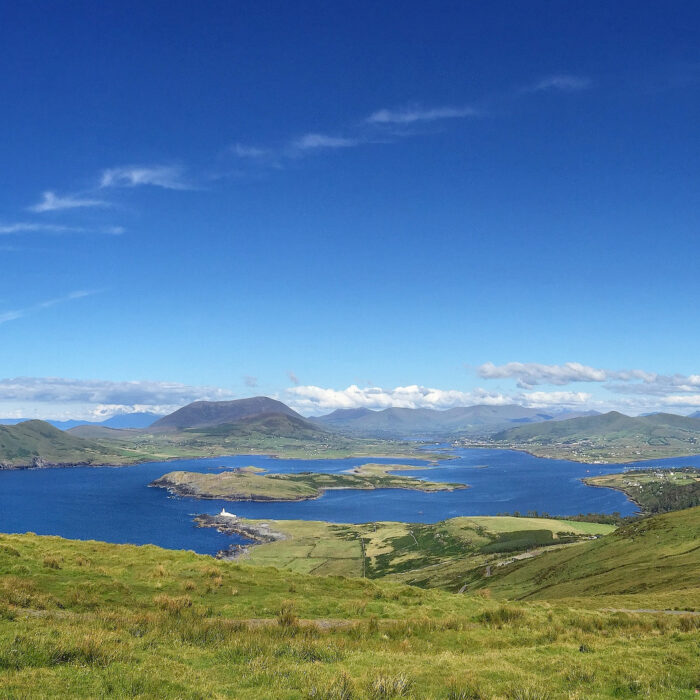
The Skellig Ring passes through some of the Iveragh Peninsula’s finest scenery. The Kerry Cliffs offer views of the islands on the horizon when visibility is good, while Valentia Island has several Atlantic viewpoints.
To discover the monastic history, stone steps and Star Wars filming locations, plan a separate visit to Skellig Michael. Landing there is strictly regulated and also depends on sea conditions.
The area, coordinates and nature reserve status are provided by the National Parks and Wildlife Service. Ornithological data come from the Skelligs Special Protection Area conservation objectives published in 2025. The official Irish name can be checked in the national database of Irish place names. Little Skellig’s inclusion in the marine national park is outlined by the National Parks of Ireland.
Essential information to help you plan your visit, including key landmarks, access information, and booking options.
Prendre le bateau à Portmagee. Sachez que les navettes sont parfois suspendues en cas de mauvais temps., Ring of Kerry, Ring of Kerry, Skellig Islands, Skellig Islands
51.781927, -10.508361
1 journée