

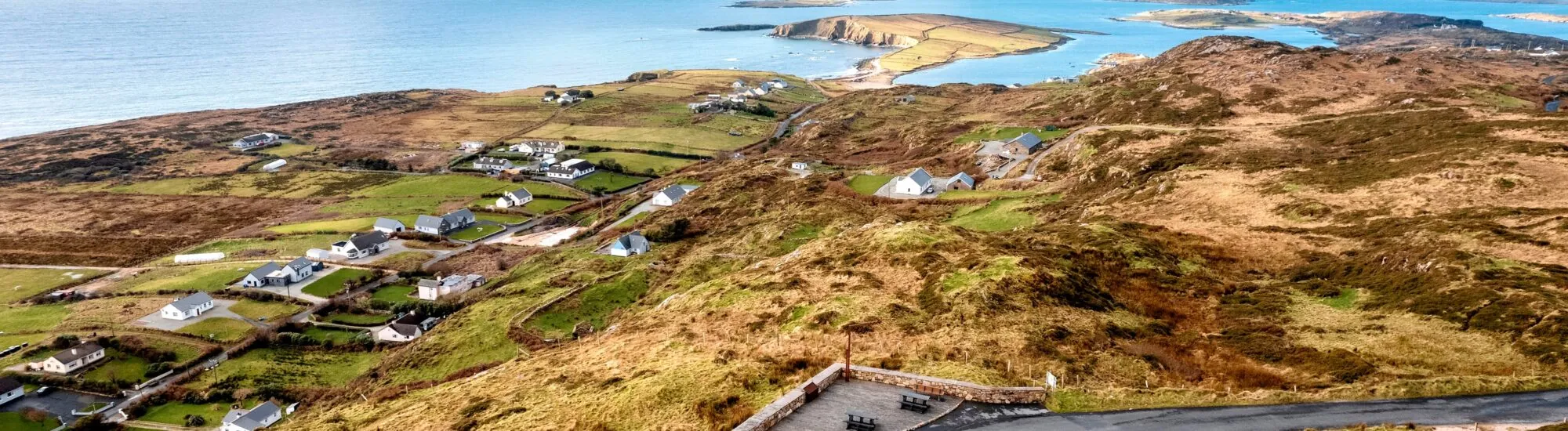
West of Clifden, the Sky Road forms a spectacular loop between the hills of Connemara and the Atlantic Ocean. Over roughly 16 kilometres, this scenic route climbs above Clifden Bay, runs alongside pastures criss-crossed by stone walls and reveals a string of wind-swept islands.
Part of the Wild Atlantic Way, the Sky Road is one of Ireland’s most beautiful drives. It can be explored by car or bicycle, with a preference for the Upper Sky Road, the upper branch where the main viewpoint is located. The drive is free and accessible all year round, subject to favourable weather conditions.
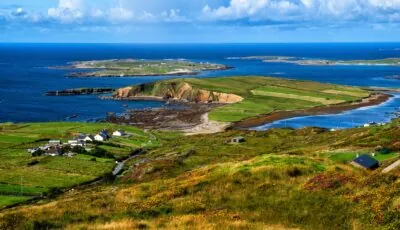
The Sky Road in Connemara – © Andreas Vogel – Shutterstock
The Sky Road begins on the western outskirts of Clifden, regarded as the capital of Connemara. From the town centre, signs clearly indicate the direction of the scenic route. The route first crosses the high ground overlooking the town before continuing towards the Kingstown peninsula.
As the road climbs, the houses become more scattered and the landscape wilder. Bogs, heathland and dry-stone walls line the road until the ocean comes into view. From here, the eye takes in Clifden Bay, Streamstown Bay and several offshore islands, including Inishturk and Turbot Island.
The full loop officially measures around 16 kilometres. Without stopping, it can be driven in 40 to 50 minutes, but it is best to allow at least 1 hour 30 minutes to enjoy the viewpoint and the various vistas. Allow more time if you wish to walk to the ruins of Clifden Castle.
A few kilometres from Clifden, the road divides into two branches. The Upper Sky Road climbs higher and leads to the route’s most famous view. The Lower Sky Road stays closer to the coast, homes and small coves.
If you only choose one, opt for the Upper Sky Road. It is the original historic Sky Road and offers the clearest views of the Atlantic. At its highest point, a parking area allows visitors to stop without obstructing traffic. This is the main Discovery Point on the Wild Atlantic Way along this route.
The Lower Sky Road has a more intimate atmosphere. It winds between pastures, stone walls and isolated homes, close to the bay. The two branches eventually meet again : you can therefore follow the Upper Road without turning back, then continue the loop towards Clifden.
From the Upper Sky Road viewpoint, Connemara seems to break apart between land and ocean. Rocky peninsulas reach out into waters dotted with islets, while meadows form an irregular mosaic bordered by miles of low stone walls.
The light is one of the landscape’s greatest attractions. In this Atlantic-facing region, sunny spells quickly follow showers. A shaft of sunlight can illuminate an island while the coast remains beneath cloud, giving the panorama an almost unreal depth.
Sunset is especially sought after. As the road faces west, the sky can take on spectacular colours above the ocean. Clouds do not necessarily spoil the experience : they often create Connemara’s finest displays of light.
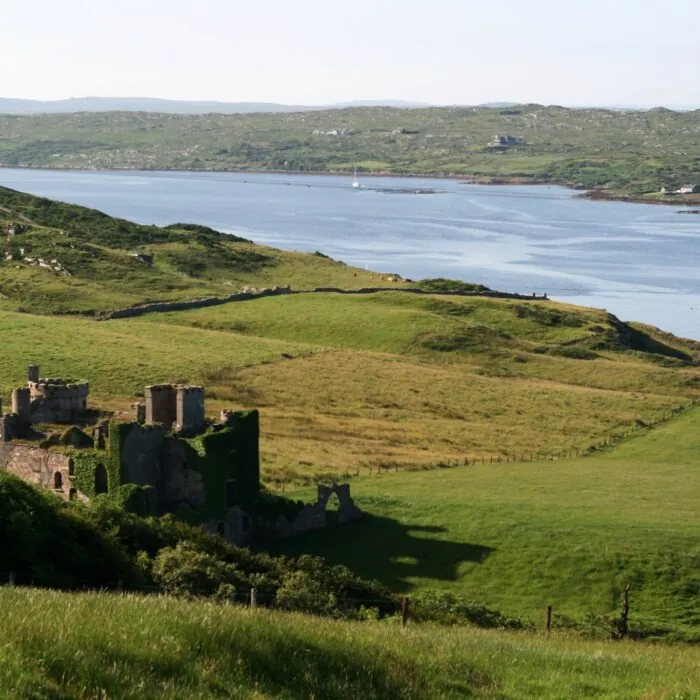
Shortly after leaving Clifden, the Sky Road passes close to Clifden Castle. This neo-Gothic residence was built in the early 19th century for John D’Arcy, founder of the town of Clifden.
The castle is now in ruins and cannot be reached directly by car. A gate and several stone pillars mark the start of the path. The walk crosses private farmland where a right of way is tolerated as far as the monument. Please stay on the path, close any gates behind you and respect the livestock.
Allow approximately 20 to 30 minutes’ walking each way. The ground can be muddy after rain, and the ruins are not secured like a developed visitor site. It is therefore best to view them carefully, without climbing the walls.
The Sky Road is surfaced and does not require a four-wheel-drive vehicle. A standard hire car is more than sufficient. However, it remains narrow and winding, and is sometimes bordered by banks that limit visibility.
Adjust your speed before bends and hill crests. When two vehicles meet, one may need to pull into a passing place to let the other through. These spaces should not be used for extended parking.
Sheep may also be on the road or emerge from a field. They are not a staged attraction, but part of local farming activity. Slow down and wait for them to clear the road without using the horn unnecessarily.
Finally, avoid stopping on a bend, in front of a farm entrance or in the middle of the road to take a photograph. The upper viewpoint parking area and sufficiently wide passing places offer much safer conditions.
The Sky Road makes for a lovely cycle from Clifden. The distance is manageable, but the climb to the Upper Road and winds blowing in from the Atlantic can make it more demanding than it appears.
An electric bike may be useful for occasional cyclists. Wear visible clothing, use lights in grey weather and remain alert to vehicles on blind bends. The road has neither a cycle lane nor a continuous hard shoulder.
It is also possible to explore certain sections on foot. However, care is needed on the narrowest stretches, where the verges are limited. For a longer hike, choose a walking route planned in advance rather than an improvised walk along the entire road.
Late spring and early autumn generally offer a good balance of light, visitor numbers and daylight hours. In summer, long evenings allow time to wait for a sunny spell or admire the sunset, but the road sees more cars and cyclists.
Morning is often the best time for a peaceful drive. Later in the day, the light becomes warmer, though the viewpoint can sometimes be busier.
The Sky Road remains strikingly beautiful under cloud, but fog can completely obscure the view. In strong winds, heavy rain or very poor visibility, it is better to postpone the trip. The weather changes quickly in Connemara : conditions may improve a few hours later.
A visit naturally pairs with exploring Clifden. The town has cafés, restaurants, pubs and useful shops before you set off. It is also the best place to fill up with fuel or use the toilets, as facilities are virtually non-existent along the loop.
Around 20 kilometres away, Connemara National Park offers the opportunity to continue the day with a hike. Climbing Diamond Hill provides another remarkable view of the mountains, bogs and coastline.
You can also head to Cleggan, the departure point for crossings to Inishbofin, or continue towards Omey Island. The latter is accessible by car and on foot only at low tide : tide times must be checked before any crossing.
Want to extend your visit without having to rush around? Here are a few well-located places to stay near the must-see attractions.
Essential information to help you plan your visit, including key landmarks, access information, and booking options.
15km à l'ouest de Clifden, Clifden, Clifden (County Galway) - Republic of Ireland
53.503677, -10.068218
1 heure