



Arthur Guinness was the man who turned a small brewing operation into one of Ireland’s most famous businesses. When he took over the brewery at St James’s Gate in 1759, he laid the foundations for an industrial enterprise carried on by several generations of his family.
His story has since been overlaid with legends carefully cultivated by the brand: a 9,000-year lease, a revolutionary recipe and the immediate creation of the famous black beer. The reality is more nuanced. Arthur Guinness initially brewed ales and invented neither porter nor stout. His real talent lay in understanding market trends and building a business strong enough to endure through the centuries.
Arthur Guinness was born in County Kildare around 1724 or 1725. Celbridge is generally given as his birthplace, but the available documents do not establish this with absolute certainty. He may also have been born near Oughterard, where his mother’s family lived.
The date of 24 September 1725, sometimes cited in biographies, is not historically certain. His tomb states that he was 78 when he died in January 1803, which would place his birth between January 1724 and January 1725.
His father, Richard Guinness, worked in the service of the Reverend Arthur Price, the future Anglican Archbishop of Cashel. Family tradition holds that Richard also oversaw beer production on the Celbridge estate, and that Arthur learned brewing alongside him. This story remains plausible, but no contemporary source can confirm it precisely.
In 1752, Arthur Price died, leaving £100 to Richard Guinness and the same amount to the young Arthur. The bequest represented considerable capital for the time, although it was probably not enough on its own to explain the creation of the future business.
In 1755, Arthur Guinness took over a small brewery in Leixlip, a few kilometres from Celbridge. The site offered several advantages: the River Liffey provided the necessary water and power, while barley was grown on the neighbouring farmland.
Arthur mainly produced ale for the local market there. The business performed well enough to allow him to lease other nearby buildings the following year. When the brewer decided to move to Dublin, production at Leixlip was entrusted to his brother Richard.
Accounts claiming that Arthur Guinness immediately sought to combat alcoholism by replacing gin with a less potent beer should be treated with caution. Criticism of gin was widespread in the 18th century, but the sources do not support the view that this was the main or personal motivation behind his business.
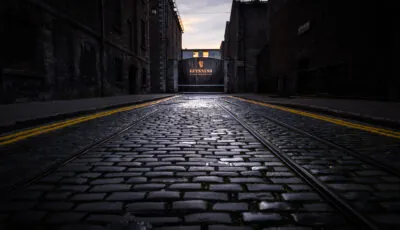
St James’s Gate – Giuseppe Milo – CC
By the late 1750s, Arthur Guinness realised that Dublin offered far greater prospects than Leixlip. The capital had a port, a growing population and numerous establishments able to distribute his beers.
He identified a former disused brewery at St James’s Gate, west of the city. On 31 December 1759, at around 34 years of age, he signed a lease with the owner, Mark Rainsford, for a plot of roughly four acres.
The agreement set an annual rent of £45 and the extraordinary term of 9,000 years. This lease has become one of the best-known episodes in Irish industrial history. A copy is now displayed in the floor of the atrium at the Guinness Storehouse.
The original agreement is no longer the document governing the entire present-day site, however. As the brewery expanded, the company bought the land and rights surrounding the original four acres.
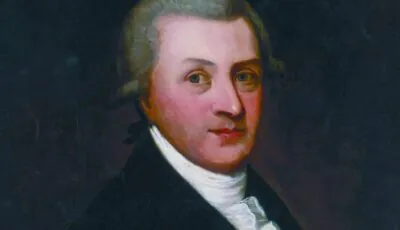
Arthur Guinness – Public domain
Arthur Guinness did not invent stout, nor did he begin producing today’s black beer as soon as he arrived at St James’s Gate. During his early years in Dublin, he brewed mainly ales similar to those he had made in Leixlip.
Porter is a dark beer that emerged in London in the early 18th century. Its name is said to be linked to its popularity among porters working in the streets, markets and docks of the English capital. As the beer began to gain popularity in Ireland, Dublin brewers sought to compete with British imports.
Arthur Guinness began producing his own porter in the 1770s, probably around 1778. He therefore did not create an entirely new style: he adapted an English beer to his production facilities and the tastes of his customers.
The word stout then referred to a particularly strong or full-bodied beer. The term stout porter was gradually shortened to stout. The first Guinness beers officially sold under the names Single Stout and Double Stout appeared several decades after Arthur’s death.
Porter enjoyed growing success among Dublin consumers. Its greater ability to withstand storage and transport also gave it a commercial advantage over some more delicate ales.
In response to this demand, Arthur Guinness gradually expanded his dark beer production. In 1799, he brewed his last ale and decided to devote the St James’s Gate brewery entirely to porter.
Two years later, in 1801, the company launched a West India Porter. Richer in hops and alcohol, this beer was designed to withstand long sea voyages more effectively. It is the ancestor of today’s Guinness Foreign Extra Stout.
The dark colour of these beers came from the heavily roasted malts used by brewers of the time. Their composition, fermentation processes and flavour have nevertheless changed considerably since the late 18th century.
The beer produced by Arthur Guinness was not the Guinness Draught served in pubs today. The latter was not launched until 1959, to mark the bicentenary of the signing of the St James’s Gate lease.
Guinness Draught uses nitrogen alongside carbon dioxide. This innovation, developed under the direction of brewer and mathematician Michael Ash, creates the fine bubbles, smooth texture and thick creamy head now associated with the brand.
Arthur Guinness’s beer was a porter fermented and conditioned according to 18th-century methods. It would have had more carbonation, a less creamy texture and a different flavour profile.
Arthur Guinness therefore did not devise the definitive recipe for a product that remained unchanged for more than two centuries. He founded a brewing tradition that his descendants, followed by several generations of brewers, continuously developed.
Sources do not fully agree on the date of the first export. A document from 1769 mentions the shipment of six and a half barrels of Dublin Ale to England. The Guinness Storehouse, meanwhile, presents a 1796 shipment as the company’s first known export.
This difference may be explained by the type of beer concerned or by the documentation used. In any event, exports remained relatively modest for much of Arthur Guinness’s lifetime.
The brand’s spectacular international expansion took place mainly in the 19th century, under the leadership of his descendants. They developed the industrial capacity of St James’s Gate and extended the commercial network to Great Britain, Europe, Africa and the colonies.
Arthur Guinness did not confine his activities to the brewery. In 1763, he became an officer of the Dublin Corporation of Brewers, before being appointed master of the corporation in 1767. He subsequently represented the profession’s interests in Dublin’s municipal life.
In the 1770s, he became a beer supplier to Dublin Castle. He also served as a governor of the Meath Hospital and took part in the Friendly Brothers of St Patrick, a fraternal charitable society.
He notably donated 250 guineas to the schools attached to St Patrick’s Cathedral. This commitment foreshadowed the Guinness family’s philanthropic tradition, which was greatly developed by his descendants in the 19th century.
Arthur should not, however, be credited with all the company’s later social initiatives. The favourable wages, medical services, pensions, workers’ housing and major restoration projects funded by the family were primarily the work of subsequent generations.
The claim that Arthur Guinness personally campaigned with Henry Grattan against beer taxation is insufficiently documented. It may result from confusion with his son, Arthur Guinness II, who was more involved in the political debates of the early 19th century.
In 1761, Arthur Guinness married Olivia Whitmore, who came from a well-to-do Dublin family. The couple later settled at Beaumont House, north of the capital.
Arthur and Olivia had 21 children, ten of whom reached adulthood. Several of their sons took part in the family business, but it was primarily Arthur Guinness II, born in 1768, who took over the brewery.
This family succession played an essential role in the business’s success. Arthur Guinness did not build a finished global empire on his own: he created a prosperous enterprise that his children, grandchildren and great-grandchildren gradually transformed into an industrial giant.
The brewery became Ireland’s largest in 1838, more than thirty years after its founder’s death. By the end of the 19th century, St James’s Gate had established itself as one of the world’s largest breweries.
Arthur Guinness died on 23 January 1803 at Beaumont House, near Dublin. He was buried in Oughterard cemetery in County Kildare, alongside members of his family.
At the time of his death, the brewery produced around 20,000 barrels of beer a year. The business was significant and profitable, but it had not yet acquired the international scale it would reach in the following century.
Arthur Guinness II continued the specialisation in porter and expanded exports. Later generations enlarged the site, adopted new industrial technologies and gradually built the brand’s commercial power.
The Guinness name is now inseparable from Ireland. The brand is sold in more than 120 countries and brewed in several dozen countries. The beer consumed in Ireland and Great Britain is nevertheless still produced at St James’s Gate.
The Guinness harp, inspired by the medieval harp held at Trinity College Dublin, was not chosen by Arthur. It was adopted as a commercial symbol by his descendants in the 19th century, before being registered as a trademark in 1876.
Guinness is no longer an independent “family empire”. Guinness PLC merged with Grand Metropolitan in 1997 to form Diageo, the international group to which the brand still belongs in 2026.
The historic brewery remains operational in Dublin, while the Guinness Storehouse presents the family’s history, brewing processes and the evolution of its advertising campaigns. Opened in 2000 in a former fermentation building, it has become one of Ireland’s most visited attractions.
Arthur Guinness is therefore less the inventor of an unchanging recipe than the founder of an exceptional family and industrial venture. His true talent was to transform a disused four-acre brewery into a business capable of surviving its era and growing far beyond anything he could have imagined.