

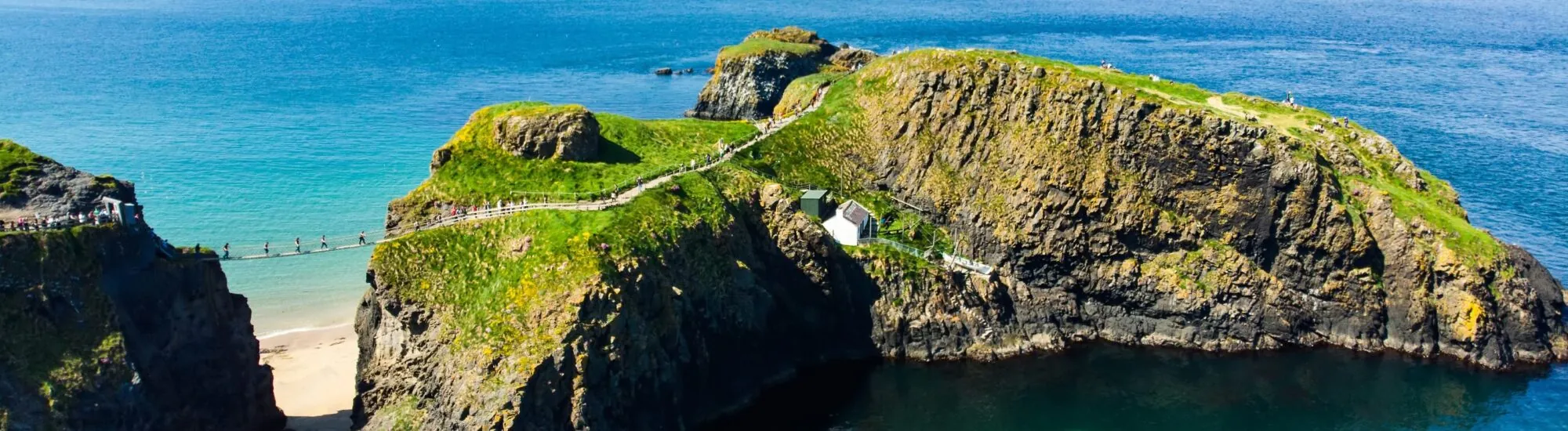
Suspended almost 30 metres above the Atlantic, Carrick-a-Rede Rope Bridge links the cliffs of County Antrim to a small rocky island once used by salmon fishermen. At 20 metres long, this rope bridge has become one of the best-known attractions on Northern Ireland’s Causeway Coastal Route.
Yet the crossing is only part of the experience. Reaching the bridge involves following a coastal path with superb views of the cliffs, Rathlin Island and the turquoise waters of the Antrim coast. Advance booking is essential to cross the bridge, as access may be suspended when the wind becomes too strong.
Carrick-a-Rede Rope Bridge – © robnaw
Carrick-a-Rede Rope Bridge is near the village of Ballintoy, on the north coast of County Antrim. It spans a 20-metre-wide sea chasm separating the mainland from Carrick-a-Rede Island.
The bridge is suspended almost 30 metres above sea level. Its current structure combines ropes, safety netting and wooden planks. It is regularly inspected and maintained by the National Trust, the organisation responsible for managing the site.
The crossing remains narrow and moves slightly underfoot, but it is no longer the rudimentary structure once used by fishermen. Crossings are supervised, the number of people on the bridge is controlled, and access may be suspended when weather conditions no longer provide sufficient safety.
The name Carrick-a-Rede comes from the Irish Gaelic Carraig a’ Ráid, generally translated as “the rock in the road”. It is thought to refer to the island’s position on the route taken by Atlantic salmon as they migrate to the rivers where they were born.
Sea currents forced the fish to pass around the rock, making them easier to catch with large nets. This natural feature explains why Carrick-a-Rede became an important fishing station several centuries before it developed as a tourist attraction.
Salmon fishing at Carrick-a-Rede and in the neighbouring Larrybane area has been documented since 1620. Fishermen would travel to the island by boat to set their nets and watch for passing fish.
The first known rope bridge was installed in 1755. It made it easier to link the coast to the island and reduced reliance on boats, which could become dangerous when the sea turned rough.
It is therefore more accurate to say that the tradition of bridges at Carrick-a-Rede dates back more than 270 years. The bridge seen today is not the one from 1755: fishermen regularly rebuilt and adapted the crossing according to their needs and damage caused by storms.
Earlier versions of the bridge were considerably more precarious. Some had only a single rope serving as a handrail, while feet rested on a few widely spaced planks. Yet fishermen carried their equipment across the void in sometimes difficult conditions.
The bridge was not an attraction designed to provide thrills. It was a working tool that gave access to an isolated fishery. The men also used a rowing boat and heavy nets, which were hauled up to the island using a lifting system.
A large wooden derrick was used to lift the boat out of the water so that it would not be smashed against the rocks. The historic structure was swept away by a storm in 2014, then rebuilt to preserve the memory of this activity.
In the 19th century, fishing supported many families around Ballintoy. More than 80 fishermen and salmon carriers worked in the parish at the time. Until the 1960s, catches could reach 300 fish in a single day.
The situation then deteriorated rapidly. Pressure from sea fishing, river pollution and the general decline in Atlantic salmon populations made the activity increasingly unprofitable.
The last salmon caught at Carrick-a-Rede was landed in 2002. Alex “Achi” Colgan, the last fisherman to operate the fishery, then ceased work after more than 30 years. During his final season, catches had fallen to around 250 salmon for the entire period from spring to autumn.
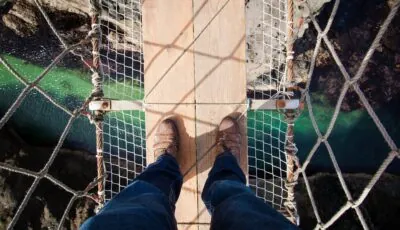
The view from Carrick-a-Rede Rope Bridge – © Conor Phelan
The bridge is not immediately beside the car park. After showing your booking, you must follow a coastal path for around one kilometre before reaching the crossing area.
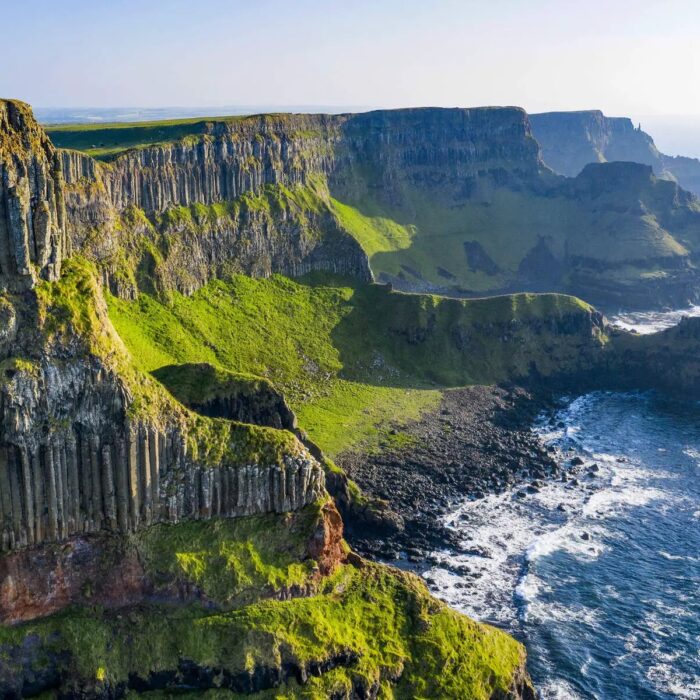
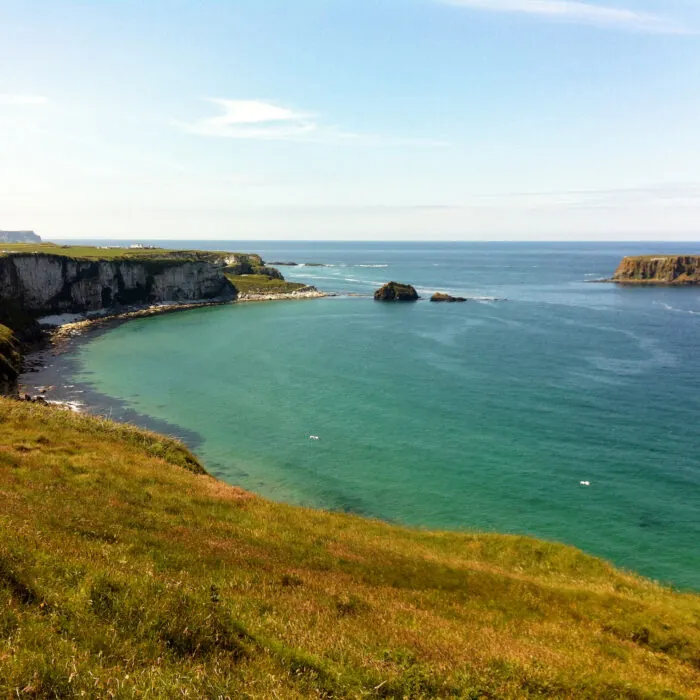
The route passes wind-exposed grassland and several cliffs. It offers fine views of the Antrim coast, rocky islets and Rathlin Island. On particularly clear days, you may be able to see as far as the Scottish coast.
The final section is more demanding. The path descends steeply and includes two long flights of steps, followed by a metal staircase leading directly to the bridge. After crossing, a short route allows you to explore Carrick-a-Rede Island before returning the same way.
Online booking is essential to cross Carrick-a-Rede Rope Bridge. This also applies to National Trust members and holders of certain passes that grant free admission.
The Visitor Experience ticket includes the bridge crossing and a space in the official car park. The timed-entry system helps limit visitor numbers, reduce queues and preserve the natural site.
Online sales close before the start of each time slot. It is therefore inadvisable to wait until you arrive to book, particularly at weekends, during school holidays and in high season.
Bookings can be made on the National Trust’s official website. As prices and opening times may change, they should be checked directly when booking.
It is possible to walk part of the coastal path and enjoy the scenery without crossing the bridge. Tickets are checked at a gate before the final staircase leading to the footbridge.
This option is suitable for those who want to admire the coast or accompany someone without making the crossing. However, it does not provide access to Carrick-a-Rede Island.
As official parking is included with the booked experience, car park access conditions should be checked before coming solely for a walk. A coastal route can also be joined from Larrybane or Ballintoy Harbour, but this makes the walk considerably longer.
Most visitors spend around an hour and a half on site. This includes the walk to the bridge, any waiting time, both crossings, exploring the island and returning to the car park.
Allow more time if you wish to watch birds, take photographs or stop at the Weighbridge Tearoom. During busy periods, the regulated crossing system may also lengthen the experience.
The crossing itself takes only a few minutes. The appeal of the site lies as much in its maritime heritage and coastal path as in the 20 metres travelled above the ocean.
Carrick-a-Rede Rope Bridge moves slightly under visitors’ weight and in the wind. This movement is normal for a suspension footbridge, but it may surprise those expecting a completely rigid bridge.
The side netting and handrails provide continuous protection. Nevertheless, the steep view down to the water and rocks remains impressive, especially in the middle of the bridge.
People with a strong fear of heights should not feel obliged to cross. The coastal route already offers several interesting viewpoints and allows visitors to enjoy the site without tackling the footbridge.
Wind is the main reason for temporary bridge closures. Even when the sky is clear, strong gusts can make crossing impossible.
The National Trust publishes closure information on its website. When a crossing booked directly through the official website is cancelled because of wind, the relevant tickets may be refunded under the conditions announced by the organisation.
It is advisable to check the site’s status on the morning of your visit. A good weather forecast does not guarantee that the bridge will be open: wind speed is more decisive than rain.
The first 500 metres of the coastal path are accessible and lead to a viewpoint equipped with an adapted telescope. Designated parking spaces are also available.
Beyond this viewpoint, the route becomes more difficult. Steep slopes, uneven surfaces, numerous steps and the metal staircase make access to the bridge unsuitable for wheelchairs and pushchairs.
A manual wheelchair may be borrowed, subject to availability, for the accessible section. Sensory bags are also available from the Booking Hut to help some visitors prepare for and enjoy the experience more comfortably.
Children can visit Carrick-a-Rede, but the route includes unprotected cliffs, slopes and many steps. They must remain under an adult’s constant supervision.
A pushchair cannot reach the footbridge. For a young child unable to walk the entire route, the visit may therefore prove difficult. The return journey, which includes a long uphill stretch, must also be taken into account.
On the bridge, instructions given by staff must be followed. Visitors should not run, deliberately make the structure sway or stop for too long to take photographs when others are waiting.
Dogs on leads are permitted in part of the estate and on the coastal path. However, they are not allowed to cross the bridge or access Carrick-a-Rede Island.
This restriction is due to the narrowness of the footbridge, the presence of stairs and the need to protect the island’s birds and fragile habitats.
Address: Carrick-a-Rede, 119a Whitepark Road, Ballintoy, County Antrim, BT54 6LS, Northern Ireland.
The site is on the Causeway Coastal Route, around 8 kilometres west of Ballycastle and 11 kilometres east of Bushmills. The Giant’s Causeway is about 12 kilometres away.
By car, the main entrance is accessible from Whitepark Road. Official parking must be arranged with your booking. Additional spaces may be opened at the former Larrybane quarry during busy periods.
Translink public transport serves the area from Coleraine, Ballycastle and, depending on the service, Belfast. As frequencies vary throughout the year, check the journey planner before setting off.
Ballintoy Harbour is a few minutes’ drive away. This small harbour surrounded by cliffs was used as a filming location for several scenes in the series Game of Thrones. Its access road is very narrow and parking is limited.
To the west, White Park Bay stretches out as a long sandy beach between the cliffs. It is a pleasant place for a walk, but swimming is not recommended because of strong currents.
The Giant’s Causeway, Dunseverick Castle and Dunluce Castle offer opportunities to extend your exploration of the Antrim coast. Carrick-a-Rede can therefore easily be included in a day on the Causeway Coastal Route, provided you book a time slot compatible with other visits.
Is booking Carrick-a-Rede Rope Bridge compulsory?
Yes. Advance booking is essential to cross the bridge, including for National Trust members.
How far do you have to walk to reach the bridge?
The bridge is around one kilometre from the main car park. The route includes slopes, steps and a metal staircase in its final section.
Does the bridge close when it rains?
Light rain does not necessarily lead to closure. Strong wind is the main reason for suspension, but staff may close the crossing whenever conditions become dangerous.
Can you see Carrick-a-Rede without crossing the bridge?
Yes. Part of the coastal path and several viewpoints remain accessible without crossing the footbridge. Booking is still required to access the bridge and the island.
Essential information to help you plan your visit, including key landmarks, access information, and booking options.
55.239472, -6.332639
1 heure