

A dead tree can still tell a story. Beside St Mary’s Church, in the heart of Dingle, The Trinity Tree offers a distinctive interpretation: the wood of an old sycamore has become a sculpture dedicated to the Trinity. This work can be discovered on a walk through the town, taking the time to see what emerges from the trunk and branches.
The project dates back to 2000. According to Fáilte Ireland, Canon Pádraig Ó Fiannachta, then the parish priest, commissioned the work from sculptor Lizana Correno on the eve of Trinity Sunday in June. The artist is also identified as Juan Carlos Lizana Carreño.
The choice of material is central to the work’s appeal. The dead sycamore provides both the material and the outline for the piece: the sculpture is set within a tree, shaped by the constraints of its volume. It can therefore be approached in two ways, first by observing the tree’s natural form, then the figures carved into the wood.
The English name means “the tree of the Trinity”. In Christian tradition, the Trinity refers to the Father, the Son and the Holy Spirit. The work depicts this theme as well as teachings of the Church. This is enough of a reference point to begin exploring it, even without any particular knowledge of religious art.
Before trying to identify each figure, look at the way the faces and reliefs fill the wood. Change your angle slightly from the accessible paths: a three-dimensional sculpture reads differently depending on the viewer’s position. With children, looking together for recognisable shapes is a way to explore the work without turning the stop into an art-history lesson.
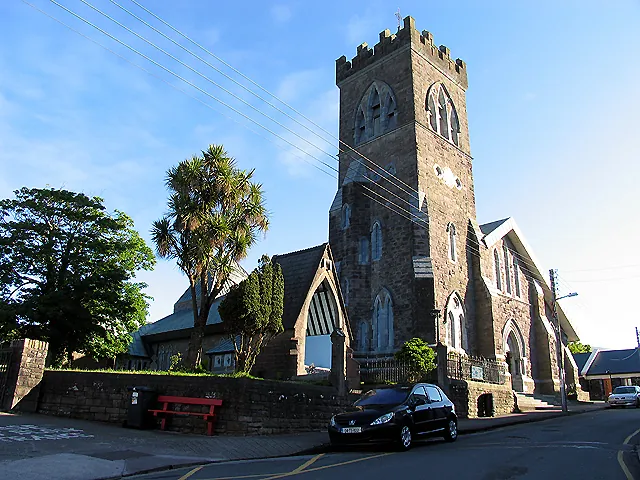
The Trinity Tree stands near St Mary’s Catholic Church. To find it, look for this name rather than St James’ Church, another religious building in the town. Its proximity to the church helps explain the sculpture’s spiritual purpose and calls for consideration towards those who have come to pray.
Its material also deserves attention. Unlike a stone or bronze statue, exposed wood requires particular care. Fáilte Ireland’s presentation mentions the use of olive oil and wax to preserve it. This detail relates to the work’s maintenance: observe it without touching or applying any product.
Allow for this stop as a moment of observation during your walk around town. Start with an overall view, then move closer only where the paths allow. To photograph the reliefs, try several compositions from ground level, without leaning on the sculpture or entering a closed-off area.
Its interest lies less in the scale of the visit than in the attention paid to detail. After the shopfronts and activity along the waterfront, this carved tree offers another way into the cultural and religious life of Dingle.
The landmark is St Mary’s Church on Green Street. Once there, follow the signs and any access restrictions around the church. The Discover Ireland listing provides the official description and the location given for the attraction.
The available information does not detail wheelchair access conditions or a guided-visit arrangement specific to the sculpture. If these details are essential to your trip, ask locally for clarification before planning a dedicated visit.
You can combine this discovery with a walk through the town centre, then continue to Dingle Harbour. The work therefore fits into a walking tour of the town, between religious heritage, shops and maritime activity, without requiring a separate excursion on the peninsula.
Want to extend your visit without having to rush around? Here are a few well-located places to stay near the must-see attractions.
Essential information to help you plan your visit, including key landmarks, access information, and booking options.
St Mary’s Church, Green Street, Dingle, Dingle Peninsula, County Kerry, Republic of Ireland, Tourist attractions in Ireland
52.14157, -10.271
No opening hours specific to The Trinity Tree are given on the Discover Ireland listing consulted. Respect the access conditions displayed around St Mary’s Church.
Check the opening hours and admission requirements before you leave, especially during peak season or on Irish public holidays.
No admission fee specific to the sculpture is stated on the Discover Ireland listing consulted.