



J. M. Synge needed only a few years to transform Irish theatre. A playwright, poet, traveller and collector of folk tales, he drew on the Aran Islands, the Wicklow Mountains and the rural west for literary material of singular power. His Ireland is neither a postcard nor an unqualified patriotic celebration: it is lashed by the sea, alive with desire, grief, anger and sometimes ferocious humour.
When he died in 1909, aged just 37, Synge had left behind six major plays, several travel narratives and an instantly recognisable theatrical language. His work, initially contested even within Irish nationalist circles, is now regarded as one of the foundations of modern theatre in Ireland.
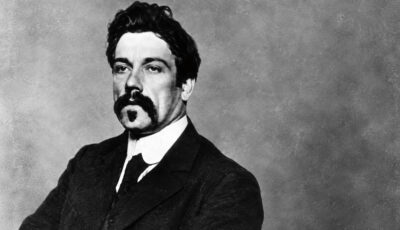
J. M. Synge, a major figure in the Irish literary revival. Restoration created from an old public-domain photographic portrait.
Edmund John Millington Synge, better known as J. M. Synge, was born on 16 April 1871 in Rathfarnham, on Dublin’s southern outskirts. His surname is pronounced roughly ‘Sing’ in English. He grew up in a relatively well-off Anglo-Irish Protestant family, several generations of whom had held religious office or occupied prominent positions in Irish society.
His father, the solicitor John Hatch Synge, died of smallpox in 1872, when the child was only one year old. Raised by a deeply religious mother, the young Synge was in fragile health and received part of his education at home. From an early age, he took an interest in the birds, plants and terrain of County Wicklow, where his family had deep roots.
This closeness to nature was never incidental. In Synge’s work, landscapes act upon people. Cliffs, sodden paths, moorland and, above all, the ocean become dramatic forces capable of overturning a life.
Before becoming a writer, Synge seriously considered a career in music. He studied piano, violin, flute, harmony and counterpoint at the Royal Irish Academy of Music. At the same time, he attended Trinity College Dublin, where he took a particular interest in Irish and Hebrew.
After graduating in 1892, he went to Germany to further his musical training. Yet his stays in Würzburg and then Cologne convinced him that he lacked the temperament to become a professional performer. He gradually turned instead towards languages and literature.
From 1895 onwards, Synge spent several winters in Paris. He attended the Sorbonne, read French authors and tried his hand at poetry and prose. Still searching for his path, he met William Butler Yeats in December 1896. The poet encouraged him to leave Paris’s literary salons behind and return to Ireland, its people and its living traditions.
That advice became one of the formative episodes of the Irish literary revival. Synge would not find his voice in the libraries of Paris, but on a handful of limestone islands exposed to Atlantic storms.
Synge first arrived on the Aran Islands in May 1898. He returned over the following years, staying mainly on Inis Meáin, the central island of the archipelago. At that time, Irish remained the everyday language there, and island communities still largely depended on fishing, livestock farming and crops made difficult by the poor soil.
The writer listened to islanders, learnt their expressions and recorded accounts of shipwrecks, legends, omens and fragments of conversation. He observed everyday gestures, funeral rites and the intimate relationship islanders had with a sea that was as life-giving as it was deadly.
Yet Synge did not simply reproduce what he heard. He transformed this oral material to create a literary language inspired by the English spoken in Irish-speaking regions. Irish constructions, carried over into English, gave his dialogue its distinctive rhythm, rich in images, repetitions and striking turns of phrase.
His stays directly informed The Aran Islands, published in 1907 with illustrations by Jack B. Yeats. They also inspired several of his plays, particularly Riders to the Sea, a brief tragedy in which a mother sees the ocean take the last men in her family.
On Inis Meáin, a natural seat formed in the rock is now known as Synge’s Chair. Perched above the ocean, it offers a spectacular view of the cliffs and the vast Atlantic.
Tradition holds that the writer came here to sit, observe the landscape, reflect and work. The association has become inseparable from his memory, even though it is difficult to document precisely how often he visited this promontory.
The site nevertheless perfectly sums up his method. Synge looks long, listens even more closely, then transforms what he has seen into theatre. Facing the Atlantic, the beauty of the landscape never conceals the vulnerability of those who depend on it.
Synge wrote mainly in English, but his prose and dialogue are deeply marked by the Irish language. He fashioned a stylised theatrical English from turns of phrase heard in the west of the country. This language is therefore not an exact documentary transcription: it is a literary creation.
Through it, farmers, fishermen, beggars, craftspeople and Travellers take centre stage. Synge gives them a poetic eloquence without erasing their contradictions. His characters can be generous, manipulative, sensual, cruel or funny, sometimes within the same scene.
This complexity displeased those who wanted the national theatre to uphold an exemplary image of the Irish people. Synge refused to turn his characters into uplifting symbols. He preferred to show individuals as theatre can reveal them: changeable, imperfect and hungry for freedom.
At the beginning of the 20th century, Synge joined the theatre movement led by W. B. Yeats and Lady Gregory. When the Abbey Theatre opened its doors in Dublin in December 1904, two of his plays were on the programme: In the Shadow of the Glen and Riders to the Sea.
Synge became one of the theatre’s directors and played an active part in its running. He was an essential voice in the Irish literary revival, but his approach remained independent. Where some expected a patriotic stage that would restore national dignity, he presented rural communities shaped by lies, desire, superstition and violence.
His early plays had already prompted reservations. In the Shadow of the Glen depicts a woman ready to leave a loveless marriage. The Well of the Saints stages two blind beggars who, after regaining their sight, discover a reality less bearable than their illusions. Synge questions social norms without offering audiences the comfort of a simple moral.
On 26 January 1907, the Abbey Theatre gave the first performance of The Playboy of the Western World. Christy Mahon, a young man on the run, arrives at an isolated public house in County Mayo and claims to have killed his father. Far from condemning him, the community is fascinated by his story. The timid fugitive becomes a kind of hero, until the unexpected return of the supposedly dead father.
The comedy attacks the workings of reputation, the public appetite for violent stories and the fickleness of crowds. But some audience members saw it above all as an insult to rural Ireland. An allusion to women’s undergarments crystallised the anger. Shouts drowned out the dialogue, performances were disrupted and police intervened around the theatre.
The Playboy Riots quickly went beyond a theatrical scandal. Ireland was then in the midst of cultural and political self-assertion. For some nationalists, portraying farmers fascinated by a parricide meant repeating the caricatures long used against the Irish people. For Synge, however, artistic creation could not submit to the official image a nation wished to present of itself.
The play jeered in 1907 would become his best-known work. It continues to be performed, translated and adapted around the world.
Synge’s work is marked by a constant tension between the individual and the community. His characters seek to escape marriage, poverty, religious authority or collective judgement. The freedom they covet remains fragile, and often comes at the cost of exile or exclusion.
Nature has an equally decisive place. In Riders to the Sea, the ocean becomes a sovereign power against which no one can prevail. Maurya has lost her husband, her father-in-law and several sons at sea. When her last surviving son prepares to leave, every object, every silence and every word seems to foretell another disaster.
In a single act, Synge gives this Aran Islands family the grandeur of an ancient tragedy. He does not seek to beautify suffering, but to show the dignity with which people eventually acknowledge what they cannot control.
His theatre also gives an exceptional place to outsiders. The beggars in The Well of the Saints and the Travellers in The Tinker’s Wedding observe society from its margins. Their existence challenges the certainties of settled communities, the Church and institutions.
At the Abbey Theatre, Synge met the actress Molly Allgood, who performed under the name Máire O’Neill. Despite their age difference and the opposition of part of the writer’s family, a passionate relationship developed between them.
Molly Allgood created the role of Pegeen Mike in The Playboy of the Western World. The couple’s correspondence reveals a more intimate Synge, far removed from the austere image sometimes attached to his work. Their plans to marry were, however, thwarted by the playwright’s illness.
After Synge’s death, Molly Allgood played Deirdre in Deirdre of the Sorrows, the author’s final play, left unfinished and staged posthumously.
Synge experienced health problems for much of his life. A first tumour was removed from his neck in 1897. During a further operation in 1908, doctors diagnosed Hodgkin’s disease, a cancer of the lymphatic system.
He nevertheless continued to write. He worked in particular on Deirdre of the Sorrows, inspired by one of the great legends of Irish mythology. Illness prevented him from completing the play fully.
J. M. Synge died in Dublin on 24 March 1909, a few weeks before his 38th birthday. He is buried in Mount Jerome Cemetery, in the Harold’s Cross area.
His theatrical career lasted less than a decade. That brevity makes the coherence of his world and the influence he would have on subsequent generations all the more striking.
Synge also left articles, reviews, translations, notebooks and autobiographical fragments. Some of these documents were published after his death from surviving manuscripts, notably those held at Trinity College Dublin.
Synge gave Irish theatre a new language and freedom of tone that left a lasting mark on his successors. Seán O’Casey subsequently brought a comparable energy to Dublin’s working-class districts. Later, Samuel Beckett, Brian Friel, Tom Murphy and Martin McDonagh each extended this tradition of black humour, musicality and characters at odds with their community in their own way.
His plays continue to be staged in Ireland and abroad. The Abbey Theatre remains closely linked to his memory, while the Galway-based Druid company has helped renew their staging. By bringing together his six plays in the DruidSynge cycle, the company showed just how coherent a world this brief body of work formed.
More than a century after his death, J. M. Synge remains a valuable guide to understanding Ireland during the literary revival. He reveals a country divided between the English language and Gaelic culture, between the desire for independence and a rejection of images that are too perfect. On the cliffs of Inis Meáin as on the Abbey Theatre stage, his work reminds us that the most spectacular landscapes always shelter complex human lives.