
A solitary shoemaker, keeper of treasures and master of deceiving humans, the leprechaun has become one of the best-known figures in Irish folklore. His green suit, red beard and pot at the foot of a rainbow now appear on postcards, in St Patrick’s Day parades and even in Hollywood films.
Yet this familiar image tells only part of the story. In traditional tales, the leprechaun is less jovial, rarely dressed like a mascot and far harder to pin down. Between medieval literature, rural beliefs and popular culture, his portrayal has continued to evolve over the centuries.
The leprechaun, leipreachán in modern Irish, belongs to the vast world of supernatural beings that inhabit Ireland’s stories. He is generally described as a small, elderly, solitary and particularly cunning man. His main occupation is making or repairing fairy shoes.
The steady sound of his hammer is said to be the best way to detect his presence. In many accounts collected in the early 20th century, people told of hearing his tool near an old fort, a lone tree, a bank or a hawthorn bush.
The French term « lutin » gives some sense of the character, but it is not a perfect translation. The leprechaun has distinctive traits of his own and should not automatically be confused with a goblin, an elf or any of the other creatures of European folklore.
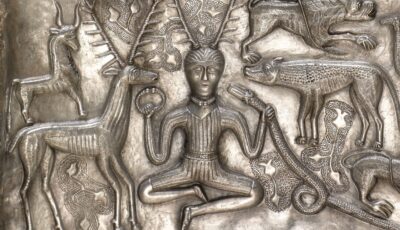
Depiction associated with the Tuatha Dé Danann – Nationalmuseet – CC
Contrary to a frequently repeated claim, the leprechaun’s first known appearance is not found in the Lebor Gabála Érenn, or Book of Invasions of Ireland. This medieval text recounts the island’s various mythical invasions, but does not tell the leprechaun’s story in the form we know today.
One of his oldest literary ancestors appears in Echtra Fergusa maic Léti, ‘The Adventure of Fergus, Son of Léti’. In this medieval tale, King Fergus falls asleep beside the water before being dragged out to sea by three small creatures called lúchorpáin.
Fergus manages to capture them. To gain their freedom, the beings grant him three wishes, including the ability to breathe underwater. These aquatic creatures do not yet precisely match the miserly shoemaker of later tales, but their name and small size link them to the modern leprechaun.
The etymology remains debated. The old term lúchorpán is often interpreted as meaning ‘small body’. Another popular explanation links the word to the Irish expression leath bhrógan, literally ‘half-shoe’, referring to the character’s trade as a shoemaker. This second origin is appealing, but it is generally regarded as folk etymology rather than linguistic certainty.
The Tuatha Dé Danann hold a central place in Irish mythology. Portrayed as a people endowed with extraordinary knowledge and powers, they are defeated by the Milesians, the mythical ancestors of the Gaels. The stories subsequently link them to the Sídhe, the supernatural world hidden beneath hills and ancient burial mounds.
Popular culture sometimes presents leprechauns as their descendants. However, this direct lineage is not clearly established in medieval texts. Rather, it results from the gradual merging of different traditions concerning Irish fairy beings.
The leprechaun certainly belongs to Ireland’s supernatural folklore, but should not automatically be made a member of the Tuatha Dé Danann. Oral traditions vary from one region to another and do not form a single mythology governed by unchanging rules.
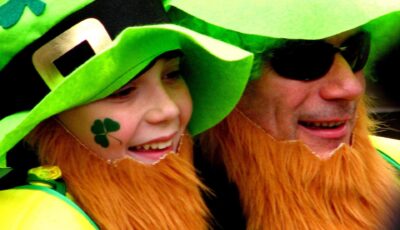
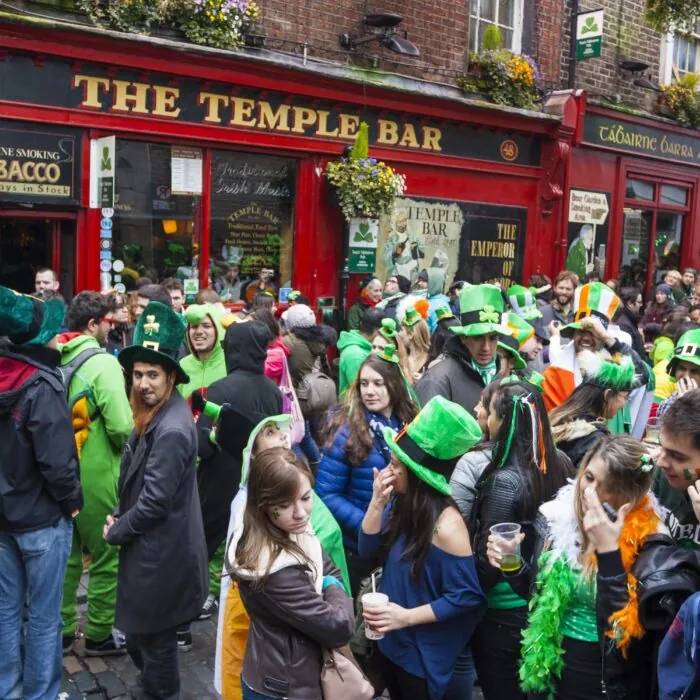
Participants dressed as leprechauns – Garry Knight – CC
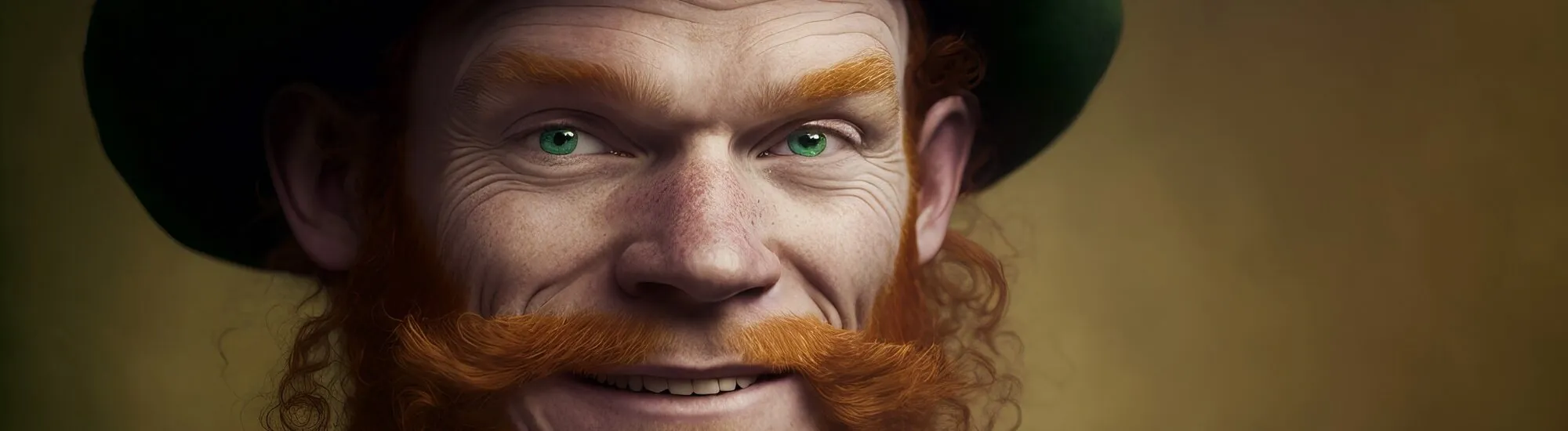
Today’s image of the leprechaun is based on a green suit, red beard, large hat and buckled shoes. Yet this appearance is much more recent than the traditional tales.
Older descriptions vary considerably from one county to another. Some traditions give him a green coat and a red cap. Others depict him dressed entirely in red, with light-coloured breeches, a leather apron and either a three-cornered or broad-brimmed hat.
At the end of the 19th century, William Butler Yeats explained that solitary fairies, among whom he placed the leprechaun, were fond of wearing a red jacket. Fairies that travelled in groups were more commonly associated with green.
Green gradually became established as Ireland’s national colour, followed by the development of St Patrick’s Day celebrations abroad. The large green hat, golden buckle and red beard therefore belong largely to the commercial imagery of the 19th and 20th centuries.
Neither is the character’s size fixed. Accounts from oral tradition sometimes describe a being only a few centimetres tall, and sometimes a little man as tall as a child. The claim that a leprechaun measures exactly 90 centimetres is therefore based on no general rule of folklore.
Traditional tales almost always portray the leprechaun as an elderly man. This consistency has given rise to the idea that female leprechauns do not exist.
Folklore, however, provides no clear explanation of how these creatures are born or reproduce. Stories claiming that the leprechaun is born of the union between a human and a spirit do not constitute a universally documented Irish belief.
It is therefore more accurate to say that female leprechauns are absent from most surviving tales than to present their non-existence as an absolute rule of Irish mythology.
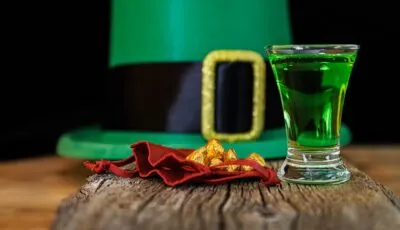
The leprechaun’s accessories – © TasiPas
In much of the oral tradition, the leprechaun repairs the shoes of other fairies. Storytellers sometimes explained that the beings of the Sídhe quickly wore out their shoes during their long nights of dancing, giving the little shoemaker an almost endless supply of work.
He is often portrayed with a single shoe on his lap. Sitting beneath a tree, near an old fort or on a mushroom, he taps the leather with a small hammer. The sharp, repetitive sound of the tool is said to reveal his presence before a walker can even catch sight of him.
This trade also contributes to his isolation. Unlike fairies who travel and celebrate together, the leprechaun works alone. Yeats therefore places him among the ‘solitary fairies’, alongside other creatures such as the clurichaun and the fear dearg.
The old description claiming that the leprechaun indulges in a liquor called dudeen is incorrect. A dudeen is not a drink, but a small clay pipe traditionally associated with Ireland.
The character often described as a great lover of alcohol is instead the clurichaun, another solitary fairy of Irish folklore. He is said to frequent wine cellars, protect stores of wine or whiskey when treated well, but destroy them if he feels offended.
Some folklorists have considered the clurichaun to be a nocturnal form of the leprechaun. Others see it as a distinct creature. The boundary between the two varies from one tale to another, which explains why their characteristics have often been blended together.
The connection between the leprechaun and treasure is firmly rooted in Irish tradition. Many tales say that he knows the location of a jar, purse or pot filled with gold coins.
A human quick enough to capture him may try to force him to reveal his hiding place. The leprechaun then uses cunning to distract his captor. He may claim that danger is approaching, point to something behind them or create an illusion. The moment the human looks away, the creature disappears.
In one popular tale, a man forces a leprechaun to show him where his gold is buried. Lacking a spade, he ties a ribbon to the plant in question before leaving to fetch his tools. When he returns, every plant in the field bears exactly the same ribbon.
The treasure at the foot of a rainbow belongs chiefly to the modern evolution of the legend. Older tales more often speak of gold buried near a fairy fort, beneath a lone tree or in the middle of a field. The rainbow, whose end always remains out of reach, became an ideal metaphor for an unattainable fortune.
Some versions of the folklore give the leprechaun two purses. The first is said to contain a silver coin that reappears every time it is spent. The second holds a gold coin intended to bribe the person who captured him.
The gift, however, proves deceptive. Once the leprechaun is released, the gold coin may turn into a leaf, ash or a worthless object. These details do not appear in every tale, but they reinforce a recurring idea: those who seek to grow rich without effort often end up being punished for their greed.
The leprechaun is therefore more than simply a miserly guardian. He acts as a mirror of human failings. His stories test greed, impatience and the inability to keep a promise.
The leprechaun is not generally portrayed as a murderous creature. He prefers to deceive humans rather than harm them directly. His small stature, however, should not be mistaken for innocence.
He is touchy, unpredictable and exceptionally skilled when trying to escape. Traditional tales advise never taking your eyes off him and mistrusting every word he says.
Like many Irish fairy beings, he does not fit easily into modern categories of good and evil. He may reward a respectful person, punish greedy behaviour or amuse himself at the expense of an overly curious passer-by.

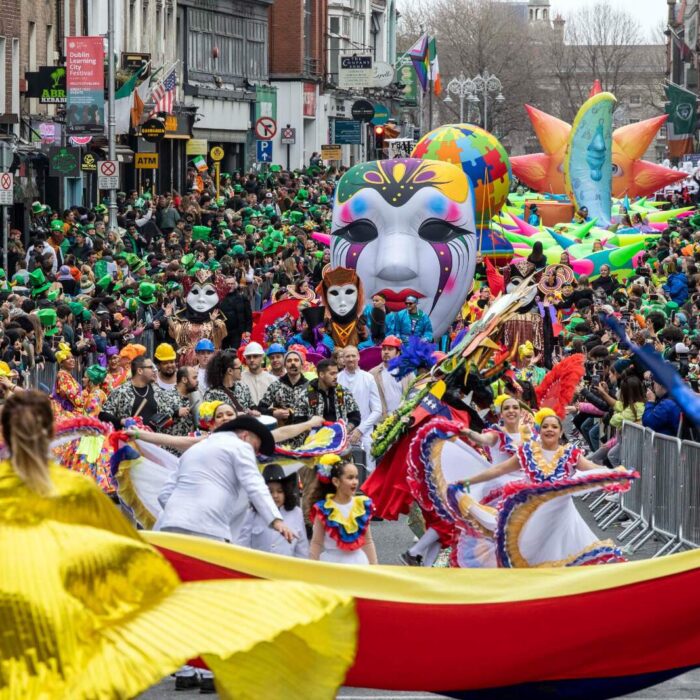
St Patrick’s Day celebrations – © Guide Irlande.com
The leprechaun has no direct connection with St Patrick or with the religious origins of the festival celebrated on 17 March. Its association with St Patrick’s Day developed much later, particularly among Irish communities established in North America.
As parades became more festive, the little green-clad figure became established alongside the shamrock, harp and Irish flag. His easily recognisable costume made him an ideal figure for parades, decorations and advertising campaigns.
Today, it is common to encounter participants wearing an artificial red beard, a buckled hat and a green suit during the celebrations. This portrayal belongs more to the contemporary festival than to the rural folklore from which the character emerged.
The leprechaun can therefore be regarded as a popular icon of Ireland, but it does not hold the same official or historical status as the Celtic harp, the emblem of the Irish state.
In the 19th century, several authors and folklorists helped to establish its portrayal. Thomas Crofton Croker gathered fairy stories in Fairy Legends and Traditions of the South of Ireland, published from 1825. Lady Wilde and William Butler Yeats later drew on various traditions in their own collections.
These works contributed to the Irish cultural revival and introduced creatures of folklore to a wider audience. However, they should not be regarded as manuals establishing a definitive version of the leprechaun: their authors selected, reorganised and interpreted the stories they passed on.
Film then profoundly transformed the character. In Darby O’Gill and the Little People, produced by Disney in 1959, the Irish fairy world takes on a family-friendly and spectacular appearance. At the other extreme, the horror film series Leprechaun, launched in 1993, makes him into a murderous creature far removed from traditional tales.
Advertising, television series, video games and sports mascots have since multiplied these portrayals. The modern leprechaun has thus become a blend of authentic folklore, Irish-American imagination and commercial culture.
The National Leprechaun Museum, in Dublin, is not limited to green hats and pots of gold. Above all, it presents itself as a space dedicated to Irish stories, myths and oral tradition.
The visit takes the form of a guided tour led by a storyteller. The daytime experiences last around 45 to 50 minutes and are recommended for visitors aged six and over. They are conducted entirely in English, so a good level of spoken English comprehension is required.
A nighttime experience called Darkland explores the more unsettling side of folklore. It is strictly for adults only and must be booked in advance.
Address: 2/3 Mary’s Abbey, Dublin 7, D07 X6R.
Daytime tours: departures generally every 30 minutes, from 10.30am to 5.30pm.
Duration: around 45 to 50 minutes.
Booking: strongly recommended, as participant numbers are limited.
Language: tours in English; Irish-language tours available on request.
Official website: leprechaunmuseum.ie.