
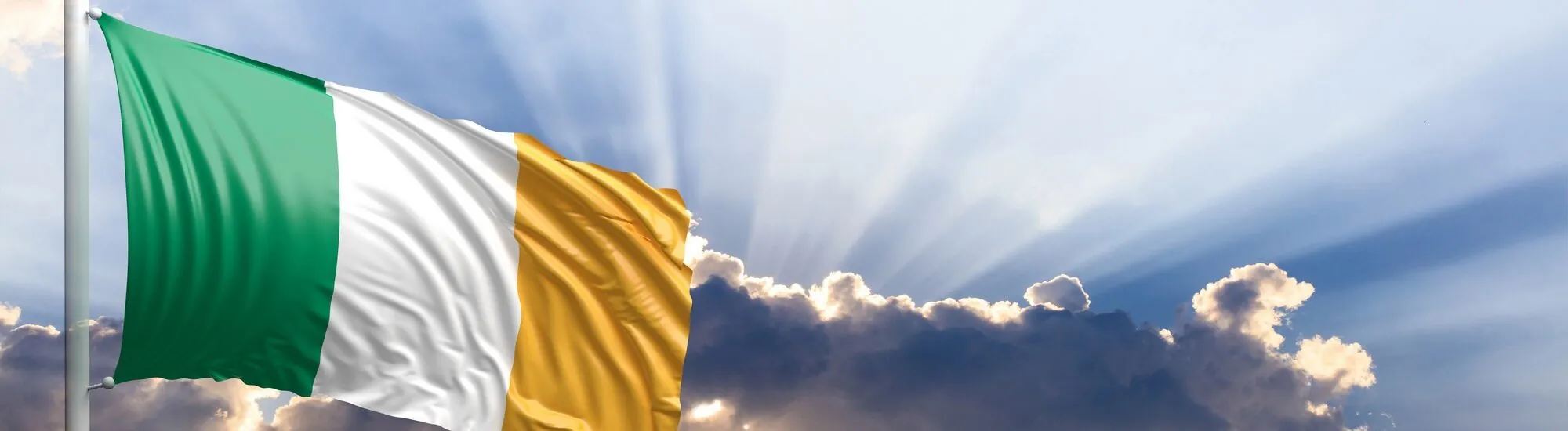
Three vertical bands, three colours and one immense ambition: to unite the different traditions of the island of Ireland under a single symbol. The Irish flag, known as an Bhratach Náisiúnta or, more commonly, an Trídhathach in Irish, does not celebrate one community’s victory over another. Instead, it conveys a message of peace between the nationalist, Catholic and Gaelic traditions, represented by green, and the Protestant and unionist tradition, symbolised by orange.
First appearing in the mid-19th century, in a Europe swept by revolutions, the green, white and orange flag later accompanied the Easter Rising of 1916, the War of Independence and the creation of the Irish Free State. It ultimately gained constitutional status in 1937 and became one of the most recognisable symbols of the Republic of Ireland.
Ireland’s national flag consists of three vertical bands of equal size. When the flag is flown horizontally, green must be at the hoist, white in the centre and orange at the fly.
Its official proportions are 1:2: its length must therefore be twice its height. No coat of arms, text, logo or additional symbol may be placed on the three bands.
The order of the colours is essential. Seen from the front, with the flagpole on the left, the flag must always read: green, white, orange. A tricolour displayed in the reverse order does not represent Ireland.
The meaning of the Irish flag must be understood as a whole. Green and orange represent two major political, cultural and religious traditions on the island. The white between them embodies the hope of lasting peace and possible reconciliation.
Green primarily represents the Irish Gaelic and nationalist tradition, historically associated with a large part of the Catholic population. This colour was already used as a symbol of Ireland long before the tricolour was created.
In the 17th century, green flags bearing a harp were used, notably, by the Irish Confederates. At the end of the 18th century, green also became one of the colours of the United Irishmen, a republican movement that advocated the political union of Catholics and Protestants.
Contrary to a common tourist interpretation, green was not chosen to represent directly the meadows or landscapes of the ‘Emerald Isle’. That poetic association exists today, but its historical meaning is above all political, religious and cultural.
Orange represents the Irish Protestant tradition and, more specifically, communities historically attached to William III of Orange. This Protestant monarch defeated the Catholic King James II at the Battle of the Boyne in 1690.
This victory held a central place in the political memory of many Irish Protestants and unionists, particularly in Ulster. The Orange Order, founded at the end of the 18th century, also takes its name from William of Orange.
Choosing orange for the future national flag was therefore a powerful political gesture. Thomas Francis Meagher’s vision was not to erase the Protestant tradition, but to recognise its full place within a shared Irish nation.
White is placed between green and orange to symbolise a lasting truce between the two traditions. It does not simply represent abstract peace: it creates a meeting place between communities long divided by religion, politics and their relationship with the British Crown.
The flag’s deeper meaning therefore lies in this central band. Without it, green and orange would remain two opposing colours. With it, the tricolour becomes a project of national reconciliation.
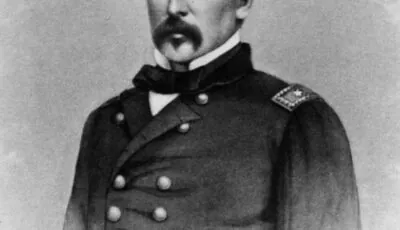
Thomas Francis Meagher – public domain
The creation of the Irish flag is chiefly associated with Thomas Francis Meagher, a revolutionary born in Waterford in 1823. He belonged to the Young Ireland movement, which brought together intellectuals and activists who supported first autonomy and then the country’s independence.
These activists championed a national identity capable of transcending religious divisions. They were also influenced by the Romantic and revolutionary movements developing across Europe during the 1840s.
The French tricolour, once again a major revolutionary symbol in February 1848, directly inspired Meagher and his companions. The choice of three vertical bands allowed them to adapt an ideal of freedom and unity to Ireland, while using colours rooted in its own history.
Thomas Francis Meagher first flew what would become the Irish national flag on 7 March 1848, at the Wolfe Tone Confederate Club in Waterford. This event therefore preceded his famous journey to Paris.
A few weeks later, Meagher travelled to France with William Smith O’Brien and Richard O’Gorman to congratulate the new French republican government. French women sympathetic to the Irish cause then presented them with a ceremonial tricolour made of silk.
Meagher unveiled this flag at a meeting held in Dublin on 15 April 1848. He explained that the central white should represent a lasting truce between ‘orange’ and ‘green’, so that Catholics and Protestants could come together in a single national brotherhood.
The historical quotation is often reproduced in a slightly modernised form. Its central idea remains unchanged: the tricolour was intended as an emblem of inclusion, not the flag of one community alone.
The year 1848 was particularly bleak for Ireland. The Great Famine continued, the population was suffering from hunger, and political demands were met by British power.
The uprising launched by Young Ireland during the summer was swiftly suppressed. Thomas Francis Meagher was arrested, sentenced to death, then transported to Tasmania after his sentence was commuted. He escaped a few years later and joined the United States, where he commanded an Irish brigade during the Civil War.
The tricolour did not disappear, however. It continued to be used by certain nationalist, republican and Fenian movements. For several decades, it nevertheless remained less popular than the traditional green flag bearing a harp.
The green, white and orange flag truly established itself in the national imagination during the Easter Rising of 1916. Several flags were used by insurgent groups in Dublin at the time.
A tricolour flew above part of the General Post Office, which had been turned into the rebellion’s headquarters. A second green standard bearing the words Irish Republic was also raised on the building. The tricolour was therefore not the only flag associated with the uprising, contrary to what some simplified accounts suggest.
After the Rising was crushed and its main leaders executed, green, white and orange gradually became the colours of the independence movement. The flag then accompanied the Irish War of Independence between 1919 and 1921.
After the creation of the Irish Free State in 1922, the tricolour was used as the national flag by the new institutions. The Constitution of the Free State did not, however, yet give it explicit status.
Its official recognition came with the Irish Constitution of 1937. Article 7 simply states that the national flag is the green, white and orange tricolour.
It is therefore incorrect to claim that the flag became official when the Republic of Ireland was proclaimed in 1949. That date marked the end of the final institutional link with the British monarchy, but the tricolour’s constitutional status had already been established twelve years earlier.
The Irish government publishes precise guidelines on the use of the flag. These rules are chiefly ceremonial in nature and are intended to preserve its dignity.
The protocol also advises against using it as a tablecloth, a podium cover or disposable decoration. When it covers a coffin at a state or military funeral, the green band is placed at the head of the deceased.
The flag’s third band is officially orange, not yellow or gold. ‘Green, white and gold’ versions sometimes appear at sporting events or on tourist items, but they do not comply with the official design.
This difference is not merely aesthetic. Replacing orange with yellow removes the historical reference to William of Orange and the Protestant tradition. The Irish government therefore advises against using these variants.
The flag of the Republic of Ireland closely resembles that of Côte d’IvoireCôte d’Ivoire. Both flags have three vertical orange, white and green bands, but their order is reversed.
On the Irish flag, green is at the hoist, followed by white and then orange. On the Ivorian flag, orange is against the hoist, followed by white and green.
Their proportions are not the same either: the Irish flag has a 1:2 ratio, while that of Côte d’Ivoire is more compact.
The tricolour is the national flag of the Republic of Ireland. It is not the official flag of Northern Ireland, which belongs to the United Kingdom.
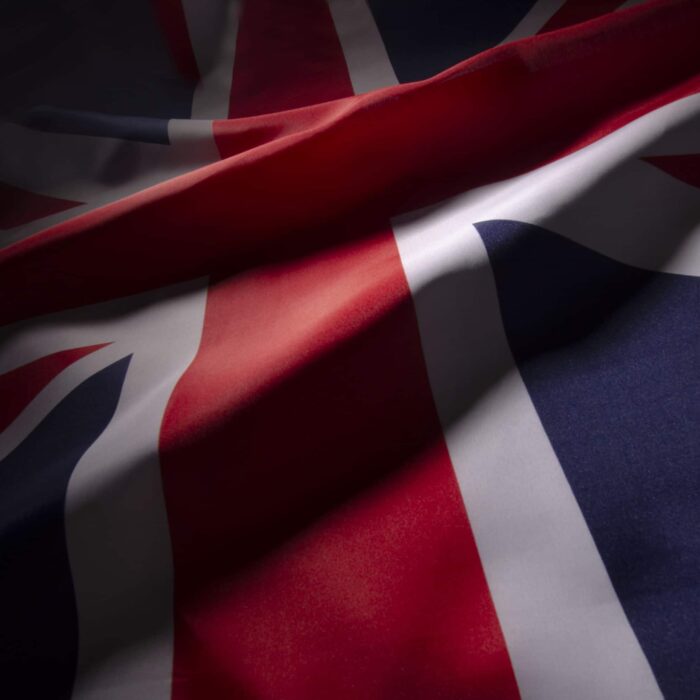
As part of the United Kingdom, Northern Ireland officially uses the Union Flag, also known as the Union Jack, notably on certain public buildings and on dates specified by regulations.
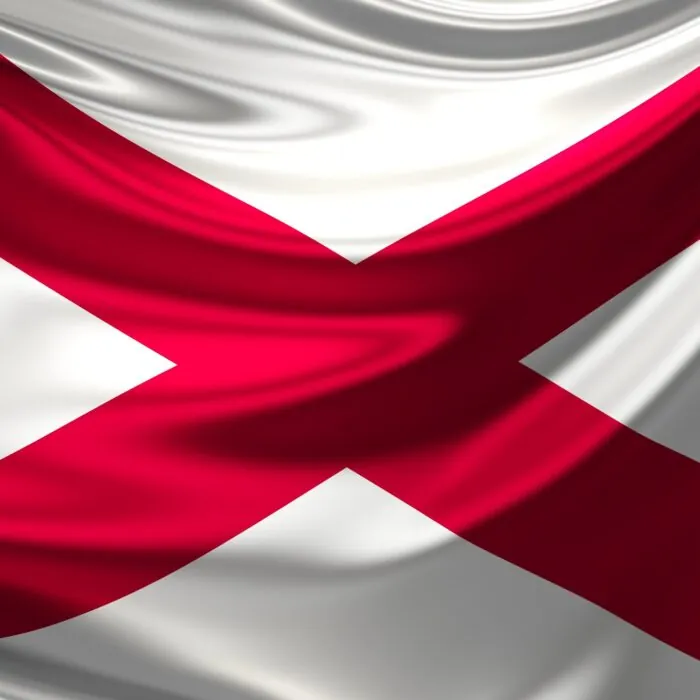
The Ulster Banner, recognisable by its red cross, red hand and crown, was used by the former Northern Ireland government between 1953 and 1972. Since that institution was abolished in 1973, it has had no official territorial status. It nevertheless continues to be used in certain sporting contexts and by part of the unionist community.
The tricolour, meanwhile, is widely associated with nationalist and republican communities in Northern Ireland. In this territory, marked by a painful political history, flags can express an identity but can also revive divisions. Their use therefore requires greater sensitivity than elsewhere on the island.
The choice of flag depends on the sporting organisation. At the Olympic Games, the tricolour represents Team Ireland. Northern Irish athletes may, depending on the applicable rules and their eligibility, compete for Ireland or for Great Britain and Northern Ireland.
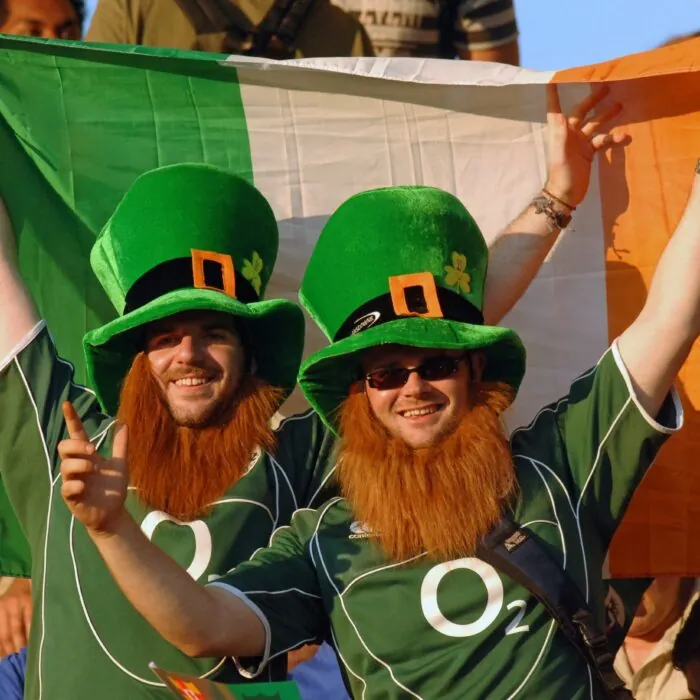
In rugby union, the national team brings together players from the Republic of Ireland and Northern Ireland. The Irish Rugby Football Union therefore uses its own flag representing the four historic provinces. At some matches, this flag may be accompanied by the tricolour, while the anthem Ireland’s Call serves as a shared song.
In other sports, such as football, the Republic of Ireland and Northern Ireland have separate national teams. The tricolour then accompanies only the Republic’s team.
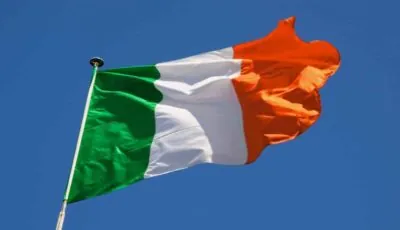
The flag of the Republic of Ireland
The tricolour flies over the main state buildings, embassies, military installations and many official monuments. It is especially visible during the national celebration of St Patrick’s Day, commemorations of the Easter Rising and major sporting events.
It also accompanies diaspora communities in the United Kingdom, the United States, Canada, Australia and many other countries. Its international appeal owes as much to the strength of Irish identity as to the simplicity of its design.
Its original message is nevertheless deeper than the festive image often associated with Ireland. Green, white and orange tell the story of a nation built on several traditions, and remind us that peace does not mean erasing differences, but allowing them to coexist.
Tagline: Between green and orange, a white band has carried the fragile dream of a reconciled Ireland since 1848.
Meta description: Discover the history of the Irish flag, the meaning of green, white and orange, its origins in 1848 and its official protocol.