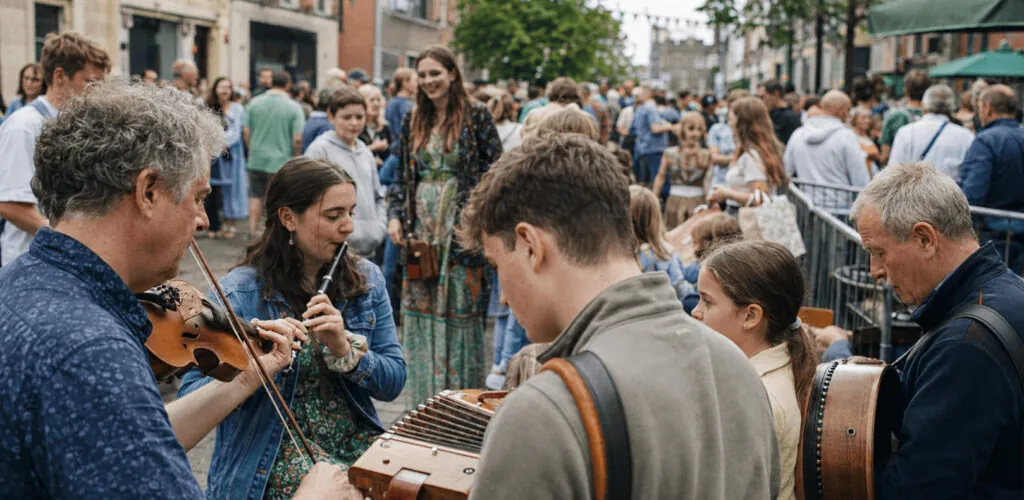
From 2 to 9 August 2026, Belfast will become the world capital of traditional Irish music. For the first time in its history, the city will host the Fleadh Cheoil na hÉireann, a huge gathering combining concerts, competitions, dancing, impromptu sessions and a celebration of the Irish language.
For eight days, musicians will take over performance venues, pubs, squares and the streets of the city centre. Organisers are expecting cumulative attendance of more than 800,000 people, making this edition one of the most important cultural events ever held in Belfast.
The Fleadh Cheoil chooses Belfast
An event born seventy-five years ago
The Fleadh Cheoil na hÉireann — pronounced roughly “fla” — is considered the world’s largest annual festival dedicated to traditional Irish music, singing and dancing.
The first edition was held in Mullingar in 1951, on the initiative of Comhaltas Ceoltóirí Éireann. At the time, the event featured just 13 competitions and around a thousand visitors. Seventy-five years later, the Fleadh brings together artists from Ireland, Europe, North America, Australia and Asia.
The festival retains a strong competitive dimension. Musicians of all ages come to try to win a national title in more than 180 categories: fiddle, flute, harp, bodhrán, accordion, uilleann pipes, traditional singing, dancing and céilí bands.
But the Fleadh goes far beyond the scope of a competition. Its reputation also rests on free concerts, musicians spontaneously playing in the streets and long sessions held in pubs.
A particularly symbolic first
Belfast, UNESCO City of Music
The choice of Belfast has a strong cultural dimension. The Northern Irish capital is the only city on the island to have received the title of UNESCO Creative City of Music.
Music has long held a central place here, from traditional Irish music and flute bands to rock, punk and classical music. Hosting the Fleadh allows Belfast to bring together different musical traditions in a single event open to everyone.
The city has already been chosen to host a second edition in 2027. It will therefore become the first city in Northern Ireland to host this major gathering for two consecutive years.
The official Fleadh Cheoil 2026 website presents the event as the world’s largest celebration of Irish music, singing, dancing and language.
Sharon Shannon will kick things off
Eight days of free concerts in front of City Hall
The heart of the festival will be the Gig Rig, a large outdoor stage set up in front of Belfast City Hall. Free concerts will be held there throughout the eight days, with no ticket or booking required.
On Sunday 2 August, the opening ceremony will begin with Shared Traditions, a show bringing together traditional musicians, the Belfast Bands Forum, the South Asian Dance Academy, a school choir of one hundred children and Irish dancers.
The evening will continue with Goitse, the Blackwater Céilí Band and Sharon Shannon accompanied by her Big Band. The Irish accordionist, known for bringing traditional music into dialogue with rock, country and reggae, will be the main headliner on this first day.
The Gig Rig programme will then welcome artists such as Lúnasa, Sí Fiddlers, Conor Mallon, Trú and the multicultural collective Macalla. Outdoor céilís will also invite the public to join in the dancing.
Northern Irish singer Foy Vance will take part in the closing show on Sunday 9 August. He is also due to give a more intimate concert during the week.
Competitions in Belfast’s major venues
Waterfront Hall and Ulster Hall to the rhythm of traditional music
The main competitions will take place in several iconic venues, including Waterfront Hall, Ulster Hall, ICC Belfast and the Ulster University campus.
The final of the senior céilí bands, considered one of the highlights of the Fleadh, will take place at Waterfront Hall on Sunday 9 August. The winning group will then move on to the large outdoor stage to close the festival.
At the same time, nearly 90 events are scheduled as part of the Fringe Fleadh. Concerts in local neighbourhoods, workshops, family shows, cultural trails and music sessions will bring the event to life well beyond the main stages.
A large proportion of the activities will be free. However, some competitions, performances and activities will require booking. The programme should therefore be checked before setting off, even though it is perfectly possible to enjoy the atmosphere by walking around the city centre.
How do you get to the Belfast Fleadh?
A city centre largely reserved for pedestrians
Belfast city centre will be partly pedestrianised during the festival. Road closures and parking restrictions are planned from Sunday 2 to Monday 10 August.
Organisers recommend using public transport or park-and-ride facilities. Three sites will be available at Sprucefield, Giant’s Park and Belfast Harbour. Parking will cost £10 per day and will include access to free shuttle buses to the city centre.
Translink also plans to increase the capacity of certain trains and provide special buses from several towns and cities in Northern Ireland. Visitors are invited to check the network arrangements during the Fleadh.
Belfast remains a compact city. From Grand Central Station, it takes less than ten minutes to walk to City Hall and the festival’s main stage.
Where to stay during the Fleadh Cheoil?
Hotels, student accommodation and official campsites
Demand for accommodation is expected to be particularly high. It is best to book a hotel or apartment in Belfast quickly, even if that means choosing an area slightly outside the centre but well served by bus or the Glider.
Student accommodation will be available for short stays. Three official campsites are also planned: Ormeau Park and Falls Park for tents, and Titanic Quarter for motorhomes, caravans and rooftop tents.
French travellers should also remember the UK entry requirements. A valid passport and an ETA electronic travel authorisation are required to enter Northern Ireland, including when travelling to Belfast from Dublin.
An ideal week for discovering Belfast
Traditional music as a gateway to the city
The Fleadh Cheoil offers an excellent opportunity to visit Belfast at its most festive. Between concerts, travellers can discover Titanic Belfast, the Cathedral Quarter, City Hall and the famous murals.
But the essence of the festival will probably be found in the streets: a fiddler set up on a street corner, an impromptu session in a pub or a group of young musicians hoping to win their first national title.
For eight days, Belfast will therefore do more than host Irish music. The entire city will become its stage.