

In central Dublin, opposite the gates of Trinity College, an unassuming door opens onto several centuries of Irish history. Behind it, the Irish Whiskey Museum tells the story of the rise, near-fatal decline and spectacular revival of a spirit once regarded as one of the world’s most prestigious.
There are no working stills here, nor any casks resting in a maturation warehouse. The venue is not a distillery, but a museum independent of the major brands. This distinction allows it to present several producers and different styles of whiskey in a single tasting.
Entirely guided, the tour covers the major periods in the history of Irish whiskey, from the earliest references to uisce beatha to the revival of contemporary distilleries. It ends in a tasting room, where three or four whiskeys are served depending on the option chosen.
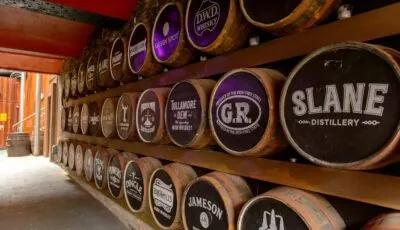
The Irish Whiskey Museum in Dublin – © Anton Ivanov Photo – stock.adobe.com
The Irish Whiskey Museum is at 119 Grafton Street, just steps from College Green and Trinity College Dublin. Its central location makes it easy to include in a day of sightseeing in the Irish capital.
Unlike the Jameson Distillery Bow Street, Teeling Distillery or Roe & Co, the museum is not associated with any particular producer. It is owned by an Irish family business and maintains its independence from the major brands.
The tasting selection changes regularly. Visitors can therefore compare whiskeys from several producers, made using different methods and with different flavour profiles.
This neutrality is the experience’s main appeal. The tour does not merely promote one brand: it tells the shared story of an industry that once dominated the global market before coming close to disappearing in the 20th century.
The Irish Whiskey Museum does not produce whiskey. The visit therefore does not offer the chance to see grain fermentation, a still in operation or spirits maturing in cask-filled warehouses.
The tour uses sets, objects, reproductions, audiovisual installations and, above all, the guide’s storytelling. It is particularly well suited to travellers who want to understand the broader history of Irish whiskey without focusing solely on the production of a single producer.
To see working stills and follow the production process in greater detail, this visit can be complemented with a tour of an actual distillery. Dublin now has several, particularly in the historic Liberties district.
The story begins with uisce beatha, an Irish expression that literally means ‘water of life’. Anglicised over the centuries, it is thought to have gradually given rise to the word whiskey.
Distillation was practised in Europe long before whiskey appeared. Knowledge developed in the Arab and Mediterranean worlds gradually spread before being adapted by scholars, apothecaries and religious communities. The earliest distilled alcohols were regarded more as remedies than as drinks for pleasure.
The earliest written reference commonly linked to whiskey in Ireland dates from 1405. The Annals of Clonmacnoise record the death of a chieftain after excessive consumption of aqua vitae. The first known Scottish reference, meanwhile, dates from 1494.
However, this earlier documentary evidence is not enough to prove that Ireland invented whiskey. Techniques circulated between religious communities established on either side of the Irish Sea. The exact origin of the first whiskey therefore remains a matter of debate.
From the 17th century onwards, the British authorities sought to control and tax distillation. A royal licence granted in 1608 in the north of Ireland is often presented as one of the first official licences connected with whiskey production.
Yet illicit production remained substantial. In rural areas, distillers made poitín, an undeclared spirit whose name derives from the small copper still, or pota, traditionally used to make it.
The 19th century was the golden age of Irish whiskey. Dublin was home to some of the world’s largest distilleries. John Jameson produced on Bow Street, George Roe near Thomas Street, the Power family on John’s Lane, and William Jameson at Marrowbone Lane.
Their whiskeys, often robust and made in enormous copper pot stills, were exported throughout the British Empire and to many international markets. Irish whiskey then enjoyed a prestigious reputation and supported thousands of livelihoods in the capital.
The decline of Irish whiskey was not caused by a single factor, but by an accumulation of political, economic and technological upheavals.
The temperance movement of the 19th century first reduced domestic consumption. The Irish War of Independence, the Civil War and then trade tensions with the United Kingdom subsequently disrupted exports. After the creation of the Irish Free State, producers gradually lost their privileged access to several markets in the British Empire.
In the United States, Prohibition, in force from 1920 to 1933, closed off one of Irish whiskey’s main markets. It also encouraged counterfeiting: poor-quality spirits were sold under Irish names, causing lasting damage to the product’s image among American consumers.
At the same time, Scottish producers adopted column-distilled grain whiskey more quickly. They developed lighter, more accessible blends able to meet growing international demand. Many Irish producers remained attached to their large traditional pot stills and were slow to adapt.
After the Second World War, the Irish industry was on the brink of collapse. In 1966, John Jameson & Son, John Power & Son and Cork Distilleries Company merged to form Irish Distillers. Much of production was subsequently centralised in Midleton, County Cork.
At the end of the 20th century, investment, Jameson’s international growth and renewed interest in craft spirits enabled Irish whiskey to regain an important place.
Since the 2010s, new distilleries have appeared across the island. Dublin too has resumed production, notably through Teeling, Roe & Co and Pearse Lyons distilleries.
This revival should nevertheless be viewed with nuance. As Irish whiskey must be aged for at least three years, some young producers initially blended or bottled spirits made elsewhere before they could market their own mature stocks.
The museum therefore tells how an industry once concentrated around a handful of players has once again become a dynamic landscape, shared by major producers, historic distilleries and independent makers.
Production begins with grain. Malted barley, unmalted barley, maize, wheat and other grains may be used, depending on the type of whiskey sought.
The grains are milled and then mixed with hot water to extract fermentable sugars. Yeast then converts these sugars into alcohol. The resulting liquid is distilled in copper pot stills or column stills.
To legally bear the name Irish whiskey, the spirit must, among other requirements, be produced and aged on the island of Ireland for at least three years in wooden casks.
Maturation changes its colour, texture and flavour profile. Casks that previously held bourbon, sherry, port or other wines can impart notes of vanilla, dried fruit, spice, chocolate or caramel.
Time spent in cask alone does not guarantee quality. The nature of the wood, the cask’s previous use, the original distillate and the blending process also play a decisive role.
Triple distillation is frequently associated with Irish whiskey. By removing more heavy compounds, it can produce a lighter, smoother spirit. Many major Irish producers do indeed use this method.
However, it is not compulsory. Some Irish whiskeys are distilled twice, while a few producers experiment with other processes. Conversely, some Scotch whiskies are also triple-distilled.
The number of distillations alone can therefore neither determine a whiskey’s origin nor judge its quality.
Single malt is made at a single distillery from malted barley, then distilled in pot stills. Single grain is also produced at a single distillery, but may contain different grains and generally uses column distillation.
Single pot still is one of Ireland’s most distinctive styles. It combines malted and unmalted barley, among other ingredients, before being distilled in pot stills at a single distillery. This recipe developed partly in response to former taxes imposed on malt.
Blended Irish whiskey is made by blending at least two categories of whiskey. The master blender’s work involves balancing distillates, casks and sometimes different ages to achieve a harmonious and consistent profile.
The classic tour ends with a tasting of three Irish whiskeys. Each glass contains around 15 ml. The Premium option adds a fourth whiskey and a souvenir glass.
The selection changes regularly, so no particular brand can be guaranteed before the visit. This rotation nevertheless makes it possible to discover several producers and compare different styles.
The guide first invites visitors to observe the whiskey’s colour, then discover its aromas by gradually bringing the glass closer to the nose. A small sip then makes it possible to assess the texture, flavours and finish: the sensations that linger after tasting.
A few drops of water can help release certain aromas. Adding water remains a matter of personal taste, however.
You do not need to be an expert to enjoy the experience. The guides use accessible language and encourage visitors to describe their impressions freely.
The perception of aromas remains subjective. Where one person recognises vanilla or apple, another may detect honey, spice or wood. There is no single correct answer.
Experienced enthusiasts will especially appreciate the diversity of the whiskeys and the quality of the historical storytelling. For a highly technical analysis of production, a distillery tour or specialist masterclass would be more suitable.
The Classic Guided Tour lasts around one hour. It includes the historical tour with a guide and a tasting of three Irish whiskeys. This option is the best choice for a first introduction.
The Premium Guided Tour follows the same route but ends with four tastings. Each participant also receives a souvenir whiskey glass.
The Blending Experience lasts around 1 hour 15 minutes. After the historical tour, participants taste four whiskeys before creating their own blend. The resulting mixture can be taken away in a 70 ml bottle, permitted in hand luggage under the usual liquid restrictions.
An Irish Coffee Masterclass offers an introduction to the history of the drink before teaching participants how to make their own Irish Coffee. The longer Cocktail Masterclass, meanwhile, includes making several whiskey-based cocktails.
The historical tours are open to children and adults who do not wish to drink alcohol. A non-alcoholic drink is then provided instead of the whiskeys served during the tasting.
The legal age to buy and consume alcohol in Ireland is 18. Young adults may be asked for identification.
The museum welcomes families, but its content remains centred on the history and production of an alcoholic drink. Very young children may therefore find the experience less engaging than an attraction specifically designed for them.
McDonnell’s Bar is in the same building. It offers a selection of Irish whiskeys, as well as beers, cocktails and Irish Coffees.
The team can recommend a whiskey according to visitors’ preferences and explain the differences between several styles. After a tour with a tasting, it is naturally important to monitor your consumption and not drive.
The shop sells bottles, glasses, books and various Irish whiskey-related souvenirs. Purchases must be transported in accordance with customs rules and applicable baggage restrictions.
All tours are guided, so it is not possible to explore the rooms independently. Group sizes are limited, and the most popular time slots can sell out quickly.
Online booking is therefore recommended, particularly at weekends and during the peak tourist season. Arrive around 10 to 15 minutes before the departure time shown on your ticket.
Tours are conducted in English. Audio guides are available in several languages, including French, for certain tours. Their availability should be confirmed when booking or directly at reception.
Allow around one hour for the Classic and Premium tours. The blending workshop lasts approximately 1 hour 15 minutes, while the Cocktail Masterclass takes around 1 hour 30 minutes.
Allow a few extra minutes if you would like to browse the shop or have a drink at McDonnell’s Bar.
The museum is opposite Trinity College and a few minutes from Temple Bar, Dublin Castle and St Stephen’s Green. Its location makes it easy to continue exploring the historic centre on foot.
The venue has no car park. As traffic and parking are difficult around Grafton Street and College Green, public transport is strongly recommended.
Bus stops on Dame Street, College Green, Westmoreland Street and D’Olier Street are less than five minutes’ walk away. The museum is also close to the Luas stops at Trinity and Westmoreland, as well as Tara Street Station.
The building has a lift serving its different levels. The stairs in this old building are relatively narrow and winding, but visitors with mobility difficulties can use the lift during the tour.
If you take part in a tasting, plan to return to your accommodation on foot, by bus, tram or taxi. Even when served in small quantities, several measures of whiskey can impair driving ability.
Essential information to help you plan your visit, including key landmarks, access information, and booking options.
119, College Green, College Green, Grafton Street, Grafton Street
53.344139, -6.259139
Departure times vary according to the option and date selected. The Blending Experience is generally offered at 4 pm and 6 pm. Check the official booking calendar before your visit.
Check the opening hours and admission requirements before you leave, especially during peak season or on Irish public holidays.
The official website sometimes shows differences between the prices listed on its descriptive pages and those offered by the booking engine. Check the final price when selecting your date.