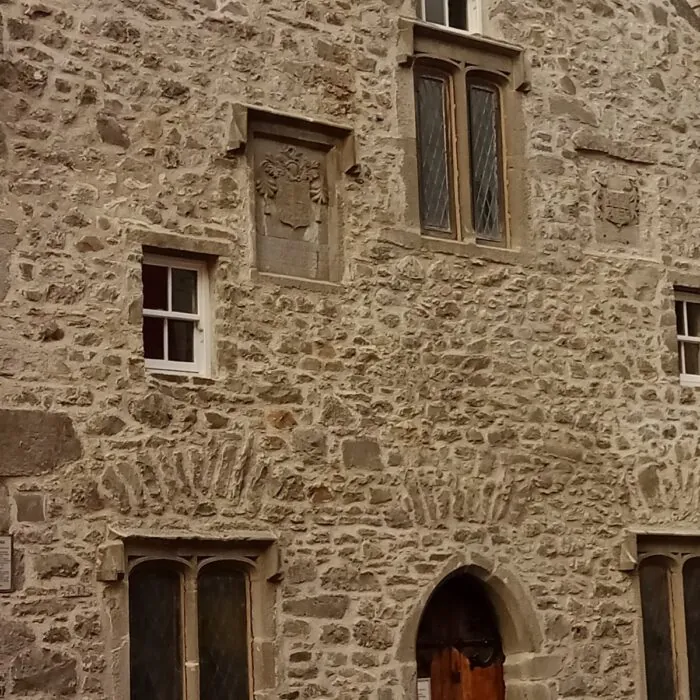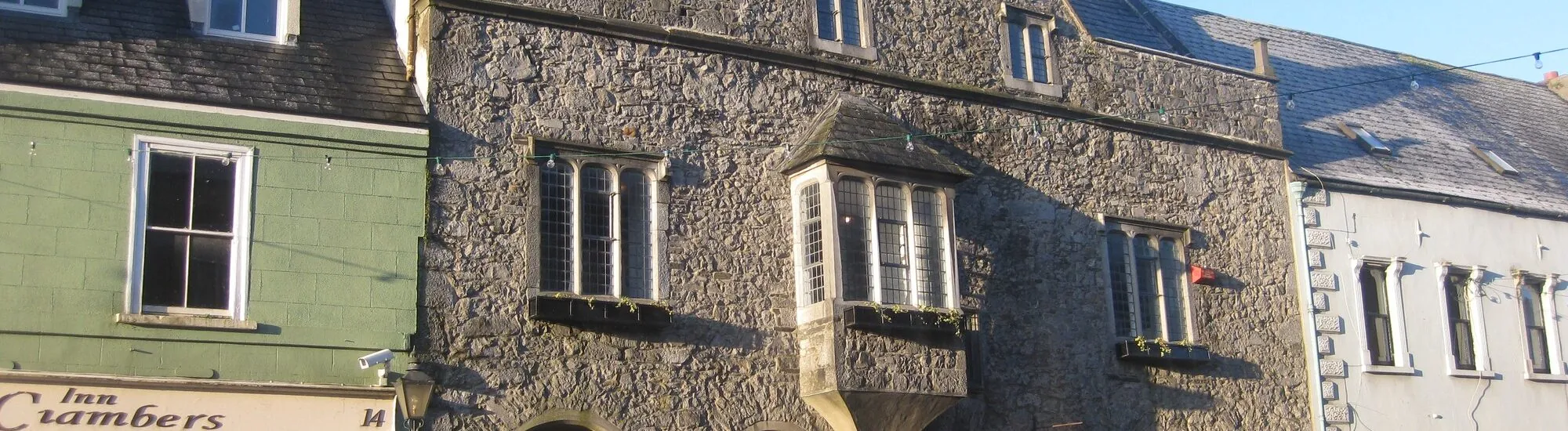
From Parliament Street, Rothe House in Kilkenny looks like a somewhat austere stone residence. But step inside and the plot unfolds in depth. One courtyard leads to a second house, then another courtyard, a third house and finally an enclosed garden. This sequence is what makes Rothe House & Garden so distinctive. It reveals how a family of Kilkenny merchants organised their business and domestic life behind a single street frontage around 1600.
The complex was built for John Rothe Fitzpiers, a merchant and politician, and his wife Rose Archer. The family had eleven children. Construction ran from 1594 to around 1610, at a time when leading merchant families played an important role in the life of the city. Archaeologists place the development on the site of a former urban residence belonging to the Abbot of Duiske. The address therefore changed function while retaining its central location, close to the commercial thoroughfares of historic Kilkenny.
The house stands on a long, narrow urban plot known as a burgage plot. The term refers to a plot with its narrow end facing the street, while the land extends behind the buildings. At Rothe House, this layout remains clear from the entrance to the garden. From the pavement opposite, first look at the openings and gallery on the façade. Once inside, take time to see how the courtyards bring light between the houses. The width of the street and the depth of the plot answered two different needs: having a presence on the street and providing space for a large household.
The paved courtyards punctuate the visit and offer constant reminders of the property’s layout. From one of them, look both towards the street and towards the far end of the plot. You will see how the buildings follow one another without the whole losing its coherence. The excavation report on the third courtyard documents the history of the complex and the conservation work undertaken by the Kilkenny Archaeological Society, which owns the property. The visit connects the stages of construction with the site itself, without reducing the house’s history to a single date.
The route is especially revealing if you have already visited Kilkenny Castle. The castle opens a window onto the history of a great aristocratic family and the power it exercised across the region. At Rothe House, you encounter another form of influence: that of merchants who lived among the streets where they conducted their business. The two visits complement each other perfectly in a single day.
The present-day garden was reconstructed from research carried out on the plot. In 2007, excavations examined traces of the historic garden. Analysis of pollen from flowerbeds dating from the Rothe period identified, among other things, traces of cabbage and chicory. The archaeological report on the garden explains how evidence gathered underground informed the project. The planting you see today makes these findings visible on the scale of a stroll.
At the end of the courtyards, the change of space is striking. Step back to take in the layout of the enclosed garden and orchard, then turn towards the houses. You can then appreciate the depth of the plot concealed by the façade. This final stage is worth taking time over, even in overcast weather. It is here that the connection between the city’s plot layout and the workings of the house becomes easiest to understand.
Rothe House offers both a self-guided route and a guided tour. The first option suits visitors who like to linger in the courtyards and garden. The second gives you the opportunity to ask questions about the families, buildings and archaeological discoveries. Allow around an hour for a first visit. The site is around a ten-minute walk from the castle and five minutes from St Canice’s Cathedral, according to the operator. If you need a step-free route, contact the team before booking to check which areas of the houses and garden are accessible.
To extend your visit in the city centre, the Medieval Mile Museum offers further insights into the families and trades that shaped Kilkenny. You can then return via Parliament Street to look again at the façade of Rothe House, this time with an idea of everything that lies behind it.
Want to extend your visit without having to rush around? Here are a few well-located places to stay near the must-see attractions.
Essential information to help you plan your visit, including key landmarks, access information, and booking options.
Parliament Street, Kilkenny, County Kilkenny, Republic of Ireland, Tourist sites in Ireland
52.654295, -7.2546323
Exceptional closure from 2 to 20 November 2026 inclusive for filming. Usual opening hours are 10am to 6pm. May to September, daily. April, October, November, December and March, Tuesday to Sunday. January and February, Tuesday to Saturday. Last admission is at 5pm from April to October, and 4pm from November to March.
Check the opening hours and admission requirements before you leave, especially during peak season or on Irish public holidays.
Self-guided visit:
Guided tour: