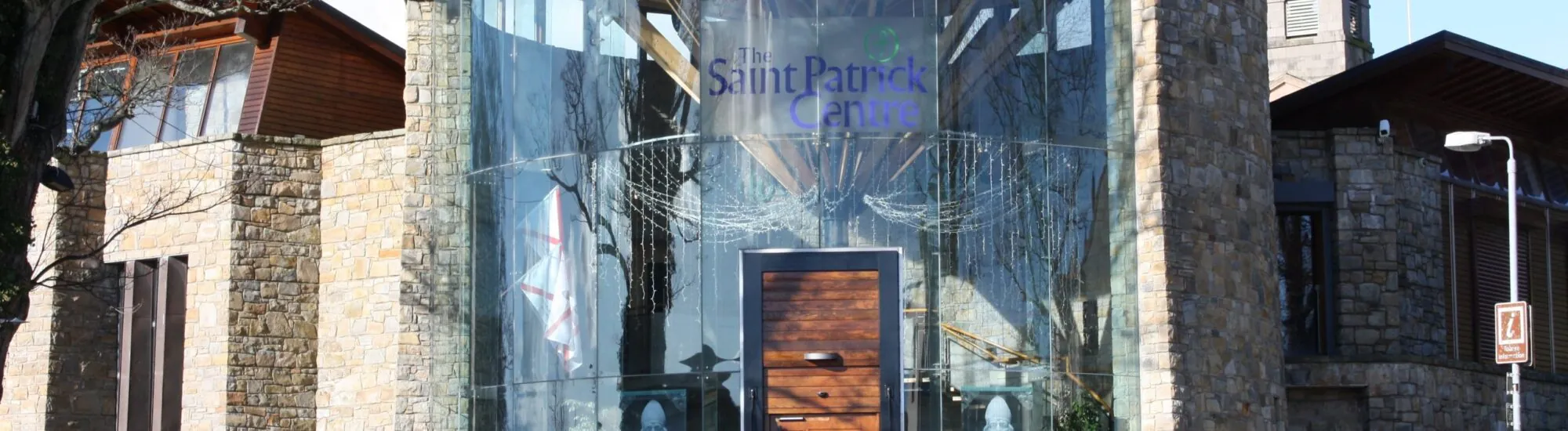
At the foot of Down Cathedral, in the historic centre of Downpatrick, the Saint Patrick Centre traces the life and legacy of Ireland’s patron saint. This permanent exhibition sets the few texts attributed to Patrick alongside accounts shaped by centuries of tradition. Captivity, the Christianisation of the island, the legend of the shamrock and the influence of Irish missionaries: the visit sheds light on a figure who has become inseparable from Irish identity.
Modern and family-friendly, the museum combines immersive projections, sculptures, archives and multimedia displays. Its proximity to the traditional burial place of Saint Patrick and Down Cathedral makes it a key stop for those following in the footsteps of early Christianity in County Down.
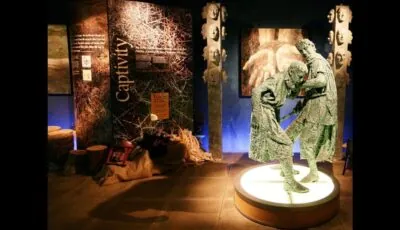
Exhibition at the Saint Patrick Centre in Downpatrick
The Saint Patrick Centre describes itself as the world’s only permanent exhibition devoted entirely to Saint Patrick. Rather than simply celebrating a religious figure, it seeks to uncover the man behind the symbol, at a time when Ireland stood on the frontier between the Roman world and Christian Europe.
The exhibition draws in particular on the Confessio, an autobiographical text attributed to Patrick. These writings are an essential source for understanding his life, although many uncertainties remain surrounding his birth, his travels and the precise chronology of his mission.
The English-language narration is provided by Northern Irish actor Ciarán Hinds. High-definition videos, illustrated panels, sculptures and an immersive projection table guide visitors through the key stages of this story.
Patrick is thought to have been born towards the end of the 4th century into a Christian family in Roman Britain. His birthplace remains uncertain: several areas of Great Britain have been suggested, but no theory has gained a consensus to date.
Still a teenager, he is said to have been captured by Irish raiders and forcibly taken to the island. Enslaved for around six years, he is believed to have tended herds in a region traditionally associated with Slemish Mountain, in present-day County Antrim. This isolation is said to have profoundly transformed his faith.
Patrick recounts hearing a voice in a dream telling him that a ship was waiting for him. He is then said to have escaped, reached the coast and left Ireland before returning to his family. Having become a cleric, he eventually returned to the island as a missionary.
His work formed part of a more complex Christianisation than the sudden conversion of the entire country. Other Christian communities probably already existed in Ireland. Nevertheless, Patrick remains the figure most closely associated with the growth of Irish Christianity in the 5th century.
Over the centuries, chroniclers embellished Patrick’s life with miraculous tales. The best known tells how he used a three-leafed shamrock to explain the Christian principle of the Trinity. Absent from his own writings, this story helped make the shamrock one of Ireland’s great symbols.
Another legend claims that the saint drove all snakes from the island. Scientific evidence, however, indicates that no snake population was naturally present in Ireland after the last Ice Age. The story is generally interpreted as a metaphor for the gradual disappearance of older pagan beliefs.
The museum clearly distinguishes these traditions from documented evidence. Part of the exhibition is devoted to hagiographers, the religious authors who turned Patrick into a heroic figure several generations after his death. Analyses by historians and academics help put these accounts into perspective.
One of the highlights of the visit is the panoramic projection shown in the centre’s auditorium. This audiovisual experience virtually flies over several landscapes associated with Saint Patrick and places his story within the geography of the island.
The exhibition also explores the legacy of Ireland’s early monasteries and missionaries. From the early Middle Ages onwards, religious figures trained in Ireland travelled across Great Britain and continental Europe, where they founded communities and contributed to the transmission of religious and classical texts.
Refurbished and enhanced with new multimedia content, the exhibition is easy to visit as a family. Children will enjoy its visual dimension, while adults can explore the historical, spiritual and political aspects of Patrick’s life in greater depth. As most of the content is in English, a basic understanding of the language will nevertheless make the visit easier.
The visit naturally continues at Down Cathedral, which stands on the hill overlooking the museum. A large granite stone in the graveyard marks the burial place traditionally attributed to Saint Patrick. However, the exact identification of his grave cannot be historically proven.
The centre is also the finishing point of the Saint Patrick’s Way, a waymarked pilgrimage route of around 132 kilometres between Armagh and Downpatrick. A pilgrim passport is available from the museum.
Nearby, the Down County Museum, housed in a former prison, offers a broader exploration of County Down’s history. The site of Saul, traditionally regarded as the place where Patrick founded his first church in Ireland, lies a few kilometres from the town.
The Saint Patrick Centre is located on Market Street, in the heart of Downpatrick. It has a shop dedicated to Irish crafts and culture, as well as a Garden Café serving drinks, breakfast and lunch. From the terraced gardens, there are views towards Down Cathedral.
The building is accessible to visitors with reduced mobility. Tickets can be booked online or purchased at reception, subject to availability. To check for any exceptional closures and projection times, visitors are advised to consult the Saint Patrick Centre’s official website before travelling.
Essential information to help you plan your visit, including key landmarks, access information, and booking options.
53A Market St, Downpatrick, County Down, Northern Ireland, Tourist sites in Ireland
54.327581, -5.719250
1 heure
Opening hours may change during holidays, private events or around 17 March. Checking the official website before your visit is recommended.
Check the opening hours and admission requirements before you leave, especially during peak season or on Irish public holidays.
Prices vary according to age, group composition and the experience chosen. Guided walks on Saint Patrick’s Way and special events are priced separately. Check the official ticket office for the price applicable to your date of visit.