

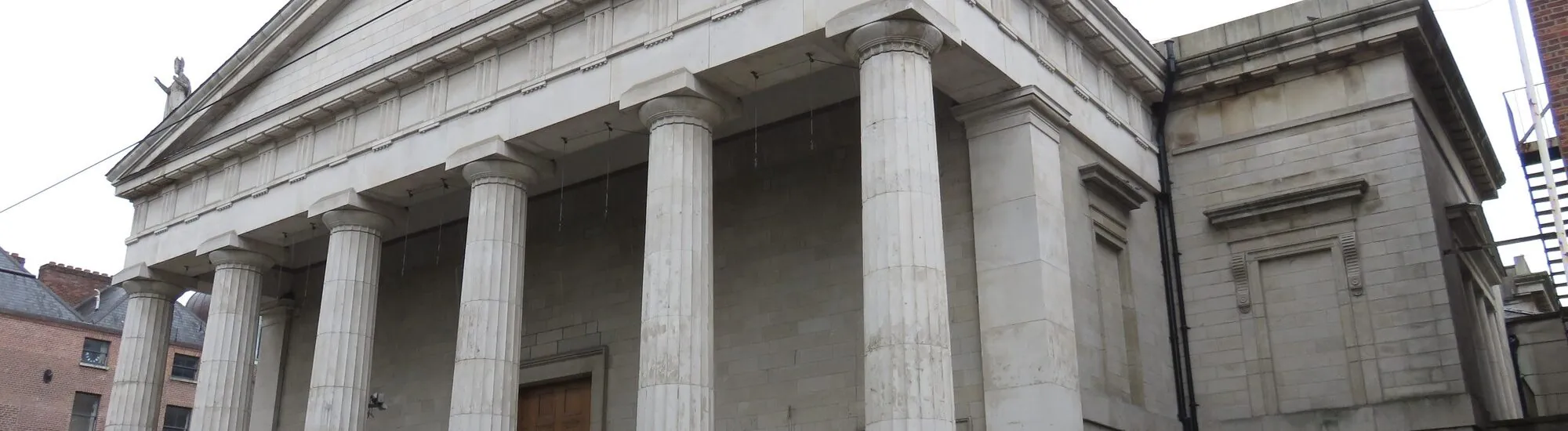
Just steps from O’Connell Street, a six-column stone portico gives Marlborough Street the air of an ancient temple. This is St Mary’s Cathedral, Dublin’s Catholic cathedral, long known as the Pro-Cathedral. Dedicated in 1825, it officially received cathedral status in 2025, its bicentenary year. The interior has been temporarily closed since 17 August 2026 for conservation and accessibility works. Depending on the site arrangements, the façade can still be seen from the street. The diocese publishes up-to-date information on the closure and the venues where services are held.
In the early 19th century, the local Catholic community gathered in a chapel on Liffey Street, which had become too small. Archbishop John Thomas Troy acquired the Marlborough Street site in 1803. The project took time. Troy laid the foundation stone in 1815, and his successor, Daniel Murray, dedicated the church on 14 November 1825, the feast day of St Laurence O’Toole, patron of the diocese. The bicentenary account published by the archdiocese places this move within the parish’s long history and the context of easing restrictions on Catholics.
The date helps to convey what the project represented. The church was opened four years before Catholic Emancipation in 1829. Walking the short distance from O’Connell Street today, it is easy to see how central its location is, even though the portico stands back from the main thoroughfare. The National Inventory of Architectural Heritage notes that plans to establish the cathedral on the former Sackville Street, now O’Connell Street, had met with resistance.
A pro-cathedral is a church that serves as a cathedral on a temporary basis. In Dublin, that temporary arrangement lasted two centuries. St Mary’s served as the mother church of the Catholic archdiocese, and its historic name still appears on maps and in archives. On 14 November 2025, Archbishop Dermot Farrell announced St Mary’s official designation as the archdiocese’s cathedral by Pope Leo XIV. If you are planning a visit, make sure you look for Marlborough Street. On the south side of the river, Christ Church Cathedral and St Patrick’s Cathedral belong to the Church of Ireland and can be visited separately.
From the pavement opposite, the eye is first drawn to the Doric columns and triangular pediment. This borrowing from Greek architecture gives the building a profile very different from Dublin’s medieval cathedrals. The copper-clad dome is set back behind the portico. If the route around the works permits, move towards Cathedral Street for a clearer view of the building’s form. The architectural inventory describes a cruciform plan and several phases of enlargement or alteration. Once the interior reopens, the transition from the portico to the nave and the space beneath the dome will reveal the scale of the plan.
On 29 August 1922, at the height of the Irish Civil War, St Mary’s hosted Michael Collins’s requiem Mass. The procession travelled from City Hall to Marlborough Street through streets lined with onlookers. Éamon de Valera’s state funeral was also held here in 1975. These two ceremonies connect the building with different generations of Irish political history. To put the events preceding the creation of the Irish Free State into context, the GPO Witness History is just a few streets away.
The building also has its own musical history. The Palestrina Choir became St Mary’s resident choir in 1903. Its origins lie in a boys’ choir formed in the 1890s by Vincent O’Brien. During the cathedral’s closure, the choir is based at the chapel on Dublin City University’s All Hallows campus and sings at Masses during its periods of activity. Check the diocese’s current page for the schedule and venue.
The closure affects the interior. The announced programme includes work on the roof, access to the building, technical installations and spaces for choirs. The main diocesan celebrations have been transferred to St Andrew’s Church on Westland Row. Parish life and sacraments continue at St Joseph’s Church on Berkeley Road, which is also home to the girls’ choir. When visiting the city centre, make the façade a brief stop between the General Post Office and Marlborough Street, then consult the parish page if you would like to attend a service. At the time of checking, the cathedral’s official page did not give a firm reopening date.
Want to extend your visit without having to rush around? Here are a few well-located places to stay near the must-see attractions.
Essential information to help you plan your visit, including key landmarks, access information, and booking options.
Marlborough Street, Dublin, County Dublin, Republic of Ireland, Tourist sites in Ireland
53.35085, -6.25903
Interior closed since 17 August 2026 for conservation and accessibility works. Check with the diocese for reopening details and relocated services.
Check the opening hours and admission requirements before you leave, especially during peak season or on Irish public holidays.
Façade visible from the public street, depending on the site arrangements. Interior temporarily closed.