

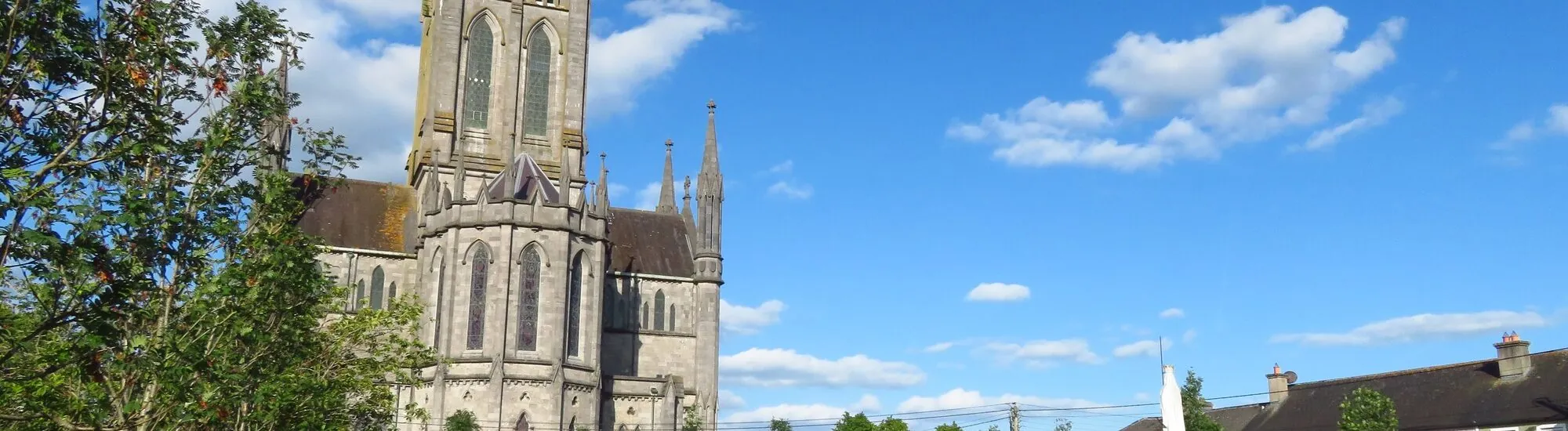
Walking up James’s Street, the square tower of St Mary’s Cathedral rises above the rooftops of Kilkenny. Up close, the mass of limestone gives way to detail, from pointed-arch openings to the buttresses that punctuate the walls. Consecrated in 1857, this Catholic cathedral tells a different chapter of the city’s story from that of its castle and medieval lanes. Construction began before the Great Famine, and it opened after the crisis’s harshest years. To explore it, plan a stop outside service times and take a few minutes to see how the tower sits within the city’s slope.
Before St Mary’s was built, St James’s Chapel, constructed in 1774, served as the cathedral for the Catholic community. The Bishop of Ossory, William Kinsella, announced plans for a new building in 1842. The chosen site was Burrell’s Hall, which had housed a Catholic educational institution. Work began in April 1843, and Kinsella laid the foundation stone in August. The timeline published by the parish states that, by the time of his death in December 1845, the walls were only a few feet high.
Construction continued through the years of the Great Famine. Parish records date the consecration to 4 October 1857, under Bishop Edward Walsh. The ceremony began early in the morning and took place before an audience admitted by ticket. To place this date within Kilkenny’s history, compare the building with the medieval landmarks in the centre. At St Mary’s, the scale of the building reflects the place a Catholic institution sought to occupy in the nineteenth-century city.
When looking at a map of Kilkenny, check the name and street before you set off. St Mary’s Cathedral is the Catholic cathedral of the Diocese of Ossory, on James’s Street. St Canice’s Cathedral, near the round tower north of the centre, belongs to the Church of Ireland. A former parish church dedicated to St Mary, meanwhile, houses the Medieval Mile Museum, near High Street. These three sites work well together on foot, and each represents a different period and purpose.
The architect William Deane Butler, also associated with St Kieran’s College, designed a Gothic Revival cathedral in dressed limestone. The Irish architectural inventory describes a cruciform plan, with a square tower at the point where the nave and transept meet. According to the parish, this tower is around 57 metres high and is the feature visible from afar. As you approach from the side, step back to see how it rises above the lower sections. Closer to the building, the pointed windows and the profile of the buttresses reveal the silhouette in greater detail.
Comparisons with England’s Gloucester Cathedral often appear in local descriptions. More broadly, the building belongs to the nineteenth-century revival of Gothic forms. To get a sense of this without architectural terminology, follow the lines of the windows and arches with your eyes, then compare them with the grid of shopping streets below. The cathedral owes as much to its position in the landscape as to the details of its construction.
Inside, walk along the nave until you can take in the transept crossing. The parish highlights, among other features, the marble high altar purchased in Italy and a statue of the Virgin Mary by the sculptor Giovanni Maria Benzoni, in place when the cathedral opened in 1857. The self-guided tour highlighted by Visit Kilkenny uses QR codes placed around the building. They offer useful context if you would like to understand the decorative elements before you leave. During services, visit at another time and keep passageways clear.
To read the plan from inside, first note the aisles flanking the nave. The two arms of the transept then widen the space beneath the tower. The chancel extends this axis towards the high altar. Once outside again, look for these same volumes from the side of the building. The arrangement of the roofs makes the cruciform plan described by the inventory easier to see.
From High Street, walk up James’s Street towards the tower. Allow around 25 to 40 minutes to look around the exterior and explore the nave at your own pace. Visit Kilkenny indicates wheelchair access. If your visit depends on specific access arrangements, a particular time slot or the language available for the digital tour, contact the parish before coming. To continue your walk, head back down towards the Medieval Mile Museum or make for the Black Abbey, another stop on the city’s religious heritage trail.
Want to extend your visit without having to rush around? Here are a few well-located places to stay near the must-see attractions.
Essential information to help you plan your visit, including key landmarks, access information, and booking options.
James’s Street, Kilkenny, County Kilkenny, Republic of Ireland, Tourist sites in Ireland
52.65242, -7.25707
The parish publishes Mass times: 9 am from Monday to Saturday, and 11 am and 5.30 pm on Sundays. Tourist visiting hours are not specified on the parish website. Confirm access with the parish and visit outside service times where possible.
Check the opening hours and admission requirements before you leave, especially during peak season or on Irish public holidays.
Free admission, according to Discover Ireland.