

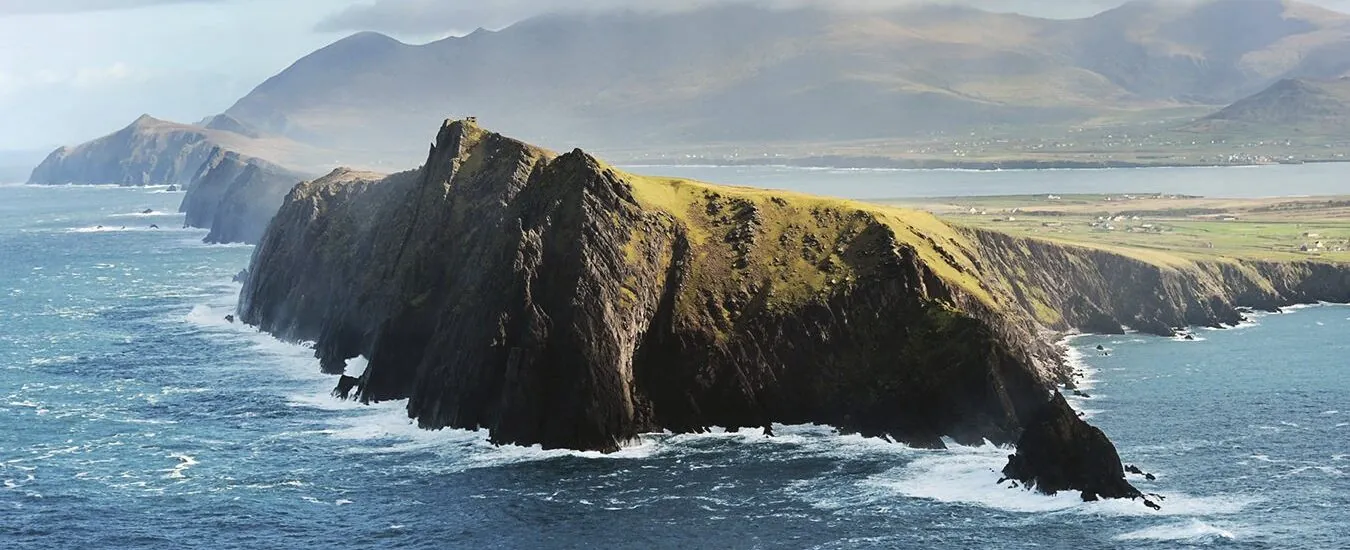
Sybil Head, or Ceann Sibéal in Irish, is one of the great wild headlands of the Dingle Peninsula in County Kerry. Rising above the Atlantic near Ballyferriter, this vast rocky promontory encapsulates the most spectacular scenery in western Ireland: vertiginous cliffs, wind-swept pastureland, sheltered beaches and views over the Blasket Islands.
Less famous than Slea Head or Dunquin, Ceann Sibéal nevertheless has an instantly recognisable silhouette. Its imposing form dominates this stretch of coast, accompanying travellers as they make their way across the peninsula between Ballyferriter, Clogher and Dunquin.
Film enthusiasts may also experience a strange sense of déjà vu. In 2016, Lucasfilm crews chose Ceann Sibéal as the location for major scenes in Star Wars: The Last Jedi. A replica of the Skellig Michael monastery was even built here to recreate Luke Skywalker’s planet Ahch-To without requiring repeated filming on the real monastic site, which is particularly fragile.
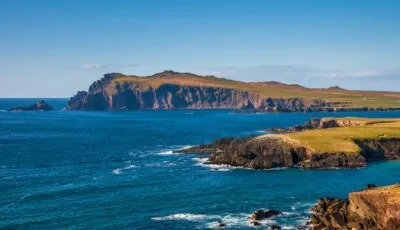
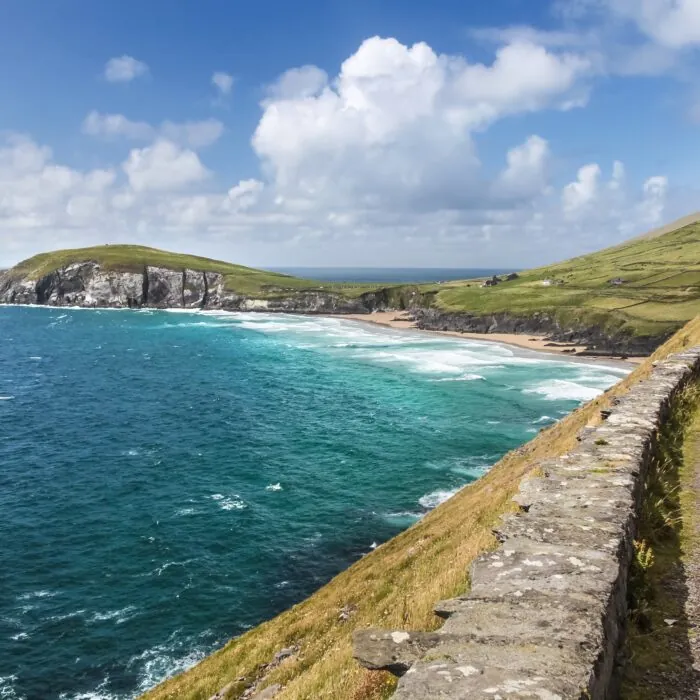
View from Sybil Head on the Dingle Peninsula – © Monica
Ceann Sibéal lies at the western tip of the Dingle Peninsula, at the heart of one of Kerry’s wildest landscapes.
The promontory overlooks the Atlantic directly and offers outstanding views of the surrounding coastline. From the best vantage points, the eye takes in the peninsula’s rugged contours, nearby beaches and, offshore, the Blasket Islands.
The landscape is typical of this far corner of Kerry: broad expanses of grass seem to stretch right to the edge of sheer cliffs before plunging abruptly into the ocean.
In calm, clear weather, the place has an almost peaceful quality. When wind and cloud roll in from the Atlantic, Ceann Sibéal takes on an entirely different character and becomes far more dramatic.
It is this changing nature that makes it so beautiful.
You do not need to climb Ceann Sibéal to enjoy one of its finest views.
One of the most interesting viewpoints lies near Clogher Head, along the route of the famous Slea Head Drive. From here, Ceann Sibéal’s silhouette stands out perfectly against the landscape.
This is an especially appealing option for travellers who simply want to photograph the promontory without taking on a more demanding walk.
The road between Dunquin and Ballyferriter runs through this very landscape. Clogher Head is therefore an easy stop to include in a day spent exploring the Slea Head Drive.
The panorama also provides a clearer sense of the geography of this part of the peninsula, where beaches, rocky headlands, pastureland and the Atlantic follow one another almost without interruption.
Today, this is one of the most remarkable stories associated with Ceann Sibéal.
In 2016, Lucasfilm crews took over this remote corner of the Dingle Peninsula to film Star Wars: Episode VIII – The Last Jedi.
The challenge facing the producers was particularly complex. The first scenes set on the fictional planet of Ahch-To, Luke Skywalker’s refuge, were filmed on Skellig Michael.
But this Kerry island is an exceptionally fragile archaeological and natural site, inscribed on the UNESCO World Heritage List. Its ancient early Christian monastery and bird colonies placed considerable constraints on filming a production of this scale.
Lucasfilm therefore chose Ceann Sibéal to recreate part of this world on the mainland.
The set created at Ceann Sibéal was impressive.
Set designers built a replica of Skellig Michael’s monastic settlement on the promontory, complete with its famous beehive-shaped dry-stone huts and various features inspired by the real monastery.
Scaffolding, technical installations and temporary access routes were needed to allow a production involving several hundred people to work in this isolated setting.
Filming there made it possible to extend visually the scenes shot on Skellig Michael while limiting the pressure placed on the island.
On screen, the two landscapes are combined to form a single place: Ahch-To.
The viewer is therefore left with the impression that Luke Skywalker is continually moving around the same island, when in reality some scenes were filmed on Skellig Michael and others on the Dingle Peninsula.
Do not look for Luke Skywalker’s huts when you visit: the installations created for filming were temporary.
The site was restored after the production left, allowing it to regain its natural character.
There is therefore no Star Wars village to visit at Ceann Sibéal.
For fans of the saga, the appeal lies instead in recognising the contours and landscapes used in The Last Jedi. Clogher Head is, in particular, an excellent place to take in Ceann Sibéal as a whole.
The Dingle Peninsula has several other links with cinema, too. Films such as Ryan’s Daughter and Far and Away also used its landscapes as locations.
The landscapes around Ceann Sibéal naturally invite further exploration on foot.
However, an important distinction must be made between the viewpoints from which to see Sybil Head and access to the promontory itself.
Ceann Sibéal should not be regarded as a conventional visitor attraction, with an official car park at the foot of a fully developed trail to the summit. Some of the surrounding land is privately owned and used for farming.
It is therefore essential to respect private property, fences and any access restrictions. Never cross a fence or closed gate simply because a route found online appears to indicate a way through.
For an official walk with fine views of Ceann Sibéal, it is best to choose the peninsula’s waymarked trails.
The Dingle Way is the peninsula’s principal walking route. This long-distance trail follows a broad loop around Corca Dhuibhne and crosses some of western Kerry’s finest landscapes.
It passes through the Dunquin and Ballyferriter areas, allowing walkers to discover the surroundings of Ceann Sibéal over the course of a multi-day hike.
It would, however, be misleading to describe the Dingle Way as a trail that simply takes you to the summit of Sybil Head. The long-distance route crosses the region, but Ceann Sibéal is a distinct landform whose access must take account of private property and local conditions.
Another important correction: walking the entire Dingle Way does not generally take “several weeks”. Depending on the stages chosen and walking pace, the full route is usually completed over several days.
Travellers wishing to walk in the area without committing to the full Dingle Way have an excellent alternative: Siúlóid na Cille.
This waymarked loop of around 4.5 km starts near the Blasket Centre in Dunquin and takes approximately 1 hour 30 minutes.
Rated moderate, it offers magnificent views of Clogher Beach, Ceann Sibéal, Mount Brandon, Eagle Mountain and the Blasket Islands.
The route follows small roads, sandy tracks and coastal paths. It also passes near the former school built for the filming of Ryan’s Daughter.
It is a very good option if your main aim is to enjoy the landscapes of this part of the peninsula while staying on an officially waymarked route.
The coast around Ceann Sibéal forms part of a particularly rich marine environment.
Numerous seabirds frequent the peninsula’s cliffs and waters. Depending on the season, observant travellers may spot different species flying above the ocean or nesting among the rocky areas.
Kerry’s waters are also visited by several species of cetacean. Dolphins can be seen around the peninsula, although their presence from any particular point on land can of course never be guaranteed.
The land is dominated by pasture, heathland and vegetation able to withstand the wind and salt spray carried in from the Atlantic.
In spring and summer, the colours become particularly beautiful as the green of the meadows contrasts with wildflowers, dark cliffs and the ever-changing blue of the ocean.
Ceann Sibéal can be admired throughout the year, but the weather plays a considerable role here.
In clear weather, the views over the headland, the Blaskets and the coast are extraordinary. Low cloud and mist, on the other hand, can swallow up part of the landscape within minutes.
Wind is another important consideration. This end of the peninsula is directly exposed to Atlantic weather systems, and gusts can become very powerful.
Pack waterproof and windproof clothing, as well as sturdy footwear, if you plan to walk in the area.
For photography, do not necessarily be disappointed by an overcast sky. Rapid shifts in light, cloud and showers can sometimes create spectacular atmospheres over Ceann Sibéal and the Blasket Islands.
Sybil Head’s beauty also lies in its raw character. But this lack of development calls for real caution.
The cliffs have no continuous safety barriers, and some areas may feature steep slopes or exposed drops.
It is essential to keep well back from the edge, particularly when the ground is wet or the wind is strong.
Also avoid trying to reach a viewpoint simply to recreate a photograph seen on social media. On this kind of coast, just a few metres can be enough to take you from relatively safe ground into an exposed area.
By staying on authorised routes and respecting private property, Ceann Sibéal nevertheless offers one of the finest landscape experiences on the Dingle Peninsula.
And when its vast silhouette appears around a bend on the Slea Head Drive, with the Atlantic and the Blaskets behind it, it is hard to imagine a better setting in which to hide Luke Skywalker at the edge of the galaxy.
Want to extend your visit without having to rush around? Here are a few well-located places to stay near the must-see attractions.
Essential information to help you plan your visit, including key landmarks, access information, and booking options.
Ballyoughteragh South, Dingle Peninsula, County Kerry, Republic of Ireland, Tourist Attractions in Ireland
52.1835650775355, -10.465044327441607
1 heure
daily
Check the opening hours and admission requirements before you leave, especially during peak season or on Irish public holidays.
free