

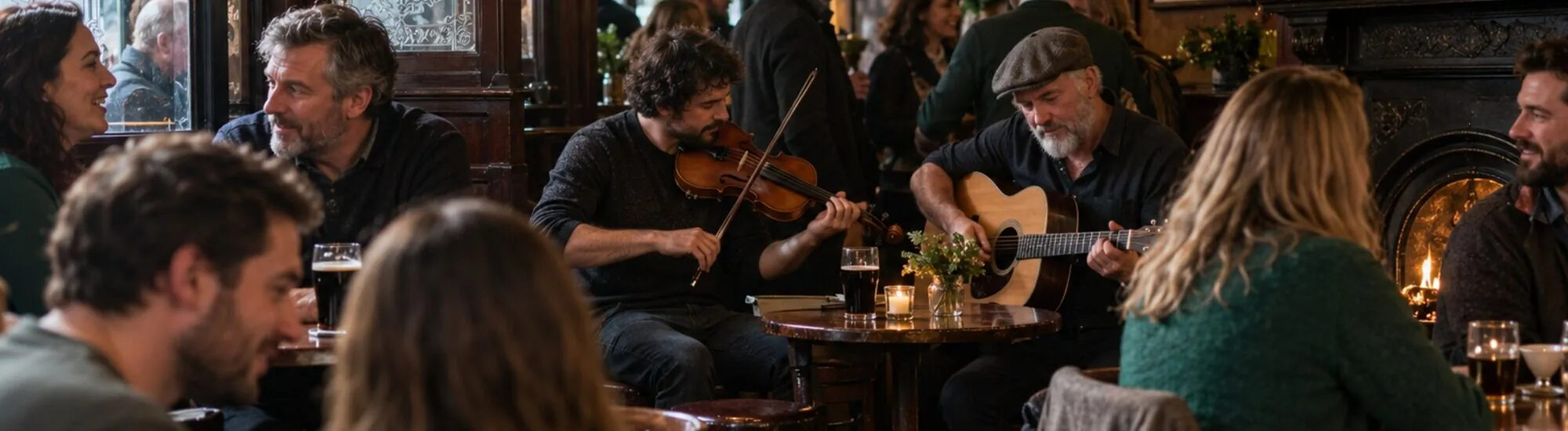
Which are the best pubs in Dublin for celebrating St Patrick’s Day? The answer depends less on how famous the venue is than on the kind of experience you are looking for. Some stand out for traditional music, others for their Victorian décor, history or local clientele. On 17 March, these distinctions matter: an excellent pub on a quiet Tuesday can become almost impossible to access when the whole city is celebrating its national holiday.
Our selection favours established, recognisable venues across several neighbourhoods. It promises neither a seat nor live music at a set time: the programme, opening hours and entry conditions may change for St Patrick’s Day. Always check the information published by the pub a few days before your visit.
At 77 North King Street, near Smithfield Square, The Cobblestone is one of Dublin’s best-known venues for traditional Irish music. Here, music is not simply a backdrop for visitors: sessions are central to the pub’s identity.
For St Patrick’s Day, it is an obvious choice – and therefore in very high demand. Arrive early if you want to hear the musicians and see more than the backs of the people standing in front of you. The pub is slightly removed from the heart of Temple Bar, but Smithfield remains easily accessible on foot or by Luas when services are running normally.
Choose it for: traditional music and an atmosphere that is more musical than spectacular.
O’Donoghue’s is at 15 Merrion Row, near St Stephen’s Green. The pub is closely associated with the history of Irish folk music and the early days of the Dubliners. The photographs and memorabilia displayed inside recall the many artists connected with the venue.
On 17 March, it can become exceptionally crowded. The pub has a courtyard and several different areas, but its popularity far exceeds its capacity to offer everyone a comfortable evening. Go for its musical heritage, not with the expectation of finding a table.
Choose it for: the history of Irish folk and an evening in the southern part of the city centre.
The Long Hall, at 51 South Great George’s Street, is one of Dublin’s most photogenic historic pubs. Its Victorian interior, dark wood panelling and decorative details create a setting very different from Temple Bar’s large party venues.
It suits travellers who want to savour the atmosphere of a genuine old pub rather than seek out a succession of entertainments. It is in the heart of the city and naturally draws large crowds on 17 March. Visiting in the early afternoon may be more pleasant than arriving late.
Choose it for: the décor, heritage and a central stop before the evening gathers pace.
Temple Bar is often criticised for its prices, crowds and visitor-focused pubs. The Palace Bar, at 21 Fleet Street, nevertheless retains a historic and literary identity worth seeking out. Its interior, more intimate than some of its huge neighbouring venues, has real character.
The issue is not the pub, but the timing. On St Patrick’s Day, Fleet Street is one of Dublin’s busiest areas. If you would like to discover The Palace Bar, call in early and have a back-up plan. In the evening, the crowds can erase much of the charm you came for.
Choose it for: discovering a characterful pub without leaving Temple Bar.
The Stag’s Head is tucked away at the corner of Dame Court and Dame Lane. Rebuilt in the late 19th century, it is renowned for its Victorian interior, wood panelling, stained-glass windows and imposing bar. Its location makes it easy to reach Dublin Castle, Grafton Street or Temple Bar.
Its central location makes it very popular during St Patrick’s Day. The venue has several spaces, but its passageways remain narrow and moving around becomes difficult once the crowds arrive. It is better suited to an early stop than an impromptu evening meeting for eight people.
Choose it for: the interior architecture and a stop between Dame Street and the Grafton Street area.
At 8 Poolbeg Street, Mulligan’s is valued for its traditional pub atmosphere and lack of overdone folk décor. It lies east of College Green, not far from Tara Street and the Liffey quays.
It is a good option for getting slightly away from the pressure of Temple Bar without leaving the city centre. Do not expect an empty refuge on 17 March, however: its reputation attracts regulars and well-informed visitors alike.
Choose it for: a pub with character, a more understated atmosphere and a convenient location near the Liffey.
Doheny & Nesbitt occupies numbers 4 and 5 Lower Baggot Street, a few minutes from St Stephen’s Green. Its interior retains the partitions, wood panelling and details associated with Victorian pubs. It is also known as a meeting place for political, media and sporting circles.
Its location outside Temple Bar can offer a different kind of evening, without guaranteeing peace and quiet. Baggot Street has several pubs and attracts a large clientele after events in the city centre. It is an interesting area in which to spend the evening within one neighbourhood, without crossing the whole city.
Choose it for: a Dublin atmosphere, historic décor and a night out around Baggot Street.
The Brazen Head is at 20 Lower Bridge Street, near the Liffey and Christ Church. The current building is mainly associated with the 18th century, although the tavern claims older roots. Its courtyard and various rooms create an instantly recognisable atmosphere.
Its fame makes it a major tourist stop. On 17 March, do not come here looking for a secret known only to locals. It remains a worthwhile choice for its setting and history, particularly if you are staying near Christ Church, Smithfield or the Liberties.
Choose it for: heritage, décor and a stop west of the historic centre.
Darkey Kelly’s is on Fishamble Street, close to Christ Church Cathedral. The pub combines food and music, which can be handy if you would rather not have to find dinner and then somewhere to continue the evening separately.
For St Patrick’s Day, check whether tables need to be booked and whether a special programme has been announced. Eating relatively early then makes it possible to walk to Temple Bar, Dame Street or the Liberties without relying on transport.
Choose it for: combining food, music and proximity to Christ Church.
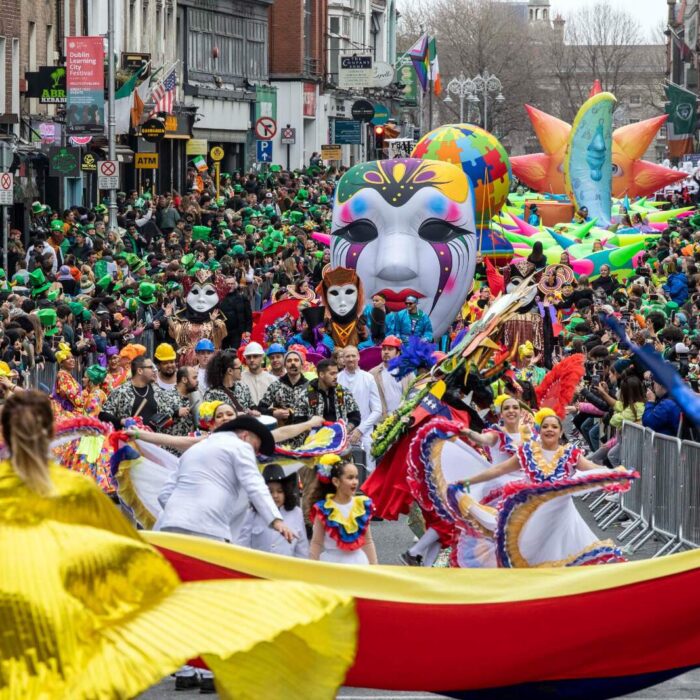
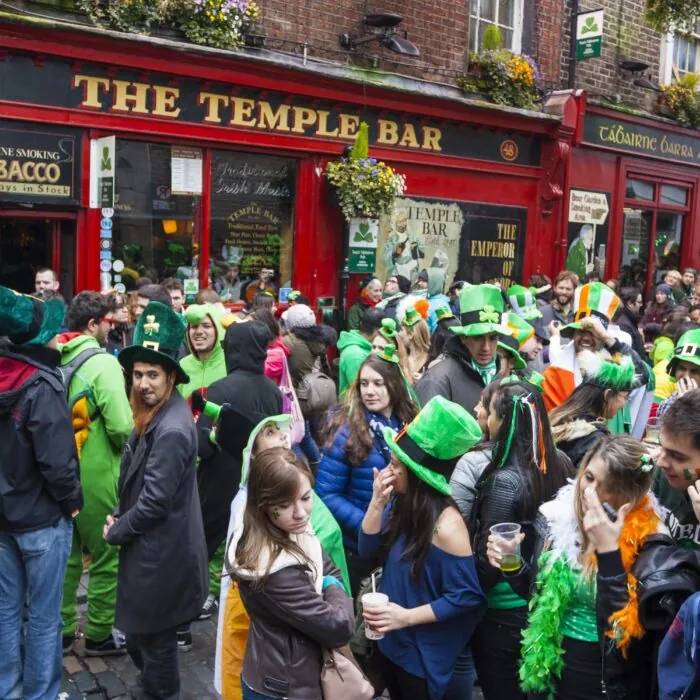
Temple Bar embodies the international image of the celebrations: decorated façades, music, visitors from around the world and streets that are full from early in the day. It can be fun to pass through and experience the atmosphere. For spending several hours in a pub, it is rarely the best choice if you are looking for conversation, an audible music session or even a little space.
The pub named The Temple Bar is an iconic address, but also one of the most photographed and sought-after venues. Do not confuse popularity with a guaranteed experience. On 17 March, a slightly out-of-the-way address can offer a far more Irish memory than an hour spent in a queue.
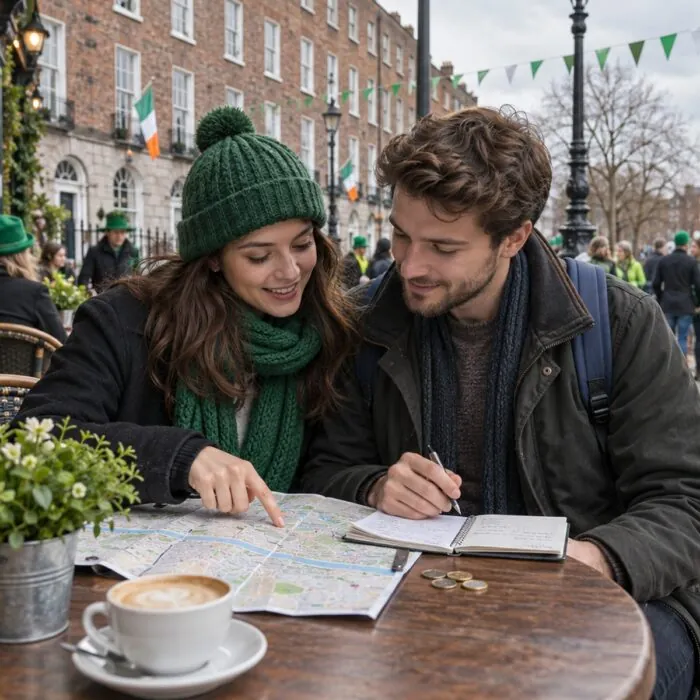
Crossing Dublin to tick off famous names is a poor strategy on St Patrick’s Day. Streets are busy, transport services may be altered, and every change of venue carries the risk of joining another queue. Choose a coherent area instead.
For music, pair Smithfield and The Cobblestone with a walk towards the Liberties. For Victorian pubs, stay around South Great George’s Street, Dame Lane and Grafton Street. For a more local atmosphere, base your evening around Merrion Row and Baggot Street.
Set a very specific meeting point with your group. “Outside the pub” quickly becomes impractical when several hundred people are filling the street. Keep your accommodation address offline too, and plan your return before starting the evening.
Start in the early afternoon if there is a particular venue you are keen to visit. Pubs may restrict entry once they reach capacity, and no list of the “best pubs” can get around that reality.
Bring identification, even if you are well above the legal drinking age. Checks may be stricter, and every venue has its own admission rules. Avoid bulky costumes and large bags. Waterproof, comfortable clothing will be more useful than a full green outfit.
Drink in moderation, eat before the evening and do not drive. St Patrick’s Day is more enjoyable when it does not simply become a race between bars. The music, the architecture of the pubs and the encounters along the way make for a far more lasting memory.
If Temple Bar, Dame Street or South Great George’s Street is your priority, central accommodation avoids late-night transport but leaves you more exposed to noise. For O’Donoghue’s and Doheny & Nesbitt, look around St Stephen’s Green, Merrion Square or Baggot Street. Smithfield is the most logical base for The Cobblestone and the Liberties.
Our guide Where to stay in Dublin for St Patrick’s Day? compares the neighbourhoods, their advantages and their limitations in detail. Book early: the best-insulated central rooms are rarely the ones still available at the last minute.